Answering the needs of homeowners looking to automate attic, garage, greenhouse, or living-space ventilation, this guide compares top smart thermostat-enabled, variable-speed fans. These selections suit buyers who want precise climate control, energy efficiency, and remote operation. Each option is evaluated for who it’s best for, plus practical trade-offs. The table below highlights the five products chosen for quick reference.
Product Quick Reference
- iLiving ILG8SFRC — Best for budget-smart control with integrated thermostat and humidity sensing.
- VIVOHOME 12″ EC Motor — Best for large spaces up to 1400 sq ft with multi-sensor automation.
- Quietcool Smart Attic Fan Control — Best for simple app control and built-in safety shut-off.
- Amico 10″ Smart Shutter Exhaust — Best for compact setups with tight space and robust auto modes.
- VIVOHOME 14″ EC Motor — Best for high-occupancy areas needing strong airflow with smart timing.
iLiving ILG8SFRC Exhaust Fan with Smart Thermostat

The iLiving ILG8SFRC pairs a shutter-style exhaust design with a programmable thermostat and humidity sensor. It offers easy conversion from a standard hardwired fan to smart operation. Features include auto cycle ON/OFF at set temperature and humidity, a 24-hour timer, and dual temperature sensors for precise control at the receiver and remote location. Best for budget-conscious buyers who want integrated environmental sensing in a single unit. Caution: verify wiring compatibility with existing controls before installation.
VIVOHOME 12″ Shutter Exhaust Fan with EC Motor

Designed for larger spaces, this 12″ model delivers up to 1300 CFM with nine adjustable speeds. It features a smart control system that monitors temperature (32-120°F) and humidity (30%-90%), auto-adjusting operation and built-in alarm for high levels. It’s best for attics, garages, or greenhouses needing substantial airflow with energy-conscious EC motor efficiency. Limitations include a higher upfront footprint and installation considerations for larger ducts.
Quietcool Smart Attic Fan Control
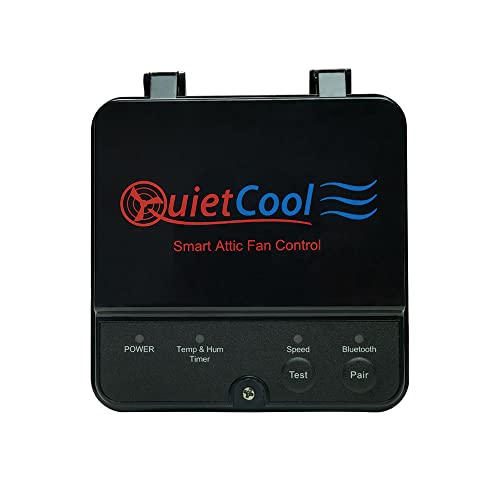
This Quietcool option emphasizes built-in safety with a fire shut-off feature and app-based control for automated fan operation. It acts as a thermostat and humidistat in a modern replacement for aging attic fans, offering presets and smart scheduling. Best for homeowners who want a straightforward, app-driven upgrade to an existing system while prioritizing safety. Limitation: dependent on compatible wiring and may require professional setup for proper integration.
Amico 10″ Shutter Exhaust with Thermostat

The Amico 10″ shutter exhaust combines a thermostat with an 8-speed auto-adjust and a 50-ft remote. It’s suited for garages, greenhouses, and small workshops that need responsive cooling and humidity control. Best for users who want a powerful, compact unit with remote operation. Caution: ensure the long-range remote is compatible with your control setup and within its operational distance.
VIVOHOME 14″ EC Motor Exhaust Fan

This larger unit delivers up to 1700 CFM with nine speeds and a smart control system monitoring temperature and humidity. It’s ideal for bigger spaces up to about 1606 sq ft, offering robust airflow with a timer to prevent overnight running. Best for high-heat environments, such as workshops or larger greenhouses. Limitation: higher power usage versus smaller models; check space and ducting compatibility.
Amico 10″ Smart Shutter Exhaust Fan with Thermostat & 8 Speed
Note: This product is also listed among the options for buyers who prefer plug-and-play installation and a stable 1073 CFM with a 13W DC motor in a mid-sized setup.
Buying Guide
What should I consider when choosing a smart, variable-speed exhaust fan?
- Coverage area: Match CFM to square footage and ceiling height. Larger rooms require higher CFM and possibly multi-speaker or multi-zone control.
- Sensor features: Look for models with temperature and humidity sensing to trigger auto-adjustments and protect spaces from heat and moisture.
- Control method: Determine whether you prefer app control, remote control, or built-in thermostat/humidistat. Some units also offer 24-hour timers and alarms.
- Energy efficiency: EC or brushless DC motors typically deliver quieter operation and better energy use. Compare dB levels and motor power.
- Safety and installation: Consider fire-safety shut-offs, compatibility with existing wiring, and whether professional installation is needed.
- Space and aesthetics: Attic, garage, greenhouse, or living area—select a model with appropriate size, mounting type, and noise profile.
How to choose between thermostat-based control vs. app-based automation?
Thermostat-based systems offer automatic responses to set temperature thresholds and humidity ranges, useful when you want hands-off operation. App-based automation enables remote monitoring and control from a phone or smart home hub, beneficial for multi-zone homes or frequent traveler oversight. Some top models combine both for flexible, reliable climate management.
What is the best option for energy savings?
Fan models with EC or DC motors generally use less energy and run more quietly than traditional AC motors. Look for models with efficient speed control, auto-timer, and smart sensors, which prevent unnecessary runtime and optimize air exchange based on real conditions.
Are there risks to upgrading an attic or greenhouse ventilation system?
Risks include improper wiring, insufficient ducting, and over-ventilation in sensitive spaces. Ensure electrical compatibility, proper mounting, and that sensors are calibrated for the specific environment. When in doubt, consult a professional installer to verify integration with existing systems.
What installation considerations matter for different spaces?
- Attic: Prioritize high CFM, low noise, and reliable thermostat control to prevent overheating and moisture buildup.
- Garage: Focus on durable construction, wide coverage, and safety features for combustible environments.
- Greenhouse: Emphasize precise humidity control, temperature thresholds, and app-based monitoring for plant health.
FAQ
- What does EC motor stand for, and why is it beneficial?
EC stands for electronically commutated motor. It is energy-efficient, typically quieter, and offers smoother speed control than traditional AC motors.
- Can these fans be controlled from a smart home system?
Many models support app control or remote setups, and some integrate with smart hubs for centralized automation.
- Do all units require professional installation?
Not all require professional installation, but some high-capacity or complex wiring may benefit from professional help.
- How do temperature and humidity sensors improve air quality?
Sensors automatically adjust operation to maintain comfortable and safe levels, reducing heat, humidity, and odors.
- Is a bigger CFM always better?
No—choose CFM based on space size, ceiling height, and desired air exchange rate to avoid over-ventilation or noise.