Finding the right hydronic differential pressure manometer depends on your system needs, accuracy, and work environment. This guide highlights five top options that address common HVAC and boiler applications, from professional-grade digital meters to compact handheld models. Each entry notes who it’s best for, why it was selected, and any important limitations. If you’re maintaining radiant floor loops, boilers, or air handling ducts, these tools help verify differential pressure quickly and clearly.
Product Summary
| Product | Best For | Key Benefit | Typical Use |
|---|---|---|---|
| TSI Alnor HM685 Hydronic Manometer | Professional labs and HVAC pros | High accuracy with wide range | Hydronic systems, 0–300 psi |
| Klein Tools ET180 Digital Manometer | On-the-go HVAC diagnoses | Two-port differential pressure, strong magnet | Quick troubleshooting |
| Leaton Professional Air Pressure Meter | Budget-friendly, general use | Digital with large LCD | Ventilation and air systems |
| UEi EM201SPKIT Static Pressure Kit | Static pressure testing | Includes digital differential manometer | HVAC testing and service |
| Testo 510 Digital Manometer | HVAC/R field technicians | Versatile differential, external static, duct velocity | Complex ductwork measurements |
TSI Alnor HM685 Hydronic Manometer

The TSI Alnor HM685 is a digital hydronic manometer designed for high-accuracy differential pressure in hydronic systems. Best for professionals who require precise readings and long operation on a single setup, it reports pressure up to ±300 psi with a resolution of 0.001 psi and 0.01 kPa. The unit runs on four AA cells and includes essential accessories such as a carry case, hose set, batteries, and interface software. This instrument suits laboratories, boiler rooms, and service teams that need dependable data over extended testing sessions.
Who it’s best for: HVAC service technicians and hydronic specialists needing robust accuracy and battery-powered mobility. Why it’s selected: Industry-grade precision, included software, and a substantial pressure range. Limitation: Heavier setup may be less convenient for simple, quick checks in tight spaces.
Klein Tools ET180 Digital Manometer

The Klein Tools ET180 is a dual-port digital manometer intended for static and differential pressure in air and gas systems. With a ±60 inH2O range and ±1.5% full-scale accuracy, it supports common HVAC troubleshooting tasks. A strong magnet on the back allows hands-free operation, aiding setups where the display is difficult to read. This unit is lightweight and suitable for field work where quick, repeatable measurements are valued.
Who it’s best for: Technicians needing quick dual-port differential measurements with hands-free convenience. Why it’s selected: Simplicity, magnetic back, and solid basic accuracy. Limitation: May not cover very high differential pressures typical in larger hydronic loops.
Leaton Manometer, Professional HVAC Digital

The Leaton digital manometer provides handheld differential pressure readings with a large backlit LCD display for easy viewing in dim environments. It measures up to ±20.68 kPa (±2.999 psi) with repeatability of ±0.2% (max ±0.5% FSO). Built from ABS with high-temperature resistance, this unit is practical for general HVAC tasks, lab testing, and maintenance projects where budget-conscious, reliable readings are required. It is a solid option when long battery life and simple operation are important.
Who it’s best for: Techs needing a cost-effective, general-use differential pressure meter. Why it’s selected: Clear display and robust construction at a modest price. Limitation: Not as feature-rich as premium models for complex ductwork or very high pressure applications.
UEi EM201SPKIT Static Pressure Kit
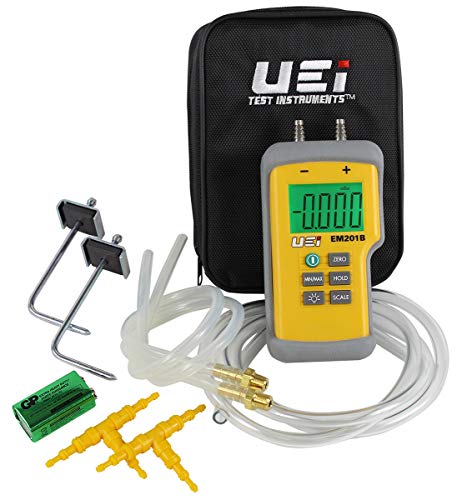
The UEi EM201SPKIT combines a digital differential manometer with a static pressure test kit, designed for HVAC testing and service procedures. It provides a clear digital readout and a comprehensive package that supports measuring static pressure and differential pressure across HVAC systems. This kit is well-suited for technicians performing routine diagnostics and installations where quick, repeatable measurements across multiple points are needed.
Who it’s best for: HVAC teams performing documented static and differential pressure testing. Why it’s selected: Integrated kit with practical accessories for field use. Limitation: The price point is higher than basic meters, reflecting broader functionality.
EHDIS Manometer Professional Dual-Port

The EHDIS dual-port manometer emphasizes practicality for measuring single-pipe air pressure or differential pressure across two pipes. It targets ventilation, air conditioning system troubleshooting, and gas-pressure testing. Features include selectable pressure range of ±2.999 psi, accuracy around ±0.3% FSO, and repeatability up to ±0.2%. It’s a versatile option for field technicians who need a compact, affordable tool for quick checks.
Who it’s best for: Technicians needing a compact, general-purpose differential meter. Why it’s selected: Flexible range and dual-port capability at a reasonable price. Limitation: May lack some advanced features found in premium models.
Testo 510 Digital Manometer

The Testo 510 is a versatile digital manometer designed for HVAC/R technicians. It measures differential pressure, total external static pressure, manifold pressure, and duct velocities. Its temperature-compensated sensor offers accurate readings across various units, and a magnetic back ensures convenient placement during measurements. This model is favored for fieldwork where multiple measurement types and reliable performance matter most.
Who it’s best for: Field technicians who need a multi-function instrument for complex HVAC diagnostics. Why it’s selected: Broad measurement capabilities and reliable display. Limitation: The device may be more feature-rich than necessary for simple differential checks.
Buying Guide: Hydronic Differential Pressure Manometers
What will you measure and where
Identify the key systems (boilers, radiant floors, hydronic loops) and the typical pressure ranges you will measure. Choose a model with a pressure range that comfortably covers your highest expected differential.
Accuracy and resolution
Consider the required accuracy for your work. Higher-end models offer finer resolution (for example, 0.001 psi) and better repeatability, which is important in precision installations and balancing tasks.
Port configuration
Decide between single-port and dual-port designs. Dual-port meters are better for direct differential measurements, while single-port units may be more compact and affordable for quick checks.
Display readability and durability
A large, backlit LCD aids readability in dim environments. ABS plastic bodies with good impact resistance help when tools are used in tight spaces and on job sites.
Power and battery life
Battery life matters for extended field use. Some models run on standard AA cells, while others may include rechargeable options or AC adapters for continuous operation.
Accessories and compatibility
Carrying cases, hoses, adapters, and software can improve usability and data management. Ensure accessories fit your existing workflow and testing protocols.
Hands-free operation
Magnetic backs or mounting options help position the meter during measurements, freeing hands for connections or adjusting valves.
Safety and environment
Check operating temperature ranges and material construction to ensure the tool is suitable for boiler rooms, mechanical spaces, and outdoor service conditions.
FAQ
- What does a hydronic differential pressure manometer measure? It measures the difference in pressure across two points in a hydronic or HVAC system, helping balance flow and diagnose blockages or leaks.
- Is a higher price always better for these meters? Not always. Higher-priced models often offer greater accuracy, more features, and better durability, but a mid-range unit can be sufficient for standard balancing tasks.
- Should I choose a dual-port or single-port meter? Dual-port meters simplify direct differential pressure measurements, while single-port meters are more compact and affordable for basic checks.
- What maintenance is required for these meters? Regularly calibrate if possible, keep sensors clean, replace batteries as needed, and store in a protective case to extend life.
- Can these meters be used for radon or non-hydronic applications? Some models are geared toward HVAC and gas testing; verify the unit’s spec sheet for compatibility with non-hydronic tasks.
- How do I choose the right range? Consider your system’s typical differential pressure plus a margin for peaks. A meter with a range that exceeds your usual readings reduces overloading and improves accuracy.