Whether you’re upgrading a portable unit, window AC, or PTAC, choosing the right plug and cord helps protect your home and keeps cooling running smoothly. This guide highlights five reliable AC power plugs and cords with safety features like LCDI or GFCI protection, designed for American outlets. It explains who each product is best for, plus practical tradeoffs to help you compare quickly.
| Product | Best For | Key Safety Feature |
|---|---|---|
| ELEGRP 0651515LY LCDI Cord | Most demanding portable or window AC setups | LCDI leakage current detection |
| ELEGRP 0651513LY LCDI Cord | Budget-friendly A/C upgrades | LCDI leakage current detection |
| ELEGRP L22620 LCDI Cord | Higher wattage 240V applications | LCDI protection for 240V loads |
| BAOMAIN LCDI A/C Power Cord | Replacement for mainstream A/C cords | LCDI protection |
| OAONAN GFCI Replacement Plug | Areas with extra shock protection needs | GFCI with auto-reset |
ELEGRP 0651515LY LCDI Power Cord For A/C

Best for: Portable and window air conditioners with higher power needs. This 14AWG LCDI cord uses shielded conductors and a WD6 plug input with a shielded load cord, protecting against aging insulation and leakage currents. It trips within 0.5 seconds if a leakage current above 5mA is detected, reducing fire risk. Suitable for indoor use with portable, window, and PTAC units.
Why choose this: Its leakage-current detection and fast interrupt offer strong protection for AC units that draw significant current. The 7.5-foot length provides flexibility for many installations. A potential limitation: heavier cord may be less ideal in very tight spaces where a shorter cord is feasible.
ELEGRP 0651513LY LCDI Power Cord For A/C
Best for: Budget-conscious AC upgrades without compromising safety. This 16AWG LCDI cord also uses shielded conductors and provides rapid leakage-current protection, suitable for many indoor air conditioners. It is a practical option when a mid-grade cord is needed.
Why choose this: It shares core LCDI protection and quick-trip behavior with the higher-end version at a lower price. Consider: It is a lighter-duty 13A option; for high-wattage portable units, verify load compatibility before installation.
ELEGRP L22620 LCDI Power Cord For A/C (240V)
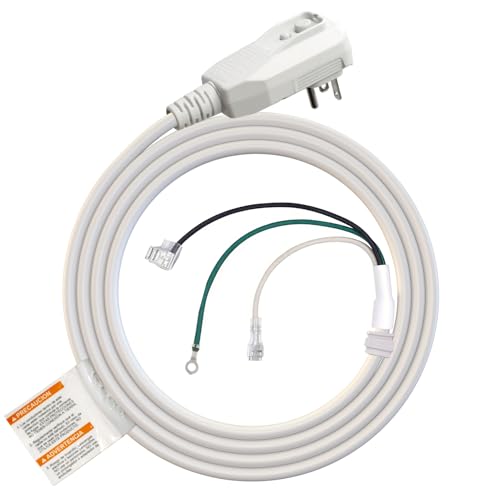
Best for: Higher-voltage, 240V air conditioner cords. This 12AWG LCDI lead is designed for 240V 20A circuits with a NEMA 6-20P, offering robust protection for larger units or installations where 240V power is standard. It helps reduce risks from aging insulation and leakage currents.
Why choose this: It expands safety coverage to higher-power A/C setups. Caution: It is not compatible with standard 120V outlets; confirm your outlet type before purchasing.
BAOMAIN LCDI A/C Power Cord

Best for: Replacements for a wide range of portable and window air conditioners. The cord includes a built-in LCDI to detect leakage currents and automatically cut off power to prevent hazards. It is designed for 6.5-foot installations and common A/C themes, making it a versatile retrofit option.
Why choose this: The built-in LCDI protection is the core value, delivering a safer connection for everyday A/C use. Limitation: Check compatibility with your specific AC model and plug type to ensure a snug fit.
OAONAN GFCI Replacement Plug Assembly

Best for: Environments needing extra shock protection. This GFCI replacement plug cuts power within about 0.03 seconds during leakage, providing fast disconnection for safety. It’s ideal when you want quick, automatic protection on a plug-and-use basis for outdoor or damp indoor areas.
Why choose this: GFCI protection complements AC use where moisture or dampness is a concern. Caution: This is a GFCI plug, not a pure LCDI solution, so ensure the protection type aligns with your installation requirements.
Buying Guide: Key Considerations For AC Plug And Cord Upgrades
- Safety features first: LCDI vs GFCI. LCDI detects leakage currents and interrupts at the source, while GFCI focuses on shock hazards in case of ground faults. For most indoor A/C cords, LCDI is standard; in damp or outdoor-adjacent spaces, a GFCI plug can be a strong addition.
- Voltage and amperage compatibility. Match the cord rating (AWG size, 120V vs 240V, amperage) to your unit’s requirements. Higher wattage units often need thicker gauge (e.g., 12AWG) and 240V capability.
- Plug type compatibility. Most home AC units use NEMA 5-15P at 120V or NEMA 6-20P at 240V. Verify your outlet and cord end matches before purchase.
- Cord length and maneuverability. Longer cords add flexibility but can create clutter. Shorter cords reduce tripping hazards in tight spaces; consider a cord length that accommodates your room layout.
- Indoor vs outdoor use. Some cords are designed for indoor use only. If your installation is in a damp area or near windows, ensure the cord’s rating aligns with environmental exposure.
- Replacement compatibility. When replacing an existing cord, verify the load rating, terminal connections (L, N, Ground), and whether the cord uses shielded conductors.
Frequently Asked Questions
- What is LCDI and why do I need it for an AC cord? – LCDI provides leakage current protection by interrupting power if a fault is detected, reducing fire risk from aging cords and insulation.
- Can I use a 240V LCDI cord on a 120V air conditioner? – No. 240V cords require compatible 240V outlets and equipment designed for 240V operation.
- Is GFCI enough to protect a window AC? – GFCI protects against shock hazards, especially in moist environments. For general cord protection, LCDI features add an extra layer of safety.
- How do I know which cord is best for my unit? – Check your AC unit’s outlet type, voltage, and power draw. Choose a cord with matching plug type, gauge, and safety features that align with usage conditions.
- Are longer cords safer for air conditioners? – Longer cords offer flexibility but can introduce voltage drop in high-load scenarios. Use the shortest length that fits your space while meeting safety requirements.
- Do these cords require professional installation? – Generally not; they are designed for standard DIY replacement. If you’re unsure about electrical wiring or outlet compatibility, consult a licensed electrician.