Answering buyers seeking dependable water tank chillers, these five options cover small to large tanks, aquarium setups, and hydroponic systems. Each choice targets specific needs—quiet operation, energy efficiency, or rapid cooling—and is best suited for different tank sizes and ambient conditions. The quick-reference table below highlights the core strengths of the selected models.
| Product | Best For | Tank Range | Approx. Power |
|---|---|---|---|
| BAOSHISHAN 1/10 HP Aquarium Chiller | Small to mid-sized tanks with quiet indoors use | Up to ~42 gallons (33 gallons summer guidance) | 1/10 HP |
| Fitnet 79 Gal Aquarium Chiller | Medium-to-large systems needing stable control | Up to ~300 L / 79 gal | 1/3 HP |
| Express Water Universal Chiller | Filtered-water setups with RO systems | Tank-specific; includes dedicated chill tank | Standard chiller power |
| Active Aqua Hydroponic Water Chiller | Hydroponics and aquaponics with higher capacity | 40–92 gallons | 0.25 HP |
| YAKUST 79 Gallon Aquarium Chiller | Chillers with LED display and remote features | Up to 79 gallons | 1/3 HP |
BAOSHISHAN 1/10 HP Aquarium Chiller 42 Gallon

Best for compact setups where quiet operation matters. This 1/10 HP chiller lowers water by about 10°F and fits a 42-gallon tank, with summer guidance suggesting 33 gallons for optimal cooling. It emphasizes silent indoor use, producing roughly 45–50 dB at one meter. The kit includes upgraded stainless steel shaft pump, tubing, and clamps for a cleaner install. Choose this if you want a straightforward, low-noise cooling solution for a small to mid-sized tank. Caution: performance varies with ambient temperature and target settings; planning around these variables improves results.
Fitnet 79 Gal Aquarium Chiller

Best for larger hobbyists or mixed tanks needing stable, automatic temperature control. This 1/3 HP chiller supports automatic constant temperature control and uses an efficient refrigerant (R134a) to hold the water within 68°F–79°F (20°C–26°C). It includes dual cooling fans for heat dissipation and recommends spacing around the unit for best performance. Choose this if you require a robust solution that can handle bigger volumes and longer run times. Limitation: cooling performance depends on tank size, volume, and ambient conditions; reduce water volume for faster cooling if needed.
Express Water Universal Chiller System
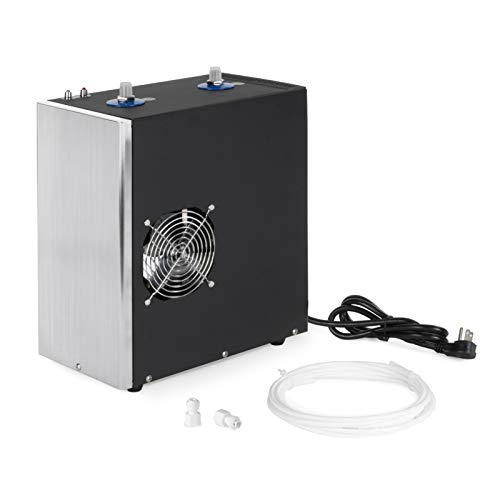
Best for filtration-centric setups that want chilled water on demand. This universal system pairs with water filters and RO setups, featuring a built-in cooling fan to surpass standard water cooling. It includes a dedicated tank with a storage capacity for cold water, providing readily available cooled output. Choose this if your workflow centers on filtered water and you want a compact, integrated cooling option. Caution: as with all filter-integrated chillers, performance scales with tank volume and ambient temperature.
Active Aqua Hydroponic Water Chiller

Best for hydroponic systems, aquaponics, and larger tanks that require rapid cooling. With 0.25 HP, it delivers fast temperature control and offers a Boost function for quicker cooling cycles. The unit is designed for 40–92 gallon reservoirs, giving flexibility for mixed-use environments. Select this if hydroponics or aquaponics are central to your setup and you need reliable, programmable cooling. Limitation: higher power draw and larger footprint than compact chillers, which may be a consideration for tight spaces.
YAKUST 79 Gallon Aquarium Chiller

Best for feature-rich control with a larger display and remote-ready options. This 1/3 HP chiller targets up to 79 gallons and provides an LED display for easy temperature adjustments. It notes that performance depends on water volume, surrounding temperature, and container material. Choose this if you want a more advanced control interface and a slightly larger cooling capacity. Limitation: operation may vary in very warm environments or with unusual tank materials; consider reducing tank volume to maximize efficiency.
Buying Guide: Key Considerations For Water Tank Chillers
- Tank size and target temperature: Match chiller capacity and cooling range to your tank volume and the desired steady-state temperature. Larger tanks typically need higher-capacity units or longer run times.
- Noise and placement: If the setup is in living spaces, prioritize models advertised as quiet (dB ratings around 30–50 dB). Place the unit with adequate clearance for airflow.
- Temperature control features: Look for precision thermostats, digital displays, and remote control options. Some units offer Booster modes for rapid cooling, useful in heat waves.
- Power and energy use: Higher HP ratings often correlate with faster cooling but increased energy consumption. Balance cooling speed with operating costs for your situation.
- Maintenance and parts: Check included hoses, pumps, and fittings. Consider models that provide easy access to pumps and filters for cleaning and replacement.
- Installation considerations: Some chillers work best with hydroponic systems or dedicated cooling tanks. Ensure compatibility with your water system and tank mounting space.
- Ambient conditions: Cooling efficiency depends on ambient temperature and airflow. Outdoor or greenhouse use may require higher-capacity or insulated installations.
FAQ
- What size chiller do I need for a 40- to 80-gallon tank?
For 40–80 gallons, a 1/3 HP chiller (like the listed 79-gallon models) is typically suitable, balancing cooling power and energy use. Consider ambient temperature and desired temperature range when choosing.
- Are water chiller units suitable for hydroponic systems?
Yes. Some models are designed for hydroponics and aquaponics, offering precise control and compatibility with nutrient solutions. Check for corrosion-resistant materials and compatible fittings.
- Is a dedicated cooling tank necessary?
Not always, but a dedicated tank can simplify temperature management and ensure consistent cold water delivery, especially in filtration-centric setups.
- Do these chillers run quietly?
Many listed models emphasize quiet operation, typically in the 30–50 dB range at typical distances. Placement and room acoustics also influence perceived noise.
- Can I use a water chiller for saltwater tanks?
Yes, many chillers are rated for both freshwater and saltwater use. Verify material compatibility with salt and consider corrosion resistance in pumps and tubing.
- How does ambient temperature affect cooling performance?
Higher ambient temperatures reduce cooling efficiency. In hot rooms, you may need a higher-capacity unit or optimization like improved ventilation and reduced tank volume.