Finding the right dehumidifier for a sealed grow room helps protect plants from mold, mildew, and excess humidity while keeping energy use in check. This guide highlights five top options suited for grow tents and large spaces alike, with clear advice on who each device is best for and why. Whether you need compact, desiccant-based control or a full-room compressor approach, you’ll see practical choices tailored to grow environments and household use.
Summary of selected products:
| Product | Best For | Key Feature | Limitations |
|---|---|---|---|
| MARS HYDRO 38 Pints Dehumidifier | Grow tents up to 4×4 ft | Outside-tent placement with ducting for moisture removal | Requires external mounting via ducting |
| ASAHWo 45 Pint Dehumidifier | Large rooms up to 4500 sq ft | Energy Star, quiet operation | Household-oriented, larger footprint |
| AEOCKY 1000 Sq Ft Rotary Desiccant Dehumidifier | Small spaces and closets | Rotary desiccant tech, compact and quiet | Best for small areas, not large basements |
| AC Infinity Terraform 8 | Grow tents needing integrated climate control | All-in-one climate control with AI | Requires ducting setup |
| KNKA 2500 Sq. Ft Dehumidifier | Basements and large rooms | Three modes with optional external tank | External tank accessory sold separately |
MARS HYDRO 38 Pints Plant Dehumidifier
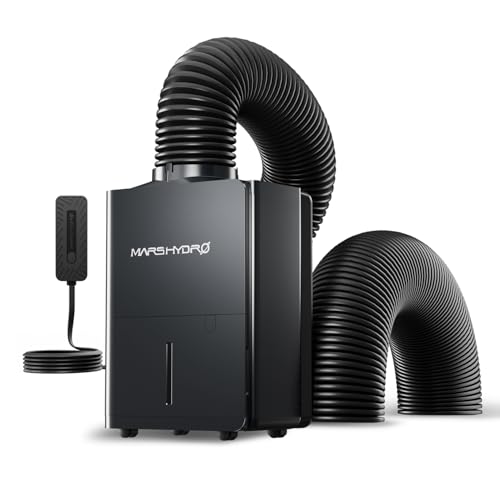
Best for grow tents that need external moisture removal without adding heat. This unit sits outside the tent and ducts moisture out, making it ideal for 3×3, 2×4, and 4×4 ft grow spaces. Features a high-efficiency compressor that removes up to 38 pints per day and sensors that monitor temperature and humidity for precise control. The Smart Auto mode maintains a target humidity between 30% and 90%, automating on/off for hassle-free operation.
Who it’s best for: growers using sealed tents who want strong dehumidification without heat transfer into the grow space. Why selected: moisture control with outside placement minimizes heat load on plants. Caution: ducting work is necessary to channel moisture out, which adds setup considerations.
ASAHWo 45 Pint Energy Star Dehumidifier

Best for large rooms and basements up to 4500 sq ft, with a quiet operation profile. This Energy Star compressor dehumidifier removes up to 45 pints per day and offers a 30%–80% humidity setting range. It features a smart control panel with a digital display for easy adjustments and an automatic Humidity Control function that adapts to room conditions. The unit is designed to be quiet, making it suitable for bedrooms or living areas where noise is a concern.
Who it’s best for: homeowners needing strong whole-home humidity management without excessive noise. Why selected: high capacity paired with quiet operation. Caution: best suited for larger spaces; very small tents may be overkill.
AEOCKY 1000 Sq Ft Rotary Desiccant Dehumidifier

Best for small spaces like bedrooms, bathrooms, closets, and RVs where quiet operation and compact size are priorities. This rotary desiccant unit delivers solid moisture removal with low noise and a smaller footprint. It includes an intelligent humidistat and a drain hose for continuous drainage. A caution: warmth and a faint scent may occur during initial operation due to desiccant material; ensure adequate ventilation if sensitive.
Who it’s best for: users needing a compact solution with low energy use and straightforward humidity control. Why selected: compact size and quiet operation suit tight spaces. Caution: best for smaller rooms, not ideal for large basements.
AC Infinity Terraform 8 Grow Tent Climate System

Best for integrated grow room climate control in tents. The Terraform 8 combines air conditioning, heating, and dehumidification with smart VPD control. It uses a ducted setup to manage temperature and humidity from a single duct output. The device auto-switches between cool, heat, and fan modes to maintain the target climate, reducing manual adjustments. This is ideal for growers who want an all-in-one approach and are comfortable configuring ductwork.
Who it’s best for: growers seeking an automated climate solution that includes humidity management. Why selected: comprehensive VPD-based control in a single system. Caution: setup requires ducting and some technical configuration.
KNKA 2500 Sq. Ft Dehumidifier

Best for larger rooms and basements with multiple drainage options. This model removes up to 34 pints per day and supports three modes: DEHU, DRY, and CONT. It offers a built-in tank, a drain hose for continuous drainage, and an optional external tank. This flexibility helps tailor operation to space and moisture loads in home environments. A caution: external tank accessory is sold separately, which adds cost for extended drainage.
Who it’s best for: spaces requiring versatile drainage and mode options. Why selected: strong performance for midsize to large spaces with flexible drainage. Caution: for very large basements, consider higher capacity models or multi-unit setups.
Buying Guide
What size should I choose? Start with the square footage and typical humidity levels. For sealed grow rooms, aim for a unit that can handle the space plus a buffer for moisture from plants. Compressor dehumidifiers work well for larger areas, while desiccant or rotary designs excel in smaller spaces or where quiet operation matters.
- Placement: consider whether you can place the unit inside or outside the tent and whether ducting is feasible. Exterior placement with ducting often reduces heat load inside the growing space.
- Control: look for automatic humidity control and smart sensors. A wider target range (e.g., 30%–80% or 30%–90%) provides flexibility across plant cycles.
- Drainage: understand whether the unit supports a continuous drain hose or relies on a tank. Continuous drainage reduces maintenance but requires accessible drainage lines.
- Noise and energy: energy efficiency and quiet operation are important in living spaces adjacent to grow rooms. Energy Star ratings and low dB levels are meaningful indicators.
- Maintenance: check for filter accessibility, ease of cleaning, and indicator lights for tank-full or maintenance reminders.
FAQ
- What size dehumidifier is best for a standard grow tent?
A dehumidifier matching the tent’s footprint (commonly 3×3 to 4×4 feet) with a daily moisture removal of 20–40 pints is a practical starting point; consider larger capacity if high humidity persists. - Should I place the dehumidifier inside or outside the grow tent?
Placing the unit outside with ducting can reduce heat transfer into the tent while still controlling humidity effectively. - Is a continuous drain hose necessary?
A continuous drain reduces manual emptying and is preferred in humid grow environments, especially when humidity fluctuates. - Do I need more than one dehumidifier for a grow room?
For larger tents or split rooms, two smaller units can provide more consistent humidity and simpler zoning than one large unit. - What humidity target should I aim for in a grow room?
Generally, maintain 40%–60% RH during most growth stages to reduce mold risk while supporting plant transpiration. - Are rotary desiccant units suitable for grow rooms?
Rotary desiccant units work well in compact spaces and low-noise environments, but may be overkill for larger basements; match capacity to space and humidity load.