When cooling large rooms or open living areas, high-capacity window ACs deliver strong cooling power, faster temperature relief, and reliable dehumidification. This guide highlights five top options that balance capacity, efficiency, and control. It’s ideal for buyers seeking substantial BTU performance without sacrificing ease of use or installation. The featured models range from ultra-large capacities to versatile 12,000 BTU units with heat or smart features. Suitable buyers include homeowners with big living rooms, multi-room apartments, or spaces that demand consistent cooling during peak heat.
Summary table of selected products:
| Product | Brand | Estimated Capacity | Best For |
|---|---|---|---|
| Keystone 23,200 BTU Window AC | Keystone | 23,200 BTU cooling / 16,000 BTU supplemental heat | Extra-large spaces up to 1,500 sq ft |
| Midea Inverter Window AC with Heat | Midea | 12,000 BTU | Large rooms up to 550 sq ft, energy efficient |
| LG 14,000 BTU Dual Inverter Window AC | LG | 14,000 BTU | Large rooms up to 800 sq ft, smart control |
| Comfort Zone 12,000 BTU Window AC | Comfort Zone | 12,000 BTU | Smart features, flexible modes |
| Tehanld 10,000 BTU U-Shaped Window AC | Tehanld | 10,000 BTU | Quiet operation in mid-to-large rooms |
Keystone 23,200 BTU Window Air Conditioner

Key features include a powerful 23,200 BTU cooling capacity with a 16,000 BTU supplemental heat option, dehumidification, and fan circulation. It’s designed for large spaces up to 1,500 square feet. The Smart Remote provides room-temperature feedback and communicates updates every 3 minutes for accurate cooling control. Best for: households needing year-round comfort in very large rooms or open-plan living areas. Caution: supplemental heat is not a primary heat source and should be used within 23–76°F outdoor temperatures.
Midea Inverter Window AC With Heat

12,000 BTU cooling with heat pump functionality offers multi-season comfort for large rooms up to 550 square feet. Inverter technology supports energy efficiency, and the unit is controllable via a digital display, remote, app, or voice assistants. It’s best for: spaces where energy savings are a priority and you need flexible cooling and heating in one unit. Limitation: heat operation may be restricted when outdoor temperatures fall below 41°F.
LG 14,000 BTU Dual Inverter Window AC
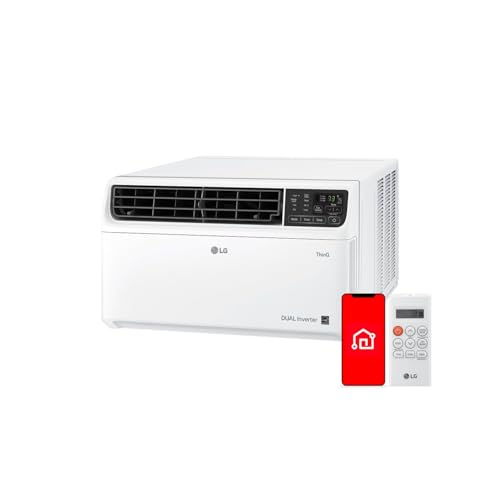
With 14,000 BTU, this LG model covers up to 800 square feet and uses dual inverter technology for energy savings up to 35% versus standard standards. It’s also equipped with LG ThinQ for remote control and compatibility with Google Assistant and Amazon Alexa. Best for: large rooms where quiet operation matters and homeowners want smart home integration. Caution: performance may vary in rooms with extreme sun exposure or high ceiling heights.
Comfort Zone Window Mounted Smart AC
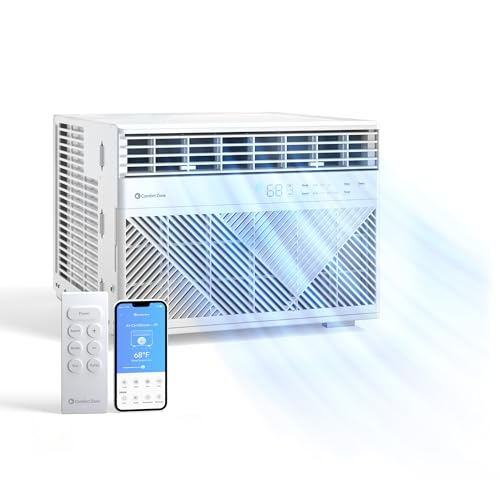
12,000 BTU with four modes (Cool, Dry, Fan, Auto) plus four speeds and a 24-hour timer provides adaptable climate control. The Sleep setting gradually adjusts temperature, and Eco Mode supports energy-conscious cooling. Best for: users who want flexible modes and smart scheduling in a mid-to-large room. Limitation: actual cooling efficiency depends on window fit and room insulation.
Tehanld 10,000 BTU U-Shaped Window AC

10,000 BTU cooling with a U-shaped design emphasizes ultra-quiet operation, isolating the noisy compressor outside the living space. It targets rooms up to 450 square feet and includes six modes (Cool, Dry, Fan, Sleep, Auto, Energy Saver). Best for: bedrooms or living spaces where low noise is essential. Caution: cooling capacity is lower than the larger units, so not ideal for very large rooms or high-heat seasons.
Buying Guide: High Capacity Window AC Considerations
What BTU should you choose for a large room? Measure the room and consider ceiling height, sun exposure, and insulation. Larger spaces generally benefit from 12,000–14,000 BTU units, while open-concept areas or rooms near heat sources may require 16,000–23,000 BTU options. Always account for occasional temperature spikes and humidity.
How important are heat capabilities? Some window ACs include supplemental heat or heat pumps. In moderate climates, these can provide value by extending cooling into shoulder seasons. Remember: supplemental heat is not a primary heat source and should be used accordingly.
Would you prefer smart controls? Smart features—remote apps, voice assistant compatibility, and energy-saving modes—can simplify daily use and optimize energy consumption. Consider inverter or dual inverter technology for consistent performance and lower running costs.
What installation considerations matter? Check window dimensions, mounting kit compatibility, and whether the unit fits your window type. Ultra-quiet operation is a priority for bedrooms or home offices, while energy efficiency ratings (like Energy Star) help lower energy use over time.
How do you balance features and price? Higher-capacity units often include additional modes, heat options, and smart features. Compare operating costs, filtration, maintenance alerts, and warranty terms to determine long-term value rather than upfront price alone.
FAQ
Do these high-capacity window ACs require professional installation?
Most models are designed for window installation by homeowners with standard tools. Follow the manufacturer’s installation guide for best results.
Can I use the supplemental heat every day?
Supplemental heat modes are intended for mild external temperatures. Do not rely on them as the primary heating source.
Which unit is best for smart home integration?
LG and Midea models offer app control and compatibility with voice assistants, making them strong choices for smart homes.
How can I improve efficiency in a large room?
Ensure proper sealing, insulation, and window fit. Use ECO or Sleep modes and optimize airflow with correct louvers and fan settings.
What is the best option for quiet operation?
Units with inverter technology and noise-reducing design, like the LG model and certain high-capacity options, tend to run quieter at similar cooling levels.