Answering the question “which low temp alarm sensor should I buy?” this guide highlights five top options designed to alert you about temperature and humidity changes. It targets buyers who need reliable monitoring for wine cellars, nurseries, RVs, greenhouses, and fridges. Each pick offers distinct strengths: long-range wireless, cellular backup, or easy WiFi-based setup. The top products are best for different environments, from remote locations to everyday home use. Use the quick comparison table below to start.
| Product | Best For | Key Strength |
|---|---|---|
| YoLink Smart Temp & Humidity Sensor (2 Pack + Hub) | Wine cellars, nurseries, RVs | LoRa long-range, ultra-low power |
| YoLink Smart Wireless Thermometer Hygrometer (3-Pack) | Fridges, greenhouses, barns | LoRa network, flexible alerts |
| Necto Cellular Temperature Monitor | Remote properties with power outages | Cellular connectivity, no WiFi needed |
| Temp Stick Remote WiFi Temperature & Humidity Sensor | Home or RV with WiFi | No subscription, unlimited alerts (texts) |
| SensorPush HT.w Smart Sensor | Fridges, freezers, classrooms | Bluetooth with optional gateway |
YoLink Smart Temp & Humidity Sensor, LoRa Long Range

Best for long-range, battery-powered monitoring in spaces where WiFi is weak or unavailable. The YoLink sensor uses LoRa to reach up to a quarter mile in open air and can last up to two years on a single battery. This makes it ideal for wine cellars, barns, or basements where network coverage is unreliable. The hub connects via Ethernet or 2.4 GHz WiFi and supports Alexa temperature readings and IFTTT applets for automation. A caution: not designed for outdoor use, so place indoors only.
YoLink Smart Wireless Thermometer Hygrometer, 3-Pack

Best for scalable environments needing multiple monitoring points without WiFi congestion. This 3-pack uses LoRa for long-range, low-power operation and provides regular temperature and humidity updates to the YoLink app. Alerts can be customized and delivered via text, email, or push notifications. It’s well-suited for freezers, greenhouses, and poultry or livestock areas. A limitation: SMS allowances may be capped depending on your plan and hub configuration.
Necto Cellular Temperature Monitor

Best for uninterrupted monitoring where WiFi is unreliable or power can fail. The Necto monitor includes 2 years of cellular service by default, providing real-time alerts via a built-in multi-network SIM card. It supports temperature, humidity, and power outage alerts with up to five contacts for unlimited text and email notifications. Rechargeable backup battery helps maintain operation during outages. A potential drawback is the service renewal cost after the initial period.
Temp Stick Remote WiFi Temperature & Humidity Sensor

Best for WiFi-based monitoring with no ongoing subscription. Temp Stick offers 24/7 real-time alerts and unlimited text messages without per-device monthly fees. It requires a 2.4 GHz WiFi network and operates with Alexa and IFTTT. Use this when you prefer a simple, subscription-free option, but beware of 2.4 GHz only WiFi compatibility and potential limitations with public or guest networks at some sites.
SensorPush HT.w Smart Temperature Sensor
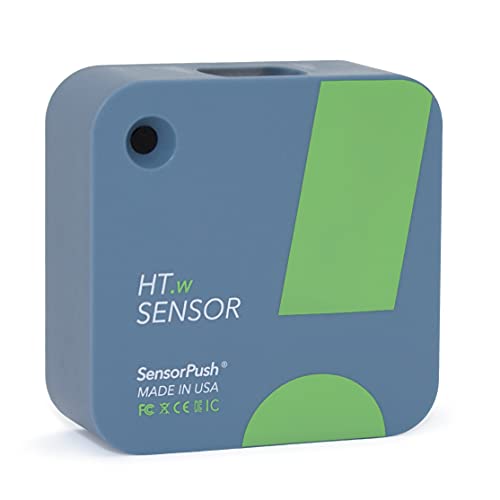
Best for compact, Bluetooth-focused monitoring with optional remote access. SensorPush provides reliable temperature and humidity sensing with a straightforward app experience. It stores data locally with onboard logging and supports a range of languages in the app. For remote monitoring beyond Bluetooth range, adding the optional G1 WiFi Gateway expands access. A limitation: primary use is Bluetooth; remote access depends on gateway availability.
Buying Guide
What form of connectivity fits your space?
Consider LoRa for long-range, low-power needs without relying on WiFi. If you have solid WiFi and prefer simplicity, a WiFi-based sensor like Temp Stick may be ideal. Cellular options like Necto work where internet access is spotty or power reliability is a concern. Choose based on whether you need constant online access or are fine with occasional data gaps during outages.
How important are alerts and data history?
Look for sensors that offer real-time alerts and long data logging. Some models provide 45 days of onboard data logging or unlimited cloud storage when paired with a gateway. If you want customizable alerts (thresholds, multiple recipients, SMS/email), verify what the model supports and any limits on message frequency or plan usage.
What environments are you monitoring?
Indoor spaces like wine cellars, nurseries, or cabinets are generally suitable for indoor-rated sensors. If you need outdoor-adaptable sensing, pick weatherproof or outdoor-capable units. For RVs and remote cabins, cellular or LoRa options can maintain coverage when WiFi is unavailable.
Battery life and power considerations
Long battery life reduces maintenance. LoRa-based devices often excel here, with multi-year battery life. Cellular devices may rely on power with a longer replacement cycle, but ensure you have a plan for ongoing service access if required. If you require permanent operation during outages, a device with a rechargeable battery or backup power option is advantageous.
Costs beyond the device
Be mindful of additional costs such as subscriptions, gateway requirements, or service renewals. Some sensors include two years of cellular service, while others rely on gateway-enabled cloud storage or free local logging. Compare total cost of ownership over time rather than just the upfront price.
FAQ
- Do these sensors work without WiFi? Yes, several models use LoRa or cellular connectivity, meaning they can operate without a stable WiFi connection.
- Can I get alerts by text messages? Some sensors support SMS alerts, while others rely on app push notifications or emails. Check limits per device and plan.
- Is there a long-range option for large properties? Yes, LoRa-based sensors provide long-range coverage, and some kits include hubs to extend reach within a building or campus.
- Can these monitor both temperature and humidity? Most models track both metrics, with some offering additional data like dew point or heat index.
- Do I need a subscription for alerts? It depends. Some devices include unlimited alerts with no ongoing subscription, while others require periodic service renewals.
- Are these suitable for fridges and freezers? Yes, several models are designed to monitor cold environments with precise low-temperature alerts.