Answering your search for reliable, high-flow roof exhaust fans, this guide highlights five top options that balance performance, durability, and energy efficiency. These picks suit different spaces—from large warehouses to home attics—while offering clear airflow advantages and practical limitations. The table below helps compare key specs at a glance.
| Product | CFM | Motor/Power | Best For |
|---|---|---|---|
| CXRCY 1400 CFM Upblast Roof Exhaust Fan | 1400 | All-copper motor, 2700 RPM | Medium to large commercial spaces |
| Master Flow GAF 1000 CFM Power Roof Mount | 1000 | High airflow, efficient motor | Attics up to 1,600 sq ft |
| VEVOR Roof Exhaust Fan (500/900 CFM) | 500 or 900 | High-power motor, adjustable speeds | Residential garages or kitchens |
| iLIVING HYBRID Ready Smart Thermostat Solar Roof Attic Fan | 1150 | 40-Watt motor with smart thermostat | Residential attics with solar/AC flexibility |
| USDGTKN 10 Inch Roof Exhaust Attic Fan | 2500 | 12W brushless DC motor | Large garages and sheds needing high flow |
CXRCY 1400 CFM Upblast Roof Exhaust Fan

The CXRCY unit delivers high-efficiency air movement with 1400 CFM, ideal for factories, warehouses, and restaurants where large volumes of air must be moved quickly. It uses a durable all-copper motor operating at 2700 RPM and consumes about 260W. A robust spun-aluminum housing and waterproof design provide all-weather durability to resist rain and debris. This model is best for spaces where continuous, high-volume ventilation is needed. Better for industrial or commercial settings that require strong airflow and long-term reliability. A potential limitation is higher initial energy use compared to smaller residential models, though it remains energy-efficient for its output.
Master Flow GAF 1000 CFM Power Roof Mount

Designed for attic spaces up to 1,600 square feet, the Master Flow ERV4 Power Roof Vent emphasizes efficient attic ventilation and reduced energy use. With an airflow capacity up to 1,000 CFM, it supports quicker removal of hot and humid air. The model is positioned as a solid choice for homeowners seeking cost-conscious cooling benefits and reliable performance in well-insulated attics. Choose this if you want strong airflow without specialized installation requirements. A caveat is that true performance depends on attic size and insulation; larger spaces may demand higher-capacity fans.
VEVOR Roof Exhaust Fan (500/900 CFM)

The VEVOR model offers adjustable airflow in two settings—500 or 900 CFM—via dual speed controllers. It features a 162W motor and speeds of 1630/2110 rpm for rapid heat expulsion. The aluminum housing and deflector add durability in varied climates, making it suitable for garages, kitchens, or bathrooms where space is constrained. Best for homes needing a compact but capable solution. A limitation is that 900 CFM may be insufficient for very large, hot spaces without additional ventilation strategies.
10 Inch Roof Exhaust Attic Fan (USDGTKN)
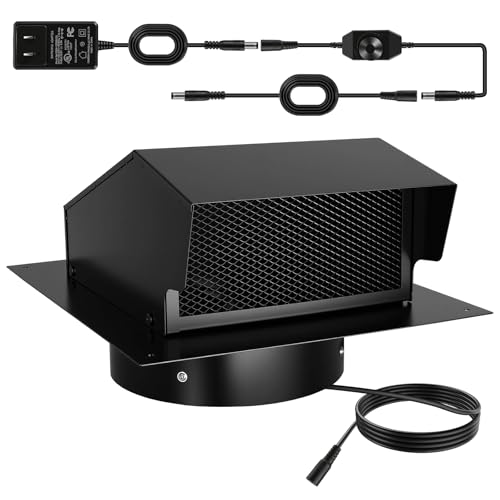
This larger-diameter unit delivers up to 2500 CFM with a 12W copper-core brushless DC motor. It’s designed to cover spaces from 200 to 3,000 square feet efficiently, while the IP68-rated motor and corrosion-resistant construction protect against weather and wear. It’s a strong pick for sizable attics or garages needing rapid ventilation. A potential limitation is that the higher airflow requires more space and may demand more robust mounting and duct considerations.
Buying Guide
What size attic or room should guide your choice?
CFM needs scale with space. For attic spaces up to 1,600 sq ft, units around 1000 CFM are typically adequate. Large garages or warehouses may benefit from 1400 CFM or higher. Measure the air volume and consider existing insulation and climate to choose the right capacity.
How important is motor type and durability?
Copper motors tend to offer robust, long-term performance in commercial settings. All-weather housings and IP-rated corrosion resistance extend life in exposed rooftop environments. If you expect rain, hail, or high humidity, prioritize weatherproof designs and durable materials like aluminum alloy or copper components.
What about energy use and efficiency?
High static airflow often comes with higher energy consumption. Look for fans with energy-efficient motors and adjustable speed controls so you can dial back airflow when full power isn’t needed. In residential settings, balance CFM with reasonable power draw to minimize utility impact.
Should you consider solar-powered or thermostat-controlled models?
Solar-assisted or smart-thermostat-enabled units provide flexible operation with climate responsiveness. They can maintain attic comfort with reduced electricity use during daylight or seamlessly switch between solar and AC power. These options suit homeowners prioritizing energy savings and automation.
Installation considerations
Ensure the roof penetration size matches the fan’s mounting footprint and that the unit’s weight is supported by the roof structure. All-weather housings and sealed electrical connections help prevent moisture ingress. If you’re unsure, consult a professional for mounting and wiring guidance.
Buying FAQ
- What airflow level do I need for a small attic? Typically 500–1000 CFM is suitable for small to mid-sized attics, depending on ceiling height and insulation.
- Can I use these fans in wet or humid environments? Choose models with IP-rated motors or waterproof housings for damp locations and outdoor roofs.
- Is higher CFM always better? Not always. Higher CFM means more energy use and noise. Match airflow to space size and ventilation goals.
- Are solar-powered attic fans effective year-round? They perform best with ample sun; plan for AC power or hybrid operation for night-time or overcast days.
- What maintenance is needed? Regular cleaning of grills and housings, plus periodic checks of wiring and seals, help maintain performance and longevity.