Answering the question for off-grid travelers: these 12V air conditioners are designed to cool small to midsize spaces without shore power or generators. They’re best suited for boondockers, RVers, truckers, van dwellers, and campers who prioritize battery life and quiet operation. Below are five top options, chosen for energy efficiency, suitability for off-grid living, and clear performance signals. A quick buyer’s table at the start helps you compare core specs at a glance.
| Product | BTU | Best For | Notes |
|---|---|---|---|
| Xenjum 11k BTU (No Heater) | 11,000 | Small RVs and Vans on limited batteries | Low-profile, soft-start, off-grid capable |
| Jrswin 12k BTU | 12,000 | Truck campers and larger cabins | Ultra-quiet operation |
| Outequip 10k BTU | 10,000 | Trailer and RV interiors with heater as backup | 4,500 BTU heater included |
| Sunster 12k BTU Split | 12,000 | RVs, trucks, and off-grid setups | Four operating modes, robust construction |
| Somokg 11k BTU | 11,000 | One-person DIY installs and compact spaces | Soft start, quiet airflow |
Xenjum 12V RV Air Conditioner (No Heater)

Key attributes center on energy efficiency and off-grid reliability. The unit offers 11,000 BTU cooling with a soft-start that lowers startup surge by 70%, extending battery life and reducing wear. It’s designed to run on a 12V battery system, with claimed runtime around 10 hours on a 600Ah setup and compatibility with solar panels for sustained off-grid operation. Best for: boondockers, RVers, and van dwellers seeking quick cooling without generator noise. Caution: model is without an included heater, so extra heating may be required in cold nights.
How this was selected: strong emphasis on low energy draw, quiet operation (reported around 35 dB), and a compact profile ideal for small roofs. The 11,000 BTU figure provides solid cooling for small living spaces while maintaining battery-friendly performance. It is a favorable pick for off-grid setups where maximizing solar and battery duration matters.
Jrswin DC 12V RV Air Conditioner (12k BTU)

Best for mid-to-large off-grid spaces where more cooling capacity is needed without shore power. This unit delivers about 12,000 BTU and is designed for quiet operation at 45 dB, useful for maintaining focus while traveling or parked. It emphasizes safety features via multi-layer circuit protection to guard against surges and vibration. Best for: truck campers or motorhomes that require reliable daytime and nighttime cooling with minimal noise. Limitation: performance and runtime are influenced by battery size and solar input; exact run times vary by setup.
Outequip RV Air Conditioner (10k BTU, with Heater)

This option blends cooling with a built-in heating element, providing 10,000 BTU of cooling and 4,500 BTU of heating. It’s suited for mild-weather scenarios where a heater supports evenings or shoulder seasons. Best for: RVs or trailers in variable climates where heating backup is desirable. Caution: heater performance is supplementary and not a primary heat source for very cold conditions, so plan heating accordingly.
Sunster 12k BTU Split DC 12V RV AC

Designed for durability and efficiency, this 12V DC split system uses a variable-frequency compressor linked to a high-airflow evaporator and premium aluminum condenser. Four operating modes include Eco and Sleep, which help extend battery life during off-grid camping or long-haul trips. Best for: users needing flexible modes and strong airflow in larger RVs or trucks. Better for: scenarios where optimizing energy use over long periods matters. Limitation: split systems may require more complex installation and roof cutout considerations.
Somokg 12V RV Air Conditioner (11k BTU, No Heater)
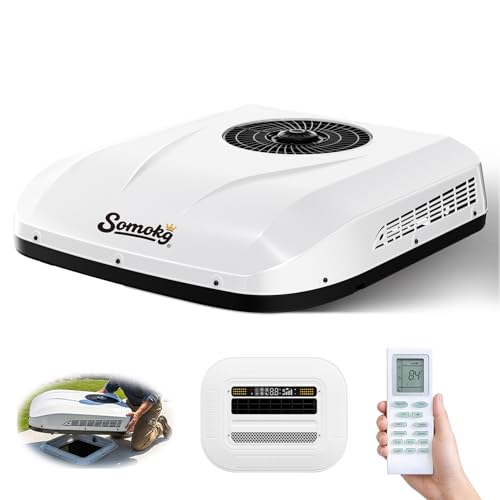
Best for one-person or compact setups with DIY install potential. This unit provides about 11,000 BTU cooling with a soft-start to minimize battery surge and an ultra-quiet operation around 35 dB. It’s designed for long battery life with 12 hours of cooling when paired with a suitable battery and solar setup. Best for: solo travelers or small campers who value quiet nights and simple installation. Caution: as with many 12V off-grid units, real-world runtime depends heavily on battery capacity and the solar array available.
Buying Guide: Key Considerations For Off-Grid 12V A/C
- Power source and efficiency: Off-grid cooling hinges on battery capacity and inverter efficiency. Look for units with soft-start technology, high COP ratings, and compatibility with solar charging to maximize runtime.
- BTU vs space: Match BTU to your space. Too much cooling in a small space wastes battery life; too little leaves you overheated. For boondocking, 10,000–12,000 BTU often fits mid-size RVs and vans.
- Noise level: Lower decibels improve sleep and driving comfort. Target units around 35–45 dB for quiet operation in halt scenarios or while driving.
- Durability and installation: UV-stabilized housings, corrosion resistance, and roof-top mounting impact long-term reliability. If you DIY, check roof opening dimensions and mounting clearances.
- Heating options and climate coverage: Some off-grid units include heating (for cold nights). Evaluate if you need a heater as backup or if you prefer a dedicated portable heater.
- Runtime expectations: Real-world runtime depends on battery size, solar input, and climate. Plan for 6–12 hours of cooling with a suitable battery bank and solar setup in warm conditions.
Frequently Asked Questions
- What is the typical runtime of a 12V RV air conditioner off-grid?
Runtime varies by battery size and solar input, but many setups offer 6–12 hours of cooling with a substantial 200–400Ah battery bank and decent solar charging in moderate heat. - Can these units run without a generator?
Yes, most 12V models are designed to operate off battery power, though the duration depends on battery and solar capacity. - Do off-grid 12V A/Cs require roof modifications?
Some models are designed for simple DIY installs and standard roof openings. Check your vehicle’s roof dimensions and mounting requirements. - Are heater-integrated units worth choosing?
Heater models are helpful for shoulder seasons or chilly nights but add power demand. If you need heating, an integrated heater can simplify the setup. - Is higher BTU always better for off-grid use?
Not necessarily. Higher BTU consumes more power. Choose BTU based on space size, insulation, and how long you want to cool between charges.