Answer: Match the cooling capacity (BTU) to your room size to maximize efficiency and comfort. This guide highlights top portable and self-evaporating models that are well-suited for specific square footage ranges. Ideal buyers include small-room users, apartment dwellers, mid-sized living areas, and larger rooms needing flexible cooling with 3-in-1 features.
| Product | |||
|---|---|---|---|
| LG 5,000 BTU Portable | 5,000 / 8,500 | Up to 150 sq ft | Portable |
| EUHOMY 8,000 BTU Portable | 8,000 | Up to 350 sq ft | Portable |
| ZAFRO 12,000 BTU Portable | 12,000 / 8,000 | Up to 350–550 sq ft (varies by model) | Portable |
| DuraComfort 12,000 BTU Portable | 12,000 | Up to 550 sq ft | Portable |
| AGTANA 14,000 BTU Portable | 14,000 / 10,000 | Up to 700 sq ft | Portable |
LG 5,000 BTU Portable Air Conditioner

Best for small rooms or rooms around 150 sq ft. This model provides compact cooling with a quiet operation profile and a window installation kit for flexible setup. Features include LCD remote control and eco-friendly R32 refrigerant.
- Best for single-bedroom or small office spaces.
- Choose this if you need a lightweight, easy-to-move unit with basic cooling and dehumidification.
- Caution: May struggle in larger rooms or during peak heat in hotter climates.
EUHOMY 8,000 BTU Portable Air Conditioner

Best for mid-sized rooms up to 350 sq ft. This 4-in-1 unit offers cooling, dehumidification, fan, and sleep modes, with a low noise profile and a window kit for quick setup. Remote control adds convenience for bedroom or apartment use.
- Better for bedrooms or small living spaces needing continuous comfort.
- Choose this if you want flexible modes and a dedicated sleep setting.
- Caution: Performance depends on room insulation and outdoor temperature.
ZAFRO Portable Air Conditioner (12,000 BTU)

Best for larger living spaces up to 550 sq ft. Features include three operating modes (cool, dehumidify, fan) with multiple speeds, smart control via app, and a long-range remote. Sleep mode reduces noise for quiet nights.
- Better for open-plan rooms or studios that need stronger cooling.
- Choose this if you want smart app control and flexible nighttime operation.
- Caution: Higher BTU units can be bulkier and heavier to move.
DuraComfort 12,000 BTU Portable

Best for rooms up to 550 sq ft that require robust, self-evaporating cooling. This unit includes all window kits and emphasizes a bucket-less, self-evaporating operation for maintenance-free use.
- Better for spaces where maintenance ease is a priority.
- Choose this if you want a complete installation kit and self-evaporating design.
- Caution: Self-evaporating systems can be less effective in extremely high humidity without drainage option.
AGTANA 14,000 BTU Portable
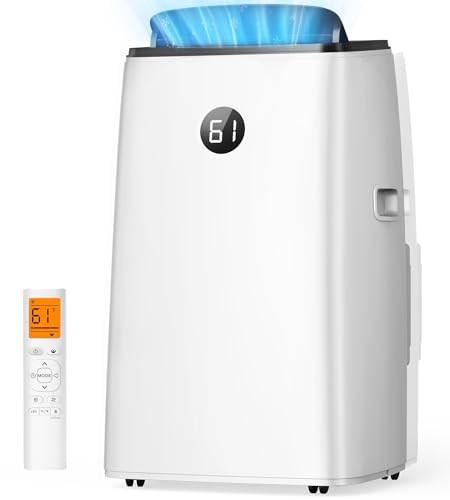
Best for large rooms up to 700 sq ft. Dual-rated BTU capacity (ASHRAE 14,000 / SACC 10,000) and auto-swing help distribute cool air evenly. Includes a drainage-free technology and a 24H timer for energy efficiency.
- Better for open living areas or garages requiring strong, even cooling.
- Choose this if you need wide-area coverage and programmable cooling schedules.
- Caution: Higher BTU units may consume more energy if not used with proper insulation.
Buying Guide: Key Purchase Considerations
How to choose the right tonnage for your space?
- Room size and ceiling height: Bigger rooms often require higher BTU capacities. Estimate 20 BTU per square foot for typical ceilings, adjusting for sunlight, appliances, and insulation.
- BTU vs SACC vs ASHRAE: SACC and ASHRAE figures indicate different testing standards; use the higher figure as a planning baseline for real-world performance.
- Portability vs. installation: Portable units offer flexibility but may be noisier and require venting windows. Fixed-wall or window units deliver consistent cooling but lack moveability.
- Energy efficiency and modes: Look for dehumidification and sleep modes to optimize energy use in humid climates or during nighttime cooling.
- Noise level: If a quiet environment matters (bedrooms or offices), consider units with low dB ratings and sleep modes.
- Maintenance needs: Self-evaporating models reduce water drainage tasks; check filter accessibility and common maintenance steps.
- Window setup and installation: Some units include full installation kits; ensure your window type (sliding/double-hung) is compatible.
Frequently Asked Questions
- What does BTU indicate in portable air conditioners?
– BTU measures cooling power. Higher BTU means more cooling capacity, suitable for larger rooms, but it should match the space to avoid wasted energy. - How do I approximate the right BTU for my room?
– Start with roughly 20 BTU per square foot for standard ceilings; adjust for sun exposure, insulation, and room usage. - Is SACC or ASHRAE more reliable?
– Both are standards; ASHRAE tends to be higher, while SACC reflects energy efficiency under different testing conditions. Use the higher figure for planning. - Are portable units difficult to install?
– Most come with window kits and clear instructions. Ensure your window type accepts the kit and vent hoses properly. - Can I run a portable AC in a humid climate without drainage?
– Some models offer drainage-free self-evaporating operations, but very high humidity can still require occasional drainage. - What features improve comfort beyond cooling?
– Dehumidification, sleep mode, timer programming, and app/remote controls can significantly enhance comfort and energy management.