If you’re chasing stronger airflow from return vents and registers, air conditioner vent blowers can help push conditioned air farther into rooms. This guide highlights top options for different homes and needs. Best for: small apartments needing quiet operation, larger homes requiring steady airflow, and users seeking smart control or remote access. Below you’ll find a quick product comparison, followed by detailed sections to help you choose confidently. A brief buying guide and FAQ finalize the information you need to decide at a glance.
| Product | Best For | Key Benefit |
|---|---|---|
| KHEOED Built-in Register Booster Fan | Quiet spaces and smart control | 10-speed, remote, smart sensing |
| ALORAIR 300 CFM Room-to-Room | Two-room balance and year-round use | Bidirectional airflow with temp control |
| PChero 4×10 Smart Vent Fan | Smart homes and bedrooms | Smart WiFi app, auto temp control |
| Hisummer 4×10 150 CFM | Quiet sleep and upstairs comfort | 17 dB Sleep Mode, precise thermostat |
| VEVOR 12 Inch Air Mover | Heavy-duty ventilation needs | High CFM, durable ETL design |
KHEOED Built-in Register Booster Fan

The KHEOED booster fan is designed for 4″x10″ ducts and is suitable for ceiling, floor, or wall vents. It improves overall airflow and supports both cooling and heating seasons. Best for: residences needing stronger, flexible air movement without major renovations. The 10-speed motor supports quiet operation and precise airflow, including a smart mode that adapts to your thermostat settings.
Who it’s best for: homeowners seeking a compact, remote-controlled option with customizable speeds for bedrooms or living areas. Why selected: it combines quiet performance with a range of speeds and smart control to fine-tune airflow. Limitation: ensure your duct dimensions are compatible (4″x10″ standard) and that your HVAC system allows fan-only operation without compromising overall balance.
ALORAIR 300 CFM Room to Room Vent Fan
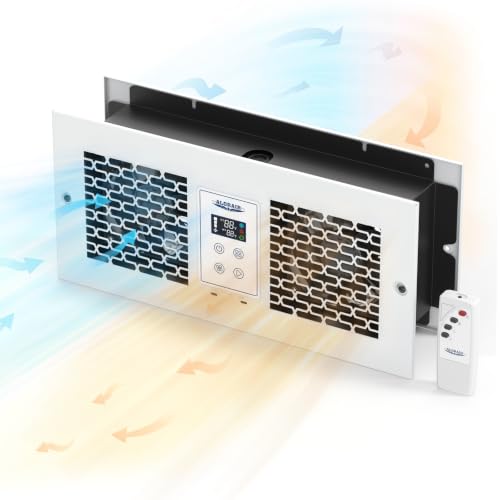
This dual-fan, bidirectional unit moves air between two connected rooms, effectively balancing temperature across spaces. It features three modes (Cooling, Heating, and Fan-only) and a precise thermostat—from 23°F to 104°F—allowing year-round use. Best for: homes with two rooms needing synchronized temperature management. Why selected: it actively transfers conditioned air rather than just circulating it, which benefits larger layouts. Caution: higher initial complexity may come with installation in some wall configurations.
PChero Register Booster Fan 4×10

The PChero booster fan delivers up to 160 CFM for 4×10 vents and offers a WiFi app for remote control and automatic temperature-based speed adjustments. Best for: smart-home users who want automated airflow management via mobile devices. Why selected: integrates with home networks for easy scheduling and control. Limitation: performance depends on your existing duct layout and how your HVAC is wired for smart devices.
Hisummer Register Booster Fan 4×10

Hisummer’s booster fan provides up to 150 CFM with a 17 dB Sleep Mode and a precise thermostat sensor. Best for: bedrooms and nurseries where quiet operation matters. Why selected: exceptional low-noise performance combined with smart sensing to adjust airflow. Caution: ensure correct installation orientation for optimal air capture and forward flow to preferred rooms.
VEVOR 12 Inch Air Mover

The VEVOR 12 Inch Air Mover is a high-capacity blower with 3198 CFM and a 585W motor, designed for heavy-duty ventilation needs. Best for: spaces requiring rapid air exchange, such as workshops or temporary odor clearance. Why selected: durable construction, ETL certification, and long ducting compatibility. Caution: higher energy usage and noise levels may not suit quiet rooms or sleeping areas.
Buying Guide
- Airflow needs: Measure room size and existing duct work to estimate required CFM. Larger rooms or multi-room setups benefit from higher CFM models or bidirectional transfer fans.
- Noise considerations: For bedrooms or nurseries, prioritize models with low dBA ratings or Sleep modes. Quiet operation improves comfort during nighttime use.
- Control and smart features: If you want remote management, look for WiFi/app control and thermostat-based speed adjustments. Ensure compatibility with your home network.
- Installation compatibility: Check vent size (common 4″x10″), mounting options, and whether the device is designed for ceiling, wall, or floor vents. Some units require wiring or specific airflow paths.
- Thermal balance: Models with built-in thermostats can regulate airflow based on actual room temperature, preventing over-boosting and energy waste.
- Durability and safety: Look for ETL or equivalent certifications, corrosion-resistant housings, and vibration reduction features to ensure long-term reliability.
FAQ
- What is a vent booster fan? A device installed in a vent to push or pull air, increasing airflow from your HVAC system into a room or between rooms.
- Do these fans work with any HVAC system? Most 4″x10″ vent boosters fit common duct sizes, but installation can vary with duct layout and existing ductwork.
- Can I use a booster fan for heating and cooling? Yes, many models support both, though performance and sound can vary by mode.
- Are smart vent boosters worth it? Smart features offer convenience and automatic adjustments, which can improve comfort and efficiency if you use compatible apps or hubs.
- How noisy are these fans? Noise levels range from around 17 dB in sleep modes to higher values in high-speed or heavy-duty models; choose based on room sensitivity.
- How do I choose the right CFM? For reference, estimate a need of about 1 CFM per square foot of living space as a starting point, then adjust for ceiling height and occupancy.