Looking for an efficient window AC unit that fits your space and budget? This guide highlights five solid options across a range of BTUs, emphasizing cooling power, energy efficiency, and smart features. Best for medium to large rooms: the Midea 12,000 BTU with heat for larger living spaces; best for small bedrooms: the GE 5,000 BTU; best for versatile seasons: the Midea 14,000 BTU Smart Inverter; best for apartments on a budget: the Whirlpool 5,000 BTU; best for flexible control and app support: the LG 8,000 BTU. The summary table below helps compare core details at a glance.
| Product | BTU / Size | Smart Features | Best For |
|---|---|---|---|
| Midea Inverter Window AC with Heat (12,000 BTU) | 12,000 BTU | SmartHome app, voice control | Large rooms up to 550 sq ft |
| Midea 14,000 BTU Smart Inverter Window AC | 14,000 BTU | APP control, Alexa/Google Assistant | Large rooms up to 700 sq ft |
| GE 5,000 BTU Digital Window AC | 5,000 BTU | Remote control, ECO mode | Small rooms up to 150 sq ft |
| Whirlpool 5,000 BTU Window AC and Dehumidifier | 5,000 BTU | Mechanical controls, dehumidifier | Small apartments and dorms up to 150 sq ft |
| LG 8,000 BTU Window AC | 8,000 BTU | WiFi control, LG ThinQ | Small to medium rooms up to 350 sq ft |
Midea Inverter Window Air Conditioner With Heat

This 12,000 BTU unit provides cooling and dehumidification plus reliable supplemental heat for transitional seasons. It is best for large rooms up to 550 square feet and includes a digital LED display, 5 modes, 3 fan speeds, a 24-hour timer, ECO mode, and a washable filter. Inverter technology supports energy savings and quick cooling. The unit supports wireless control via the Midea SmartHome app and voice assistants like Alexa and Google Assistant. Heat pump function has an outdoor temperature limit, so operation below 41°F is restricted.
- Best for large living spaces needing both cooling and standby heat.
- Better for homes with smart-home integration and remote management.
- Caution: Heat operation is limited by outdoor temperature.
Midea 14,000 BTU Smart Inverter Window AC

This 14,000 BTU inverter window AC is designed for large spaces up to 700 square feet. It offers four modes (Auto, Cool, Dry, Fan), three speeds, a 24-hour timer, and ECO energy saver. Wireless control via the SmartHome App, plus voice compatibility with Alexa and Google Assistant, makes it a strong choice for energy-conscious homes. It is Energy Star certified and emphasizes substantial energy savings with inverter technology. A front-access washable filter supports easy maintenance.
- Best for large rooms and energy savings with inverter tech.
- Better for homes prioritizing app control and voice assistants.
- Avoid if you need built-in dehumidification without cooling in high humidity.
Whirlpool 5,000 BTU Window AC With Dehumidifier
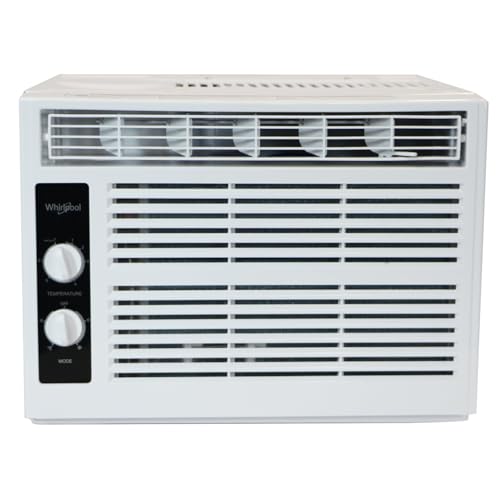
This compact 5,000 BTU unit is suitable for small rooms or apartments up to 150 square feet and includes a built-in dehumidifier. It features mechanical controls, a straightforward window installation kit, and two basic fan speeds with eight-way louvers for airflow direction. It’s best for budget-minded buyers who need reliable, simple cooling and moisture control in a compact space.
- Best for small rooms or dorms where simple operation matters.
- Better for users preferring mechanical controls over digital interfaces.
- Limitations: Smaller cooling capacity; consider larger space if needed.
LG 8,000 BTU Window AC

This 8,000 BTU LG unit covers up to 350 square feet and offers WiFi control via LG ThinQ, plus voice compatibility with Google Assistant and Amazon Alexa. It includes a fixed chassis, EZ Mount installation kit, and a washable filter. The unit is ideal for small-to-medium rooms where app-driven control and smart integration are priorities. It’s a strong pick for tech-forward buyers who want remote management from anywhere, though installation should ensure window compatibility.
- Best for smart-home enthusiasts who want app and voice integration.
- Better for mid-sized rooms where remote control is convenient.
- Avoid if you need the highest cooling capacity in a large space.
Buying Guide: Key Considerations For Window AC Units
What room size should guide your BTU choice?
Choose BTU based on square footage: small rooms (up to ~150 sq ft) often need 5,000 BTU; mid-sized rooms (150–350 sq ft) benefit from 6,000–8,000 BTU; larger spaces (350–700 sq ft) typically require 12,000–14,000 BTU. Inverter or standard compressors influence efficiency and performance in midday heat.
Do you want heat or smart features?
Heat-inclusive models are practical for transitional seasons in temperate climates. Smart features (app control, voice assistants) offer remote management and scheduling, improving daily comfort and potential energy savings when used well.
Energy efficiency and operating costs
Look for Energy Star certification and high CEER ratings. Inverter technology often provides better long-term energy savings, especially in spaces that require frequent cycling or longer runtimes.
Installation considerations
Measure window dimensions and ensure compatibility with the included EZ Mount kit. Fixed chassis models are simple to install, while some units may require professional help for optimal sealing and performance.
Maintenance and air quality
Front-access washable filters simplify cleaning and sustain performance. Regularly cleaning filters helps maintain cooling efficiency and air quality in occupied rooms.
Reliability and warranties
Review the warranty terms and included accessories like remote controls, installation kits, and defrost controls. While not a feature specification, ongoing support matters for long-term use.
FAQ
- What size window air conditioner do I need for a 350 sq ft room? An 8,000 BTU unit is typically suitable for space around 350 sq ft, depending on insulation and sun exposure.
- Can I use a window AC with a heat function year-round? Some models offer auxiliary heating, but operation may be limited by outdoor temperatures; check the unit’s heat specifications before relying on it in cold weather.
- Are inverter window ACs more energy-efficient? Yes, inverter systems often save energy by modulating compressor speed rather than cycling on and off.
- Do I need smart features to control my AC? No, many units offer manual controls, but smart features add convenience and can improve energy management if used wisely.
- Is professional installation required for window units? Most units include installation kits and are designed for DIY setup, but ensure proper sealing and safety for optimal performance.
- What maintenance helps extend a window AC’s life? Regular filter cleaning, keeping the exhaust area clear, and periodic checks of electrical connections help maintain efficiency.