If you’re selecting an air conditioning condensate pump, you want a model that reliably removes condensate, handles the right lift height, and includes safety features like an overflow switch or alarm. This guide focuses on practical, durable options suited for residential HVAC, refrigeration, and dehumidifier setups. Ideal buyers include homeowners upgrading a condensate drain, service technicians stocking replacement parts, and small commercial operators needing quiet, dependable pumps.
Summary of selected products:
- Little Giant VCMA-15ULST 115V – 65 GPH, with overflow detection switch
- Little Giant VCMA-15UL 115V – 65 GPH, no safety switch
- Little Giant VCMA-20ULS 115V – 80 GPH, overflow detection
- MSKOTOAS 1/30 HP – 132 GPH, built-in safety switch and alarm
- AQUASTRONG 1/38 HP – 85 GPH, safety switch and 20 ft lift
Little Giant VCMA-15ULST: 65 GPH With Overflow Detection

The Little Giant VCMA-15ULST is a compact, automatic condensate pump designed to remove condensate from HVAC systems, boilers, furnaces, dehumidifiers, and refrigeration units. It features a vertical-type switch to minimize footprint and a 1/50 HP motor for reliable performance. The unit is thermally protected and built with an ABS tank, stainless steel motor shaft, and a protective motor housing. It is suited for users needing overflow protection and a smaller installation footprint.
Best for: small- to mid-size HVAC setups that require auto operation with overflow detection. Choose this if overflow safety is a priority and space is limited. Limitation: 65 GPH may be insufficient for high-flow scenarios or large commercial units.
Little Giant VCMA-15UL: 65 GPH, No Safety Switch

This version offers the same core pump performance (65 GPH, 1/50 HP) but without an integrated safety switch. It remains a solid option for quiet, efficient condensate removal in controlled environments where overflow protection is managed separately. Durable construction and a proven motor design support residential and small commercial use.
Best for: users who already have separate overflow monitoring or alarm systems. Caution: lacks built-in overflow switch; ensure external safety measures are in place.
Little Giant VCMA-20ULS: 80 GPH With Overflow Detection

The VCMA-20ULS raises capacity to 80 GPH and includes an overflow detection switch, making it a better choice for mid-range systems or setups with higher condensate production. It shares the same high-quality ABS tank, stainless steel motor shaft, and thermally protected motor. It’s a robust option for apartments, small homes, and light commercial spaces.
Best for: higher condensate volume environments needing automatic shutoff on overflow. Limitations: slightly larger footprint than the 15UL variants.
MSKOTOAS 1/30 HP Condensate Pump: 132 GPH With Safety Alarm

The MSKOTOAS model provides a higher flow rate of up to 132 GPH and a lift up to 20 ft, equipped with a safety switch and built-in alarm to alert in overflow situations. The design emphasizes durability with a ceramic shaft and overheat protection, making it suitable for larger or more demanding HVAC installations, including some commercial uses.
Best for: users needing strong drainage capacity and integrated safety alarms. Caution: may be overkill for small residential systems with minimal condensate.
AQUASTRONG 1/38 HP Condensate Pump: 85 GPH, Safety Switch
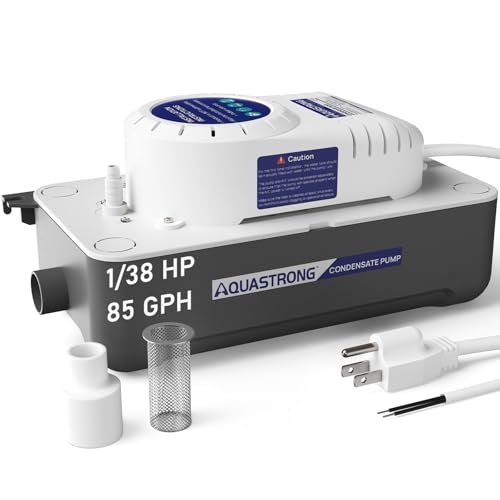
The AQUASTRONG 1/38 HP pump offers 85 GPH flow and up to 20 ft lift, with a high-level safety switch enabling direct wiring to HVAC appliances or alarms. It emphasizes quiet operation and durable construction, suitable for mid-sized cooling systems, furnaces, and dehumidifiers. It’s a balanced pick for installers seeking longer reach and safety integration.
Best for: installations requiring reliable lift and direct safety integration. Limitation: installation requires careful wiring of safety switch components.
VIVOHOME 100V-240V Condensate Pump With Alarm

The VIVOHOME model operates quietly with a 65 GPH capacity and a 15 ft lift. It includes an automatic safety alarm and a hall sensor that triggers shutoff or alarm on abnormal water levels. The unit is designed for energy efficiency and low noise, making it suitable for living spaces and noise-sensitive environments.
Best for: quiet operation needs with integrated alarm for peace of mind. Caution: ensure the control wiring for the alarm is accessible and correctly configured.
Buying Guide
What to consider when choosing an air conditioning condensate pump
- Lift height and flow rate: Match the pump’s maximum head (lift) and GPH to your system’s condensate output and vertical distance to the drain. Higher lifts require more robust motors.
- Safety features: Overflow detection switches, safety switches wired to the HVAC system, and audible alarms help prevent water damage in case of a clog or overflow.
- Durability: Look for metal components in critical areas (shaft) and a robust tank. Thermally protected motors extend service life in variable HVAC environments.
- Footprint and installation: Compact models save space, but ensure there is room for tubing connections and maintenance access.
- Power and efficiency: Evaluate voltage compatibility (115V typical in the US), motor efficiency, and noise level for living spaces or offices.
- Compatibility: Consider whether the pump uses standard tubing sizes and has a built-in safety switch that can be wired to alarms or shutoffs.
FAQ
- What is a condensate pump used for in HVAC systems?
A condensate pump automatically removes condensate produced by air conditioners, furnaces, dehumidifiers, and boilers when gravity drainage isn’t possible.
- Do all condensate pumps have overflow protection?
No. Some models include overflow detection switches and alarms, while others rely on separate safety systems.
- What does GPH mean, and why does it matter?
GPH stands for gallons per hour and indicates how quickly the pump can move condensate. Higher GPH suits larger condensate loads.
- Is 20 ft head height important?
Yes. The maximum head height tells you how high the pump can lift water to reach the drain; choose a higher head for installations with longer vertical runs.
- When should I choose a pump with a safety alarm?
Choose a model with an alarm for environments where overflow or system faults could cause damage or where monitoring is limited.
- How do I install a condensate pump safely?
Follow the manufacturer’s wiring and tubing guidelines, secure the pump on a flat surface, and ensure the safety switch and alarm wiring are correctly connected to your HVAC system or alarm panel.