Answering the common buying question: which air-cooled heat pump chiller best fits industrial water cooling needs? This guide highlights five reliable options, each designed for continuous water cooling rather than air conditioning. These machines suit workshops, engraving facilities, electronics labs, and hydroponics setups that require steady, energy-efficient water cooling. We compare cooling capacity, tank size, protection features, and ease of maintenance to help buyers pick the right model for their workload and budget. The table below summarizes the top picks for quick reference.
| Product | Cooling Capacity | Tank Size | Key Strength | Best For |
|---|---|---|---|---|
| VEVOR Air-Cooled Water Chiller, 12.3 HP | 30,240 Kcal/h | 37 gal | Dual compressor and comprehensive protections | Medium to large scale cooling needs |
| VEVOR Industrial Water Chiller – 60L, 9.4HP | Up to 15,100 kcal/h | 60 L | Balanced capacity with robust protection | Small to mid-sized shops |
| VEVOR Air-Cooled Water Chiller, 16.67 HP | 45,360 Kcal/h | 53 gal | High cooling with strong heat dissipation | Heavy-duty continuous use |
| 160L/42Gal Water Chiller (Loyalheartdy) | Water-cooling only | 42 gal | Compact, low-noise aquarium-focused chiller | Aquarium rooms, hydroponics |
| VEVOR Water Chiller 15 Ton (15HP) | Up to 38,700 Kcal/h | 150 L | Large tank with micro-computer control | High-demand cooling for workshops |
Note: All products listed are air-cooled water chillers intended for cooling water rather than serving as room air conditioners. Features like dual compressors, microchannel condensers, and automatic water replenishment aid long-term reliability in busy environments. When choosing, consider required cooling load, available space, and desired level of protection and automation.
VEVOR Air-Cooled Water Chiller, 12.3 HP

This unit uses dual 12.3 HP Panasonic compressors to achieve 30,240 Kcal/h cooling capacity. It is designed for water cooling, not air conditioning. It includes six protections (phase loss, phase reversal, motor overload, high/low pressure, auto water refill, anti-freeze) paired with gauges for real-time monitoring. Best for mid-sized industrial tasks that require robust cooling with reliable protection. Caution: Regular microchannel surface cleaning with an air gun is recommended to maintain efficiency.
VEVOR Industrial Water Chiller – 60L Capacity, 9.4Hp

With a 60 L tank and up to 15,100 kcal/h cooling capacity, this chiller balances power and footprint. It includes comprehensive protections like phase loss/reversal, motor overload, and auto water replenishment, plus high/low pressure gauges for status checks. The finned condenser and integrated fan support efficient heat dissipation. Best for workshops needing solid cooling without excessive size. Limitation: This model emphasizes stability and protection over the absolute highest cooling capacity.
VEVOR Air-Cooled Water Chiller, 16.67 HP
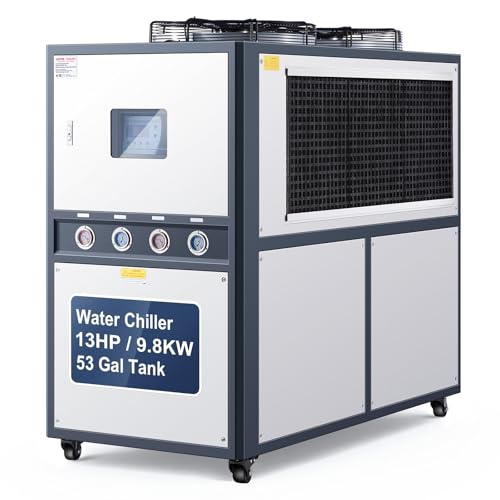
This model delivers 45,360 Kcal/h cooling with dual 16.67 HP compressors and a 53 gal tank. It uses aluminum film microchannel technology for high cooling efficiency and features extensive protections similar to other VEVOR chillers. Best for high-demand environments that require sustained performance and larger water stores. Caution: Regular microchannel surface cleaning is advised to sustain performance over time.
VEVOR Water Chiller 15Ton (15HP)

Equipped with a 15 HP compressor and a 150 L stainless steel tank, this chiller supports heavy-duty cooling up to 38,700 Kcal/h. It uses standard R407 refrigerant and includes a micro-computer control system with automatic water replenishment. Best for large shops or manufacturers requiring high-flow cooling. Limitation: Larger footprint and tank size may require more installation space.
VEVOR Air-Cooled Water Chiller, 25 HP

This high-capacity option uses dual 25 HP Panasonic compressors to reach 60,480 Kcal/h. It features six protections, auto water refill, and anti-freeze, with an aluminum microchannel condenser for efficient heat dissipation. Best for continuous, demanding cooling tasks where uptime is critical. Caution: Higher power draw and larger size require appropriate electrical and space planning.
Buying Guide
What should I consider before buying an air-cooled water chiller?
Determine the total cooling load (Kcal/h) required by your process. Choose a model with a sufficient tank size to minimize refills during operation. Look for protective features such as phase protection, motor overload protection, and high/low pressure monitoring for safer, reliable operation.
How important is heat dissipation?
Efficient heat dissipation reduces energy use and extends component life. Microchannel condensers and well-designed fans improve cooling capacity and reduce noise, especially in noisy workshop environments.
Which units are best for high-demand environments?
Consider models with dual high-capacity compressors and larger tanks (e.g., 53–60 gal or 150 L). These units provide stable cooling for continuous operations and reduce downtime for maintenance.
Maintenance and safety considerations
Regular cleaning of microchannels and fans helps prevent performance drops. Ensure proper water replenishment to avoid coil freezing. Always follow local electrical codes and manufacturer guidance for installation and servicing.
Which model fits a smaller space?
Smaller tanks and mid-range capacities (e.g., 37–60 gal) offer compact footprints while delivering solid cooling. Ideal for shops with limited floor space needing reliable water cooling.
FAQ
- What is an air-cooled water chiller used for? An air-cooled water chiller uses ambient air to cool water, primarily for industrial processes rather than room cooling.
- Do these chillers require special electrical wiring? Yes, higher-capacity units may require dedicated circuits and professional installation.
- Is a larger tank always better? A larger tank reduces refilling frequency, but it also increases footprint. Choose based on your workflow and space.
- Can I run multiple chillers in parallel? Parallel operation is possible in some systems, but confirm compatibility and control strategies with the manufacturer.
- How often should I clean the heat exchanger? Regular cleaning, as recommended by the manufacturer, maintains efficiency and prolongs life.
- Are these chillers suitable for aquarium use? Some units can be adapted for aquariums or hydroponics, but ensure compatibility with water chemistry and temperature ranges.