Answering the top buyer question: which solar-powered vent fans provide reliable airflow for attics, sheds, greenhouses, and RVs without extensive wiring? This guide highlights five dependable options, each suited to different spaces and needs. The products below cover high-CFM attic ventilation, small-space cooling, and container or RV ventilation, helping you choose based on airflow, installation, and operation style.
| Product | Best For | Key Benefit | Limitations |
|---|---|---|---|
| VEVOR 42W Solar Attic Fan | Large attics, metal or masonry roofs | Up to 2800 CFM with intelligent temp/humidity control | Higher upfront complexity |
| Hon&Guan Solar Attic Fan | Mid-size homes, adjustable solar exposure | Two operation modes with thermostat control | No battery backup |
| RecPro Solar RV Vent Fan | RVs and mobile setups | Solar-powered with quiet operation | Designed for RV plumbing caps, not homes |
| pqins 7.1″ Large Solar Greenhouse Fan | Greenhouses, sheds, chicken coops | Very high airflow with IP67 protection | Separate solar panel and fan require layout |
| 4SEASONS Solar Attic Vent Fan | Smaller attics up to 500 sq.ft. | CSA/TD certified, compact design | Lower airflow than larger models |
VEVOR 42W Solar Attic Fan

Best for: Attics with high heat load and metal or masonry roofs. The 42W MPPT regulator maximizes sun exposure, delivering up to 2800 CFM with a brushless DC motor for quiet operation. The integrated smart temperature and humidity controller helps maintain stable conditions year-round. A remote control offers convenient operation from up to nearly 10 meters away.
Why chosen: It combines strong air movement with smart controls for consistent attic cooling, reducing cooling costs. The all-weather design supports continuous operation and auto-switching from solar to electric at sunset.
Caution: The system relies on adequate sun; performance drops on overcast days or in shaded locations.
Solar Exhaust Fan By SHENVITASO

Best for: Small to mid-sized spaces like sheds, greenhouses, and coops needing reliable day-night operation. This unit uses a 25W solar panel and 8″ fan with up to 430 CFM and a low 36 dB noise level, plus a 16.4 ft power cord for flexible placement. It includes an anti-backflow valve for added seal when not running.
Why chosen: The kit supports daytime solar operation with a helpful adapter for night use, offering solid airflow without a long electrical run.
Caution: The system benefits from proper mounting to maximize sun exposure; performance varies with panel orientation.
Hon&Guan Solar Attic Fan With Thermostat
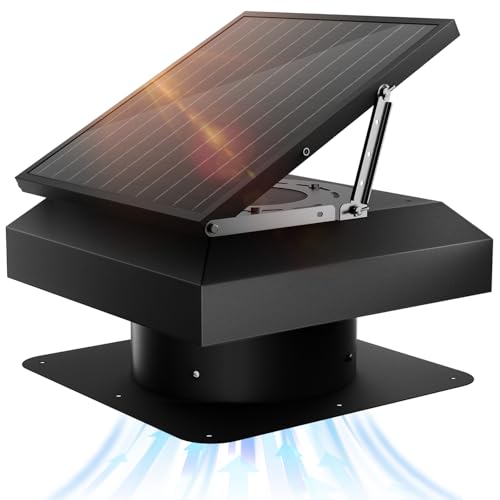
Best for: Mid-size homes needing controlled ventilation with adaptable power modes. This 40W solar roof vent delivers up to 2000 CFM and cools up to 2500 sq ft. It features adjustable solar panel positioning and a dual-mode operation (solar with optional AC/DC backup) plus thermostat-controlled auto-start.
Why chosen: The thermostat option adds reliability for varying conditions, ensuring air exchange when heat spikes occur. The system is straightforward to install and adjust for optimal sun exposure.
Caution: No battery backup means performance depends on solar input; on long cloudy spells, airflow may reduce unless powered by the adapter.
RecPro Solar RV Vent Fan
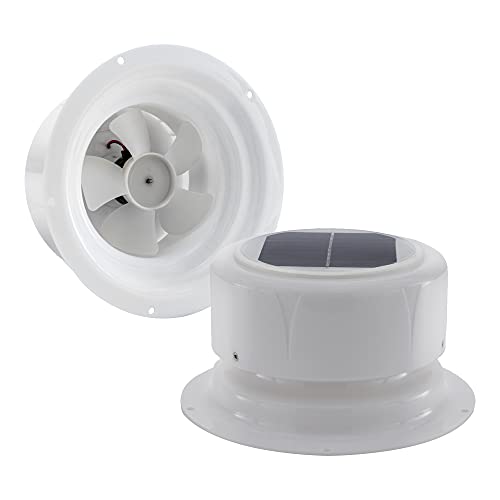
Best for: RV owners seeking plug-and-play, quiet, solar-powered ventilation for holding tanks and interior spaces. The built-in solar panel powers the fan automatically, delivering odor and moisture control without wiring or batteries.
Why chosen: Its simple installation and reliable solar operation suit mobile living spaces where power access is limited. The fan’s silent operation improves comfort inside the RV.
Caution: Designed primarily for RV plumbing vent use; suitability for stationary home use is limited by fit and mounting requirements.
Solar Blaster Mega RoofBlaster

Best for: Shipping containers needing solar-powered ventilation where external power is unavailable. The Mega RoofBlaster is designed to fit 3.5″ rib roofs with a galvanised build and sun-driven airflow to reduce heat buildup.
Why chosen: It enables independent operation in sunny locations, improving air movement inside containers and protecting contents from heat damage.
Caution: Primarily a container vent; installation must align with roof rib dimensions to avoid leaks.
4SEASONS Solar Attic Vent Fan

Best for: Small to medium attics seeking quiet, energy-efficient ventilation. The 12W panel powers up to 400 CFM, with CSA A93 certification and a durable polycarbonate housing.
Why chosen: Its compact size and certification provide a safe, reliable option for limited spaces where larger fans are unnecessary.
Caution: Airflow is lower than larger attic fans, so it’s better suited for smaller spaces or supplementary ventilation.
Buying Guide
Key considerations to help you pick the right solar vent fan:
- Space and airflow needs: Attics, sheds, and RVs vary in size. Choose a unit with CFM appropriate for the space and local climate.
- Solar panel and power options: Some fans rely solely on solar input, others offer AC/DC adapters or auto-switching. Consider sun exposure and installation flexibility.
- Control features: Temperature/humidity sensors, thermostats, and remote controls improve performance and convenience.
- Mounting and compatibility: Check roof type, rib dimensions, and mounting hardware. Containers require compatibility with rib roofs; attics require secure mounting to support the fan’s weight and airflow.
- Durability and certifications: Weatherproof housing, IP ratings, and safety certifications (CSA/TD) add long-term reliability in outdoor environments.
- Noise and operation: For living spaces like homes or RVs, consider decibel levels and quiet operation when selecting a fan.
FAQ
- Do solar attic fans work on cloudy days? They often operate best with bright sun; some models include adapters or batteries to extend use, but performance will decrease with limited sunlight.
- What CFM is suitable for my attic? A common guideline is 1 CFM per square foot of attic space, but this can vary with climate and insulation. Larger or hotter spaces require higher CFM units.
- Can solar vent fans replace air conditioning? They reduce heat buildup and can lessen AC load but are not a full substitute for cooling systems in larger homes.
- Are solar vent fans easy to install? Many are designed for straightforward mounting and come with hardware; however, proper placement for sun exposure is crucial for optimal performance.
- Is thermostatic control necessary? Thermostats help regulate airflow during peak heat periods and improve energy efficiency, especially in shaded or variable sunlight areas.
- Do these units require a battery or electronics knowledge? Some models include battery-less operation with solar power only, while others may offer adapters for continuous power supply.