Looking for an attic fan speed control that is reliable, easy to install, and compatible with common motor types? This guide highlights five top options, detailing who each is best for, how they perform, and practical trade-offs. Ideal buyers include DIY homeowners upgrading existing fans, contractors stocking versatile controls, and households seeking precise airflow management with minimal setup.
Summary of selected products:
| Product | Max Amps / Voltage | Motor Type | ||
|---|---|---|---|---|
| KB Electronics KBWC-18K | 8.0 A @ 115V | Shaded Pole, PSC (not for capacitor start/run) | Standard wall-box installations with PSC/shaded-pole motors | Not for capacitor start/run motors |
| KB Electronics 8811007 | 6.0 A @ 115V | Shaded Pole, PSC (not for capacitor start/run) | Compact wall-mounted control for lighter loads | Not for capacitor start/run motors |
| iLiving ILG8SFST | depends on model; Thermospeed integrated | General purpose AC motors | Temperature and speed integrated control | Temperature control may be affected by wiring |
| Master Flow GAF Speed Control | Rated for whole-house fans | Two-speed compatible fans | Replacing pull-chain switches in 24″ Direct Drive fans | Not for tandem whole-house fans |
| FICBXRA Variable Speed | 15 A capacity (implied by 120 VAC, 120V range) | General purpose ventilation fans | Flexible speed control with on/off switch | Ensure motor compatibility before use |
KB Electronics KBWC-18K Variable Speed Fan Control

Designed for standard 2″ x 4″ electrical wall boxes, the KBWC-18K handles up to 8.0 amps at 115 volts. It is UL and CSA approved and intended for shaded pole and PSC motors, not capacitor start or capacitor run motors. Best for: homeowners upgrading a basic attic fan with a solid, code-approved wall control. Limitations: unsuitable for capacitor-based motor configurations.
KB Electronics 8811007 Solid State Variable Speed AC Controller

With a 6.0 amp rating at 115V, this solid-state controller fits standard wall boxes and is UL and CSA approved. It is intended for shaded pole and PSC motors and should not be used with capacitor start or capacitor run motors. Best for: compact installations where lower current draw is acceptable. Limitation: lower maximum current compared to higher-amp models.
iLiving ILG8SFST Theromospeed Speed Controller
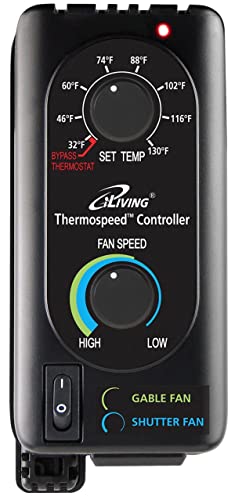
This plug-and-play Thermospeed controller combines temperature sensing with speed control, enabling automatic cycling at a set temperature. It includes an NTC temperature sensor for precise control. Best for: attics or garages where temperature-triggered airflow is desired. Limitation: integration with existing wiring should follow safety guidelines to avoid sensor misreads.
Master Flow Speed Control Switch for Whole House Fans

Designed for whole-house fans, this switch provides Low, High, and Off settings. It is compatible with Master Flow whole-house fans and can replace a pull chain switch in 24″ Direct Drive fans. Best for: homes with dedicated whole-house ventilation systems seeking straightforward speed options. Limitation: not compatible with the Master Flow Tandem unit.
KB Electronics 5.0 Max Amp Controller

The KB Electronics 5.0 Max Amp Controller is designed for standard 2″ x 4″ electrical wall boxes and supports up to 5.0 amps at 115 volts. It is UL and CSA approved and not intended for capacitor start or capacitor run motors. Best for: smaller attic fans or ventilation devices with lighter load. Caution: not suitable for gear motors.
KB Electronics KBWC-15K (UR) Variable Speed Fan Control

With a 5.0 amp rating at 120 VAC, this wall-mount variable speed control is suitable for PSC and shaded-pole motors and includes adjustable minimum voltage calibration. Best for: installations requiring adjustable minimum voltage to prevent motor stalling at low speeds. Limitation: not designed for capacitor start/run motors.
Buying Guide: Key Purchase Considerations
What motor type does your attic fan use? Most of these controls work with shaded-pole and PSC motors. Do not use with capacitor start/run motors unless specified by the manufacturer. Consider the maximum current rating you need; choose a unit that exceeds your fan’s running amps for reliability.
How easy is installation? Wall-box mounted models fit standard 2″ x 4″ boxes, popular in attics and closets. If you plan to replace a pull chain, a Master Flow-style control can be a direct upgrade. For plug-and-play setups, thermospeed or temperature-triggered controllers offer automation without complex wiring.
Do you want temperature-based control? Thermospeed and temperature-sensing options adjust fan speed based on ambient temperature, reducing energy use and improving comfort in hot seasons. Ensure the sensor placement is appropriate for accurate readings.
Programmability and precision: Some units offer adjustable minimum voltage, fine-tuned speed steps, or on/off cycling. If you require tight airflow control for a specific attic environment, prefer models with clear calibration options and stable performance across temperature ranges.
Safety and compliance: Look for UL or CSA approvals, especially for wall-mounted devices, to meet electrical code standards. Confirm compatibility with your motor type and avoid models explicitly marked for capacitor-start configurations if your fan lacks that hardware.
Frequently Asked Questions
- What is the difference between PSC and capacitor-start motors in attic fans? PSC motors use permanent split capacitor windings, while capacitor-start motors use a capacitor to start and run. Some speed controls are not compatible with capacitor-start motors.
- Can I install a speed control in an existing attic fan without an electrician? If the box is rated for a wall-mount controller and you follow the manufacturer’s wiring diagram, a confident DIYer can install it. Otherwise, consult a licensed electrician.
- Is a higher amp-rated controller always better for attic fans? Not always. Choose a controller that matches or slightly exceeds your fan’s running amperage to ensure safe, reliable operation.
- Are temperature-sensing speed controls suitable for uninsulated attics? Temperature sensing works best where there is a predictable temperature rise. In uninsulated attics, readings may vary with sun exposure and insulation integrity.
- What maintenance is required for these controls? Regular inspection of wiring connections and mounting integrity is advisable. Dust buildup can affect heat dissipation in some enclosures.
- Do these controls work with all attic fan brands? Many controls are designed for standard motor types used in common attic fans. Always verify motor type compatibility and amperage before purchasing.