Find reliable butterfly valves tailored for HVAC applications. This guide highlights five options suited for compact installations, energy-efficient control, and durable operation in heating, ventilation, and air conditioning systems. Best for small- to mid-sized HVAC runs, these valves balance space constraints with precise flow management. Use this comparison to choose valves that fit between flanges, between ducts, or in tight mechanical rooms.
Buyer snapshot:
– Small to mid-scale HVAC piping: UNOX DN50 wafer valves and similar 2″ to 2.5″ models are ideal for compact spaces.
– Industrial HVAC runs with tighter tolerances: nickel-plated or ductile iron bodies offer durability in harsher conditions.
– Automation-friendly systems: electric actuated valves suit automated dampers and process lines.
– Budget-conscious projects: wafer-style valves between flanges minimize space needs and installation complexity.
– Larger service or retrofit: 8″ PVC or ductile iron options cover broader flow ranges.
| Product | Size / Type | Best For | Notes |
|---|---|---|---|
| UNOX DN50 Wafer Type 2″ (AISI304 Disc) | 2″ Wafer | Compact HVAC runs | Stainless disc, EPDM gasket, PN16 |
| UNOX DN50 Wafer Type 2″ Iron Disc | 2″ Wafer | Space-limited systems | Nickel-plated ductile iron body |
| UNOX DN65 2.5″ With 24V DC Actuator | 2.5″ Lug/Wafer | Automated control in HVAC | Electric actuator for precise regulation |
| 4 Butterfly Valve, Wafer, 200 Psi | 4″ Wafer | Mid-sized commercial HVAC | Ductile iron body, 200 PSI |
| QWORK 3″ Stainless Steel Butterfly Valve | 3″ Tube OD | Liquid transfer in HVAC plumbing | 304 stainless steel, four locking positions |
UNOX DN50 2″ Wafer Type Valve

Best for: Small HVAC circuits requiring tight installations. The 2″ wafer design fits between flanges in restricted spaces. Features a stainless steel or nickel-coated body depending on model, with EPDM gasket for reliable sealing. This variant supports precise on-off or throttling control in compact duct and pipe runs, making it a solid choice for modern office HVAC or light commercial systems.
Why selected: Offers a balance of compact footprint and durable sealing materials suitable for air and water service within HVAC applications. The wafer geometry simplifies mounting between standard flanges, reducing installation complexity.
Limitation: Check flange compatibility (some installations require compatible flange standards) and ensure PN16 rating aligns with system pressure.
UNOX 2″ Iron Disc Wafer Valve

Best for: Systems needing robust corrosion resistance and space-efficient mounting. The valve uses a nickel-plated ductile iron body with an iron disc and EPDM gasket, suitable for HVAC water lines and general industrial piping in constrained layouts.
Why selected: Combines compact wafer mounting with durable construction for long-term service in challenging environments. Its corrosion resistance helps in humid or treated-water HVAC loops.
Limitation: Ensure compatibility of the nickel plating with the fluid media and operating temperature range.
LEIFIDE 4″ Ductile Iron Wafer Valve
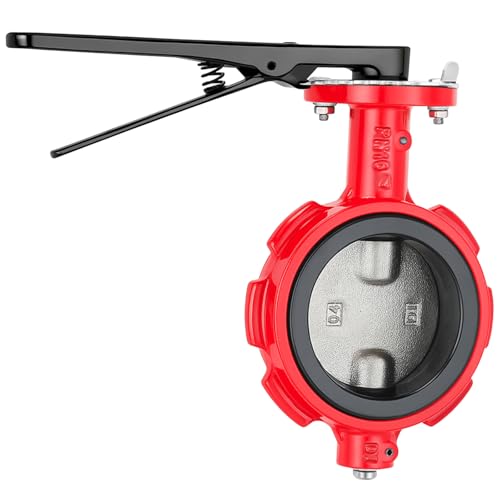
Best for: Industrial HVAC runs requiring robust pressure handling and space efficiency. The 4″ wafer valve offers a 200 psi rating and a square stem for reliable actuation in larger ducts or piping segments.
Why selected: Nickel-plated resilience enhances durability in demanding installations, and the wafer form aids alignment with flange bolt holes for quick mounting between flanges.
Limitation: Sizes and weight can demand proper support in larger ducts or piping to prevent misalignment during assembly.
QWORK Stainless Steel Butterfly Valve 3″

Best for: HVAC liquid transfer lines and dairy or brewing process piping where corrosion resistance and cleanability are priorities. The 3″ valve uses 304 stainless steel for durability and a four-position locking handle for precise control.
Why selected: Stainless construction resists corrosion and is easy to sanitize, suitable for HVAC water loops and low- to mid-pressure service. Locking positions support repeatable settings in automation-ready systems.
Limitation: Not ideal for very high-pressure or high-temperature steam lines; confirm media compatibility with EPDM or alternative gaskets for extreme conditions.
UNOX DN65 2.5″ With 24V DC Actuator

Best for: Automated HVAC systems that require remote or programmable flow control. The 24V DC actuator enables precise, energy-efficient operation and easy integration with building management systems.
Why selected: The combination of a compact wafer-type body with a motorized actuator makes it suitable for modern, automated air handling or water systems where precise throttling is needed.
Caution: Electric actuators require proper voltage supply and control wiring; ensure compatibility with the control system and safe installation practices.
UNOX 3″ DN80 With 110V Actuator
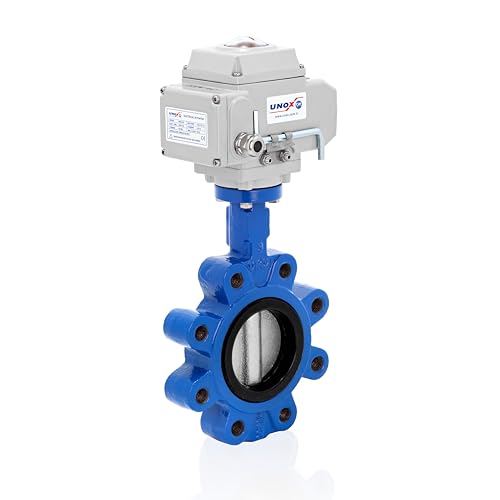
Best for: Larger automated HVAC lines or retrofit projects needing remote actuation and robust performance. The lug-type, 3″ valve provides secure flanging and quick disassembly for maintenance while the 110V actuator supports faster, programmable control.
Why selected: Offers a balance between mechanical resilience (GGG40.3 body) and automation capability for scalable HVAC installations.
Limitation: Lug-type installations require matching flanges and sufficient space around the valve for maintenance access.
Buying Guide: Key Purchase Considerations
- Size and fit: Choose valve size to match duct or pipe diameters and flange standards in your HVAC system. Wafer and lug designs affect installation ease and maintenance access.
- Material and media compatibility: For air handling, EPDM gaskets and stainless or nickel-plated bodies offer durability. For water or mixed-media loops, ensure gasket and body materials resist corrosion.
- Actuation needs: Decide between manual, electric, or actuator-assisted control. Electric actuators enable automation and remote operation but require power and integration with control systems.
- Pressure and temperature: Confirm PN rating and maximum operating temperature to prevent leaks or deformation under load. Higher psi valves are better for commercial or industrial HVAC runs.
- Installation considerations: Wafer valves between flanges are compact, but ensure bolt-hole alignment and flange compatibility. Lug-type valves provide maintenance-friendly disconnection.
- Maintenance and reliability: Look for durable discs (stainless steel or ductile iron), corrosion-resistant bodies, and gasket longevity to minimize downtime.
FAQ
- What is a wafer butterfly valve, and where is it best used in HVAC?
It is a valve with a wafer-style body designed to fit between flanges, good for compact HVAC runs and easy installation in tight spaces.
- When should I choose an actuator-equipped butterfly valve for HVAC?
Choose when automation and precise flow control are required, such as automated dampers or process lines connected to a building management system.
- Are PVC or ductile iron butterfly valves suitable for HVAC?
Yes, PVC is common for water-handling applications, while ductile iron provides strength for heavier-duty or humid environments; match to the media and temperature.
- What are common limitations to watch for?
Limitations include flange compatibility, space for maintenance, and media compatibility with gaskets and coatings.
- How do I choose between 2″, 3″, and 4″ valves for HVAC?
Base the choice on pipe diameter, required flow rate, and available space. Larger sizes handle higher volumes but require more room and support.
- Can I mix valve brands in an HVAC install?
It is possible if flange standards, materials, and pressure ratings are compatible, but consistency helps with sealing performance and maintenance.