Answering the common buying question: when choosing between ceiling fans and standing fans, pick the option that fits your room layout and cooling needs. This guide highlights five top picks for American homes, covering both ceiling and standing models. Each option is chosen for specific spaces and usage scenarios, helping shoppers decide who benefits most from each design.
| Product | Type | Best For | Key Benefit |
|---|---|---|---|
| Lasko Oscillating Pedestal Fan (White) | Standing Fan | Bedrooms, living rooms, home offices | Adjustable height up to 47″, quiet operation |
| DREO Tower Fan (Black) | Tower Fan | Small to medium rooms, nighttime use | Upgraded DC motor, 8 speeds, very quiet |
| Lasko Oscillating Cyclone Pedestal Fan (Black) | Standing Fan | Living areas with tall ceilings | 54″ height, remote control, wide oscillation |
| Depuley Modern Ceiling Fan with Light (Black) | Ceiling Fan | Living rooms, bedrooms, outdoor spaces | 42″ blade span, dimmable LED light, remote |
| Ohniyou 52 Inch Ceiling Fan (Black) | Ceiling Fan | Low-ceiling or flush-mount rooms | Low-profile design, strong airflow, remote/app control |
Lasko Oscillating Pedestal Fan

Product type: Standing fan with adjustable height. Best for bedrooms, living rooms, or home offices where you want adjustable airflow without a ceiling installation. Features include three quiet speeds for personalized airflow and widespread oscillation to reach corners of a room. The stand extends up to 47 inches and tilts for directed cooling, making it suitable for dorm rooms and quick air circulation during renovations. A potential limitation is that taller rooms may still benefit from ceiling fans for larger spaces.
DREO Tower Fan (Black)

Product type: Tower fan with DC motor and multiple modes. Best for compact rooms or nighttime use where quiet operation is priority. It features 8 speeds and 4 modes (Normal, Natural, Sleep, Auto) with remote or touch control, plus a 90° oscillation option. The enhanced motor and impeller design deliver strong airflow while reducing noise. A caveat: high-speed settings can still be noticeable in very quiet spaces.
Lasko Oscillating Cyclone Pedestal Fan (Black)

Product type: High-height standing fan with 18″ blade diameter. Best for spaces that need wider cooling coverage and a remote control for convenient operation from the couch. It offers three quiet speeds and a height reach up to 54″. Choose this if you want strong airflow in larger rooms. A limitation is the larger footprint compared to compact tower or desk fans.
Ohniyou 52 Inch Ceiling Fan (Black)
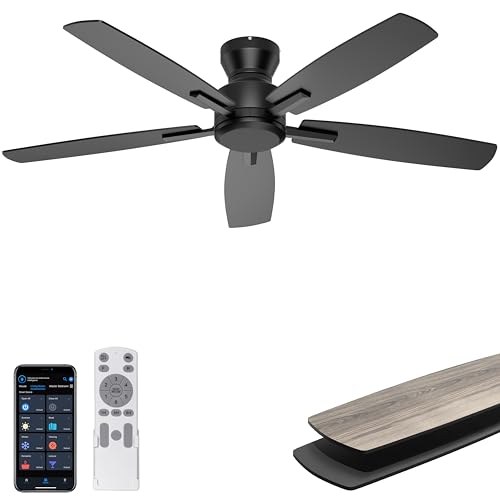
Product type: Low-profile ceiling fan for flush mounts. Best for rooms with lower ceilings, bedrooms, or nurseries where headroom is a concern. The design emphasizes quiet operation and strong airflow with a near-silent DC motor. It supports app and remote control for convenient adjustments. A potential limitation is the absence of a built-in light in the version shown, which may require a separate lighting solution for dimming needs.
LEVOIT Tower Fan (White)

Product type: 36-inch bladeless tower fan with 90° oscillation. Best for bedrooms and offices requiring near-silent operation with a programmable 12-hour timer. It automatically adjusts airflow based on room conditions via a built-in sensor. Use this if you value quiet nights and energy-efficient operation. A limitation: larger rooms may require higher-CFM models for quicker whole-room cooling.
Buying Guide: How to Choose Between Ceiling Fans and Standing Fans
Ceiling fans are ideal for rooms with sufficient ceiling height and where permanent airflow is desirable. Standing fans offer flexible placement and can be moved to target specific zones. Consider room size, noise tolerance, and whether you want integrated lighting or remote control. Material durability, energy efficiency, and maintenance needs also influence long-term value.
Do you have low ceilings?
Yes? A low-profile ceiling fan (like Ohniyou) minimizes visual clutter and maximizes headroom, while still delivering strong airflow.
Is nighttime quiet important?
For bedrooms, look for DC motor fans or bladeless designs with very low dB ratings (examples include DREO and Levoit models) to minimize sleep disruption.
Do you prefer adjustable airflow or fixed direction?
Standing fans with adjustable height and tilt (Lasko Pedestal and Cyclone variants) offer directed cooling, while ceiling fans provide steady ceiling-wide airflow without moving the unit.
Is remote or app control important?
Many modern models include remote or app control, enabling convenient adjustments from bed or sofa. This is common in the DREO, Ohniyou, and Levoit lines listed above.
How important is energy efficiency?
DC motors typically consume less energy and run cooler than traditional AC motors, improving efficiency over time. This is a key consideration for constant-use fans.
What space constraints exist?
For compact spaces, a tower fan or bladeless design is often best. For larger rooms, pedestal fans with tall height or ceiling fans with wider blade spans provide broader coverage.
Quick comparison snapshot
- Best for small rooms: DREO Tower Fan (quiet operation, multiple modes).
- Best for bedrooms with ceiling height: Ohniyou Low-Profile Ceiling Fan (flush mount, remote/app).
- Best for living rooms with tall ceilings: Lasko Cyclone Pedestal Fan (tall height, wide reach).
- Best all-purpose with light option: Depuley Ceiling Fan with Light (integrated lighting, multiple speed settings).
- Best for flexible placement: Lasko Standing Pedestal Fans (adjustable height, easy setup).
FAQ
- What should I consider first when choosing between a ceiling fan and a standing fan?
Room size, ceiling height, and whether you want fixed or movable airflow. - Are bladeless or DC motor fans quieter?
Often yes; look for models marketed as quiet or with 20dB-30dB operation. - Do all ceiling fans come with remote control?
Not all, but many modern options include remote or app control. - Is energy efficiency worth the extra cost?
DC motor fans typically offer better long-term efficiency and lower running costs. - Can I use a ceiling fan outdoors?
Some models are rated for outdoor use; verify with product specs before installation. - How do I choose the right blade span for a ceiling fan?
Smaller rooms benefit from 36-42 inches; larger rooms may require 52 inches or more.