Co2 demand control ventilation (DCV) helps keep indoor grow environments efficient by matching CO2 enrichment with fresh air exchange. This article reviews top DCV controllers designed for grow tents, rooms, and greenhouses. It highlights who each product is best for, with practical guidance on setup, energy savings, and limitations. The recommended options balance sensor accuracy, ease of use, and compatibility with common CO2 regulators and inline fans.
Summary at a glance:
| Product | |||
|---|---|---|---|
| Inkbird ICC-510 | Grow tents and small rooms | Dual outputs for CO2 and ventilation; light-sensing automation | Requires compatible CO2 equipment for full benefit |
| briidea CO2 Monitor & Controller | Medium-sized grow rooms and greenhouses | Day/night control with remote sensor; six programmable periods | Sensor cable length may affect placement |
| DANOPLUS Dual Outlet Controller | Systems needing clear value with two independent outlets | Simple dual-beam NDIR sensor; straightforward setup | Basic interface compared with AI-enabled models |
| AC Infinity CO2 Controller | Advanced grow rooms and greenhouses | Two independent outlets; dynamic CO2 and fan programming | More features may require familiarization |
| Inkbird ICC-500T | Home growers wanting plug-n-play control | Two outlets; programmable CO2 ppm control with alarms | Limited advanced scheduling compared to AI models |
Inkbird ICC-510 CO2 Controller Review

The Inkbird ICC-510 combines a dual-output design with a 100-240V universal supply, suitable for global use. It connects to CO2 regulators and inline exhaust fans, enabling automated CO2 enrichment tied to environmental signals. Its intelligent light sensor adjusts CO2 output based on ambient light, promoting energy-efficient growth. Best for small grow tents or compact rooms where both CO2 and ventilation need synchronized control. Caution: proper wiring and supported CO2 equipment are required for full functionality.
briidea CO2 Monitor And Controller
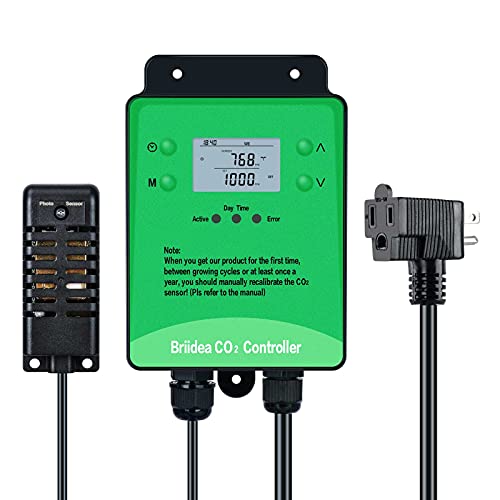
The briidea system offers day/night control with a remote sensor and six programmable time-based periods. It accommodates dimming CO2 output to align with light cycles, reducing waste while maintaining optimal uptake. Its dual-channel NDIR sensor maintains ppm accuracy even in humid environments, a common condition in grow rooms. Best for growers who want strict daily scheduling and energy savings. Limitations include sensor cable length constraints that may influence placement flexibility.
DANOPLUS CO2 Controller Dual Outlet

DANOPLUS provides two independently programmable outlets, allowing separate control of CO2 equipment and exhaust fans. It uses a dual-beam NDIR sensor for ppm readings with a simple border-high/border-low control scheme, making setup quick and predictable. It detects day/night automatically in Plant Mode and displays CO2, temperature, and humidity. Best for those seeking a straightforward, reliable dual-outlet solution. A possible drawback is a less feature-rich interface compared with AI-enabled models.
AC Infinity CO2 Controller

This model features two outlets that independently power CO2 regulators and exhaust fans. It supports custom CO2 and fan programming that dynamically activates in response to CO2 levels, along with precision cycling, night scheduling, and environmental data tracking. Best for larger grow spaces or setups requiring nuanced automation across multiple devices. Limitation: the feature set can be more complex to configure for beginners.
Inkbird ICC-500T CO2 Controller
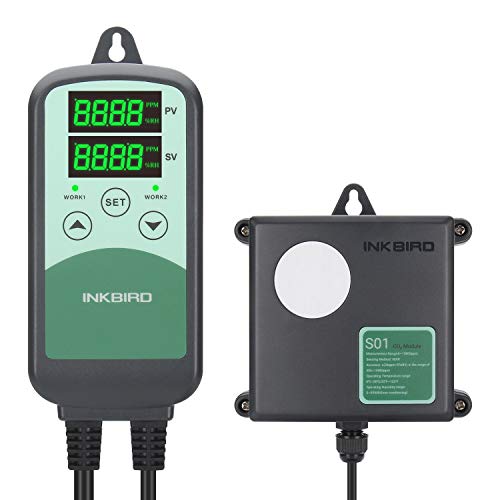
The ICC-500T offers two outlets for CO2 equipment and exhaust, with programmable CO2 ppm ranges and alarm features. It is designed for ready-to-run setups suitable for home growers. It provides plug-n-play operation and simple calibration options. Best for hobbyists seeking reliable, easy-to-use control. Limitation: advanced automation features found in premium models may be limited.
Buying Guide: Key Considerations for CO2 DCV Controllers
- System size and placement: Match controller capacity to tent, room, or greenhouse size. Longer sensor cables and dual outlets provide flexibility for larger spaces.
- Sensor type and accuracy: NDIR sensors offer better stability and lower drift, especially in humid grow environments. Consider models with dual sensors for redundancy.
- Control strategy: Light-based, time-based, or adaptive learning approaches affect energy use and CO2 efficiency. Day/night scheduling helps prevent waste during darkness.
- Outlets and device compatibility: Ensure the controller supports your regulators, inline fans, and any remote sensors you plan to use.
- Ease of setup vs. features: Simpler controllers are quick to install but may lack advanced scheduling. AI-enabled or app-connected units offer deeper tuning.
- Data visibility: Look for models that display CO2, temperature, and humidity and can log data for trend analysis.
FAQ — Quick Answers for CO2 DCV Buyers
- What is DCV for grow spaces? DCV uses sensors to adjust ventilation and CO2 delivery, optimizing plant growth while saving energy.
- Do I need a remote CO2 sensor? Remote sensors improve placement flexibility and can reduce measurement errors in large rooms.
- Is dual-outlet control better than single-outlet? Dual outlets allow independent control of CO2 and exhaust, improving reliability in varying conditions.
- Are AI-enabled controllers worth it? AI-enabled devices adapt to light cycles and environmental changes, often improving efficiency in complex setups.
- What maintenance is required? Regular calibration checks and sensor cleaning help maintain accurate readings and longer device life.
- Can these controllers work with any CO2 regulator? Most units support common regulators and inline fans, but verify compatibility before purchase.