Answering the need for reliable coil cleaners, this guide showcases five top options suited for commercial and residential HVAC systems. The right cleaner helps remove grease, grime, and odors from evaporator and condenser coils, improving airflow and efficiency. The selections below fit a range of maintenance needs—from no-rinse evaporator work to heavy-duty condenser cleaning—so you can choose based on your system type and maintenance workflow.
Buyer focus at a glance:
- Best for no-rinse evaporator coil cleaning: Leak Saver Foam Blaster variants and BERlOVE.
- Best budget-friendly gallon option for frequent use: Essential Values.
- Best for mixed evaporator/condenser cleaning with strong foam: Simple Green Foaming Coil Cleaner.
Product Comparison at a Glance
| Product | Best For | Key Benefit | Notes |
|---|---|---|---|
| Simple Green Foaming Coil Cleaner | General purpose coil cleaning | Foaming action with no rinse required in evaporators | Gallon size; versatile for various system types |
| Leak Saver Foam Blaster AC Coil Cleaner (3 Pack) | Deep cleaning on evaporators and condensers | High-pressure, penetrating foam for tough grime | No rinse on evaporators; light rinse on condensers |
| BERlOVE Foaming AC Coil Cleaner | Professional use, both evaporators & condensers | High-expansion foam with no-rinse efficiency | High-coverage foam; aims to boost efficiency |
| Essential Values Coil Cleaner (Gallon) | Frequent, heavy-duty cleaning | No-dilution required; fast-acting | Non-foaming formula for condenser coils |
| Leak Saver AC Coil Cleaner for All Condensers & Evaporators | Versatile HVAC system coils | Concentrated cleaner with adjustable dilution | 4:1 to 10:1 dilution; no-rinse option possible |
Simple Green Foaming Coil Cleaner

Product type: Cleaning Agent. Package dimensions: 8.0 in L x 8.0 in W x 12.0 in H. Weight: 5.0 lbs. The cleaner is designed for both evaporator and condenser coils with foil compatibility for efficient foaming action. Best for maintenance teams needing a general-purpose, easy-to-use coil cleaner that supports quick turnover in service calls.
Best for: Facilities and technicians seeking a reliable, versatile penny-pincher for routine coil cleaning. Why selected: It offers a balanced foam formula and practical gallon packaging for ongoing maintenance. Caution: Verify compatibility with non-metal coatings before extensive use.
Leak Saver Foam Blaster AC Coil Cleaner (3 Pack)

Product type: Cleaning Agent. Features high-pressure foam penetration that drives cleaner deep into coils before foaming. No-rinse for evaporators; light rinse may be used for condensers. Best for: HVAC pros and serious DIYers who need deep clean with fast workflow. Why selected: The focused spray and expansion help reach buildup beyond surface grime. Caution: For evaporators, ensure condensate water helps rinse away debris; test before widespread use in sensitive systems.
BERlOVE Foaming AC Coil Cleaner

Product type: Cleaning Agent. Features high-expansion foam that penetrates evaporators and condensers, liquifying grime, dust, and odors. No-rinse on evaporators; light rinse on condensers. Best for: Technicians and DIY users who want fast, thorough cleaning with extended airflow improvement. Why selected: It emphasizes efficiency gains and broad system compatibility. Caution: Check your system’s material compatibility with foaming cleaners when used on rubber or membrane components.
Essential Values Coil Cleaner for AC Unit (Gallon)
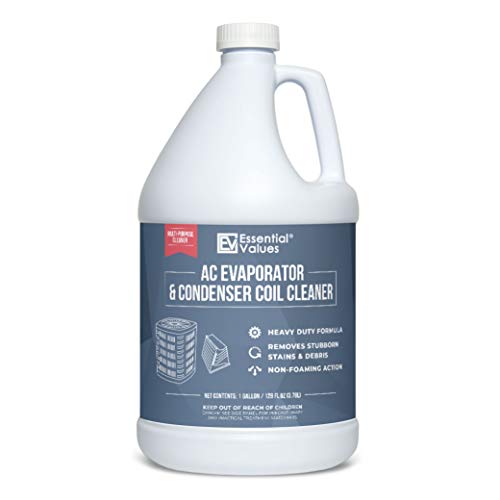
Product type: Cleaning Agent. Non-foaming formula designed for condenser coils with easy application. No dilution required, but dilution is optional for heavier soils. Best for: Commercial properties and residential buildings where a straightforward, fast-cleaning solvent is preferred. Why selected: The gallon size supports frequent maintenance cycles while offering simple use. Caution: May require rinsing for stubborn deposits in some coil configurations.
Leak Saver AC Coil Cleaner for All Condensers & Evaporators

Product type: Cleaning Agent. Features triple-action formula with detergent, degreaser, and deodorizer. Concentrated for dilution ratios from 4:1 to 10:1, with no-rinse option possible for evaporators when moisture allows. Best for: HVAC technicians serving varied systems and customers needing a flexible, all-in-one cleaner. Why selected: The adjustable dilution supports different soil levels and coil designs. Caution: No-rinse option requires attention to condensate moisture in the system.
Buying Guide: What to Consider When Choosing an AC Coil Cleaner
- Coil type and system: Evaporators often require no-rinse formulas, while condensers may tolerate rinsing. Choose accordingly.
- Foaming action: High-expansion foams are effective for deep cleaning; immediate foaming works on lighter soils but may miss hidden buildup.
- Dilution and rinse requirements: Some cleaners are ready-to-use, others require precise dilution; consider workflow and risk of residue.
- Material compatibility: Check compatibility with metals, gaskets, and polymers in your coils to avoid damage.
- Packaging and frequency: Gallon-sized containers suit ongoing maintenance; multi-pack options suit service teams.
- Odor and environmental impact: Biodegradable formulas and milder scents can improve indoor air quality post-cleaning.
- Application method: Spray, foam, or aerosol formats influence ease of use and coverage in tight spaces.
FAQ
- Q: Do these cleaners require rinsing on evaporator coils? A: Some no-rinse formulas are designed for evaporators, but always follow the product’s instructions and ensure condensate flow can rinse away debris where applicable.
- Q: Can I use a single cleaner for both evaporators and condensers? A: Yes, many cleaners are marketed for both coil types, but verify dilution, rinsing, and material compatibility for your specific system.
- Q: Which cleaner is best for heavy-duty grime? A: Foam-based and high-pressure spray formulas like Leak Saver Foam Blaster or BERlOVE typically perform better on stubborn buildup.
- Q: Is a gallon size sufficient for large commercial systems? A: For regular maintenance of multiple units, a gallon may be a starting point, but plan for additional containers based on scale and service frequency.
- Q: Are biodegradable formulas safer for indoor air quality? A: Biodegradable options often have fewer harsh residues, but always test in a small area and ensure proper ventilation during cleaning.