Answering the need for reliable rooftop air movement, these commercial roof ventilation fans excel in high-heat or smoke-heavy environments. They’re best for industrial facilities, restaurants, warehouses, and large kitchens. The top picks balance airflow capacity, durability, and weather resistance to keep spaces comfortable and maintain equipment longevity. The following five models offer strong options for different space sizes and noise tolerance.
| Product | CFM Range | Ideal For |
|---|---|---|
| VEVOR Roof Exhaust Fan | 500/900 CFM | Mid-sized shops, garages, and kitchens needing adjustable airflow |
| PeakPursuit 1400 CFM Upblast | 1400 CFM | Restaurants and light commercial spaces |
| CXRCY 1400 CFM Upblast | 1400 CFM | Factories and warehouses needing robust airflow |
| SierraSquad 2400 CFM Upblast | 2400 CFM | Large kitchens, factories, and outdoor-roof loads |
| PrecisionAuto 2400CFM Industrial | 2400 CFM | Heavy-duty commercial ventilation |
VEVOR Roof Exhaust Fan, Adjustable 500/900 CFM

The VEVOR model uses a 162W high-power motor with speeds of 500 and 900 CFM. It features a lightweight aluminum alloy housing, a deflector, and a sturdy base for corrosion resistance and long-term stability. This unit is well suited for medium-sized spaces such as a home workshop, garage, or kitchen venting where adjustable airflow improves energy efficiency.
Best for: smaller to mid-sized spaces needing flexible airflow without excess noise. Choose this if you want adjustable CFM and a compact, durable build. Be aware that higher CFM is not available in this model.
PeakPursuit 1400 CFM Upblast Roof Exhaust Fan

PeakPursuit delivers 1400 CFM with a direct-drive motor designed for consistent performance. Its weather-resistant spun aluminum housing protects against outdoor exposure, making it suitable for rooftop installations in restaurants or light industrial spaces. Noise levels are kept low to minimize disruption in work or dining areas.
Best for: commercial kitchens and small to medium warehouses requiring steady airflow with lower noise. Better for outdoor rooftops where weather resistance matters. Caution: ensure mounting matches base dimensions for proper alignment.
CXRCY 1400 CFM Upblast Roof Exhaust Fan

CXRCY pairs a 1400 CFM high-flow system with an all-copper motor running at 2700 RPM, offering strong performance with energy efficiency. The spun-aluminum housing and waterproof design enhance all-weather durability for outdoor installations in factories, warehouses, or large kitchens.
Best for: environments needing robust airflow and a durable copper motor. Choose this if you want high RPM and long-term reliability in demanding spaces. Limit: copper motors may require professional maintenance if servicing is needed.
SierraSquad 2400 CFM Upblast Roof Exhaust Fan

The SierraSquad model provides a high airflow of 2400 CFM with a direct-drive motor for consistent performance. The weather-resistant build uses spun aluminum to resist outdoor exposure, making it suitable for large kitchens, factories, and other commercial spaces demanding significant ventilation.
Best for: very large spaces or operations with intense heat or fumes. Better for rooftop installations where high CFM is a priority. Limitation: higher CFMs may require sturdier mounting and electrical considerations on the roof.
PrecisionAuto 2400CFM Industrial Upblast Roof Exhaust Fan
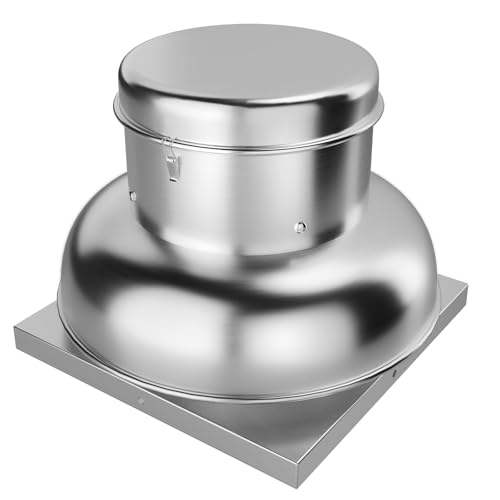
PrecisionAuto offers a 2400 CFM airflow with a high-speed direct-drive motor. It emphasizes durable, weather-resistant stainless steel construction designed for restaurant kitchens, warehouses, and workshops, delivering strong ventilation while aiming to minimize maintenance needs.
Best for: heavy-use commercial ventilation with focus on durability and quiet operation. Choose this if you need robust stainless steel construction. Limitation: higher energy use at peak CFM compared to smaller models.
Buying Guide: How to Choose Commercial Roof Ventilation Fans
What airflow do you actually need? Start by calculating the volume of the space (length × width × height) and consider acceptable air changes per hour. For kitchens, warehouses, or factories, higher CFMs help remove heat, smoke, and fumes more quickly.
Motor type and drive: Direct-drive motors reduce moving parts and maintenance, but verify electrical compatibility and mounting. In loud environments, prioritize models with quieter operation specifications.
Durability and weather resistance: Look for spun aluminum housings, stainless steel components, and waterproof seals for outdoor rooftop use. Consider corrosion resistance for coastal or humid climates.
Size and mounting compatibility: Base diameter and mounting footprint should fit the existing roof opening. Heavier units may require reinforced mounting and professional installation.
Noise considerations: If ventilation occurs near work or dining areas, choose fans advertised as low-noise or with vibration-reduction features.
Maintenance and service: All-metal construction with exposed components may require periodic cleaning or belt/impeller checks. Check local availability of spare parts and service support.
Frequently Asked Questions
- How many CFM do I need for a large kitchen? A large kitchen typically requires 2000–4000 CFM, depending on space size and hood configurations. Higher airflow improves heat and smoke removal, but installation must handle the load.
- Are upblast roof exhaust fans weatherproof? Many models feature weather-resistant housings and waterproof seals, but verify IP ratings and mounting clarity for your climate and rooftop exposure.
- Is a copper motor better than aluminum? Copper motors can offer durability and efficiency, but cost and maintenance vary. Both materials are used in weather-rated designs; choose based on application and serviceability.
- Can I install these on any roof? Roof mounting requires appropriate opening size, structural support, and electrical compliance. A professional roofer or HVAC technician should verify compatibility.
- Do these units run quietly? Some models emphasize low-noise operation, but high CFMs typically produce more sound. Look for models with noise-reduction features if quiet operation is essential.
- What maintenance is typical? Regular inspection of motors, bearings, mounts, and seals; cleaning airflow pathways; and confirming electrical connections helps ensure long-term performance.