Direct answer: For most homes, a compact automatic condensate pump with a reliable float switch is ideal, while hand-operated pumps work well for maintenance tasks or emergency clears. This guide highlights five top options suited for different needs, from automatic operation to simple drain line cleaning. It also notes who each product is best for and any practical limitations to consider. The following table provides quick comparisons of the selected products.
| Product | |||
|---|---|---|---|
| RectorSeal Mighty Pump 97795 | Best for hand-operated cleaning and maintenance | High volume, low pressure | |
| Aquastrong 115V 70GPH | Best for automatic drainage in many HVAC setups | Up to 16 ft lift; 70 GPH | |
| Aquastrong Mini Split 9.6 GPH | Best for quiet, compact installations | Up to 33 ft head; 9.6 GPH | |
| Gulfmew 3/4″ Condensate Trap | Best for backflow prevention in drain lines | Standard condensate trap with water seal | |
| Moonshan Mini Condensate Pump | Best for 100–240V, wall-mounted setups | Up to 38 ft head; 10+ GPH |
RectorSeal Mighty Pump 97795

The RectorSeal Mighty Pump uses heavy-duty PVC and is hand-operated. It’s designed to clear slime, mold, and dirt from primary and secondary condensate drain lines without electricity. Best for users who prefer a simple, portable drain line cleaner for routine maintenance. It is lightweight yet durable and can also handle standing water in overflow pans and heater pans. A potential limitation is that it requires manual pumping, which may be less convenient for frequent, high-volume use.
Aquastrong 115V 70GPH Condensate Pump

Best for automatic drainage in a variety of HVAC appliances, this pump handles up to 70 GPH with a vertical lift up to 16 feet. It features a float switch for automatic operation, a 3.3-foot power cord, and a thermoplastic housing that resists abrasion and corrosion. It supports multiple devices with five 1″ inlet ports and a 2/5″ O.D. barbed outlet. Use this when you want a compact, easy-to-install pump that runs quietly in the background. Limitation: some installations may require additional tubing adapters to fit different systems.
Aquastrong Mini Split HVAC Condensate Pump
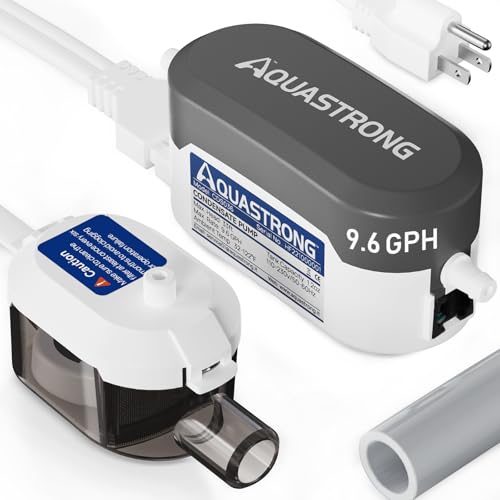
This mini-split oriented pump is rated at 9.6 GPH with a 33-foot lift. It operates quietly thanks to an efficient motor and has a hall switch for auto operation. It’s compact and designed for easy installation in line-set covers or above ceilings. The five 1″ inlet ports allow you to run multiple lines, and it includes a removable reservoir for maintenance. Choose this when space is at a premium and noise must be minimized. Limitation: lower flow makes it less suitable for high-volume condensate scenarios.
Gulfmew 3/4 Inch Condensate Trap

The Gulfmew condensate trap uses a transparent U-shaped PVC design that stops backflow and reduces the risk of dirty air re-entering indoor spaces. It’s best for users who want visible, straightforward backflow prevention and easy inspection. It helps ensure smooth drainage in various HVAC configurations. A limitation is that it is a trap accessory rather than a full pump, so it won’t actively move condensate without an accompanying pump.
Moonshan Mini Condensate Pump

The Moonshan pump covers 100–240V with automatic operation and a dual sensing system. It provides up to 38 feet of head and 10+ GPH of flow, along with a 16-foot tube. It is suitable for wall-mounted installations and offers a built-in alarm for overflow detection. Best for more demanding setups that require a higher vertical lift and integrated alarm. Caution: ensure vertical mounting and adequate clearance for maintenance access.
Buying Guide
What should you consider when choosing a condensation pump drain line?
- Application type: Automatic pumps are best for continuous drainage, while hand-operated options suit occasional maintenance tasks.
- Lift and flow: Match the vertical lift and flow rate to your system’s condensate output and installation height.
- Power and installation: Consider voltage compatibility (115V vs 230V), cord length, and space for mounting or placement.
- Inlet/outlet compatibility: Check tubing sizes and the number of inlet ports to connect multiple devices if needed.
- Reliability and maintenance: Look for float switches, alarms, and removable reservoirs to simplify upkeep.
- Backflow prevention: Traps or traps with clear inspection windows help maintain clean drain lines and indoor air quality.
Common Scenarios And Recommendations
- Small apartments or single-unit systems: Choose Aquastrong 70GPH for automatic drainage with straightforward installation.
- Quiet, space-limited installations: Opt for the Aquastrong Mini Split or Moonshan pump for low noise and compact design.
- Maintenance and line cleaning: Use RectorSeal Mighty Pump for hand-operated clearing of slime and blockages.
- Drain line backflow prevention: Gulfmew trap helps stop dirty air from re-entering indoor spaces.
Frequently Asked Questions
- What is the difference between a condensate pump and a condensate trap?
Answer: A condensate pump actively moves water, often with an automatic float switch. A condensate trap slows or blocks backflow and helps prevent air from carrying condensate back into the space. - Do I need an automatic switch on every pump?
Answer: Not necessarily, but an automatic float switch reduces the risk of overflow and is recommended for most installations. - Can I use a condensate pump for multiple devices?
Answer: Some pumps feature multiple inlet ports allowing parallel connections; verify compatibility before wiring. - Is it safe to mount a condensate pump on a wall?
Answer: Yes, many models are designed for wall mounting; ensure a flat, stable surface and access for maintenance. - What maintenance is required for condensate pumps?
Answer: Regularly clean reservoirs, floats, and filters every six months or as recommended by the manufacturer. - Which pump is best for a high-rise installation?
Answer: Pumps with higher head lift, such as those offering up to 38 feet, are better suited for taller buildings.