Looking for an office-friendly fan or exhaust option to improve air circulation and comfort? This guide highlights five top picks that balance quiet operation, effective airflow, and straightforward setup for small to medium office spaces. Best for desks, shared work areas, or rooms without centralized HVAC, these picks optimize airflow without becoming noisy distractions. The featured products cover desktop circulators, twin-window options, and ducted exhaust fans for more comprehensive ventilation.
| Product | Best For | Why It Stands Out |
|---|---|---|
| Honeywell TurboForce HT900 | Personal desk or small office | Quiet, 3 speeds, 90° pivot for targeted cooling |
| Comfort Zone CZ319WT Twin Window Fan | Rooms with windows needing intake/exhaust | Dual speed, reversible airflow, secure auto-locking expanders |
| Amico 12″ Smart Shutter Exhaust | Small to medium spaces needing controlled exhaust | 1282 CFM, thermostat control, energy-efficient DC motor |
| VIVOHOME AutoFlow 10.2″ Bath Exhaust | Bathrooms or humid spaces in office | Humidity-sensing auto-ventilation, remote, energy-saving EC motor |
| Broan-NuTone 50 CFM Exhaust | Compact restrooms or utility areas | Energy Star, low noise, easy no-cut installation |
Honeywell TurboForce Air Circulator HT900

Features include a small footprint suitable for desks or tabletops and a 90° pivoting head for directed airflow. The unit claims quieter operation relative to similar compact fans, with three speeds to tailor comfort in a personal workspace. Best for individuals who need localized cooling without disturbing nearby coworkers. Limitation: designed for personal cooling rather than whole-room air exchange, so it’s less effective for improving overall ventilation in larger offices.
Comfort Zone Twin Window Fan CZ319WT

This unit offers dual-speed airflow and a reversible function that lets you choose intake or exhaust to improve overall room air movement. Auto-locking expanders simplify window mounting, and the included design accommodates windows 22-1/4″ to 33″. Best for offices with direct window access seeking a cost-effective, flexible airflow solution. Caution: window fans can introduce outdoor noise when operating at higher speeds and may require window clearance for best seal.
Amico 12″ Smart Shutter Exhaust Fan

Delivering up to 1282 CFM, this wall-mounted unit is designed for larger spaces such as garages or workshops adjacent to an office area. A smart thermostat and 8-speed control offer precise airflow management, while a brushless DC motor provides energy efficiency and quieter operation. Best for offices with higher heat loads or adjacent workspaces needing robust exhaust. Limitation: installation requires adequate wall space and electrical connections for the thermostat and motor control.
VIVOHOME AutoFlow Bathroom Exhaust Fan with Humidity Sensor
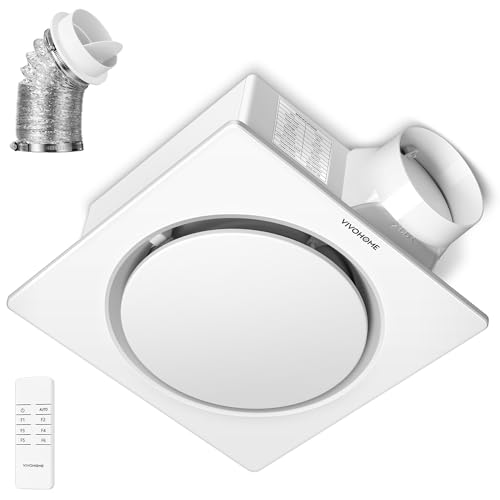
Equipped with a humidity-based auto-ventilation system, this unit provides 110 CFM at 12.5W, making it energy-efficient for restrooms or damp office spaces. The included remote adds convenience for adjusting three speed modes, and the self-adjusting airflow helps maintain consistent ventilation even with duct changes. Best for offices with hydration or steam concerns, such as kitchens or breakout rooms. Caution: not ideal as a primary climate-control device for large open-plan offices.
Broan-NuTone Bathroom Exhaust Fan 50 CFM

With 50 CFM and Energy Star certification, this compact exhaust option is suitable for smaller bathrooms or utility spaces in office settings. It features easy installation with no attic access required and operates at a low noise level suitable for quiet office environments. Best for restrooms or small break areas. Limitation: lower airflow capacity means it won’t handle larger or heavily used spaces as efficiently as higher-CFM models.
Buying Guide
What should you consider when choosing an office exhaust fan?
- Space size and purpose: For personal cooling, a desk fan like the Honeywell HT900 may suffice. For whole-room ventilation or window access, twin-window or wall-mounted exhaust options are better suited.
- Airflow vs. noise: Higher CFM fans remove heat and moisture faster but can be louder. Look for models with speed controls or energy-efficient motors to balance performance and quiet operation.
- Installation and space: Window fans require window clearance, while wall-mounted exhausts need wall space and electrical access. Consider whether you can install without major remodeling.
- Humidity and temperature control: Thermostats and humidity sensors help maintain comfortable conditions in damp or hot spaces. Smart controls reduce manual adjustments.
- Energy efficiency: Brushless DC motors and Energy Star-rated units save power over time, especially in offices with constant ventilation needs.
FAQ
- What size exhaust fan is best for a small office?
Answer: For spaces up to 100-150 square feet, a 50-150 CFM fan (or a compact desk fan) is typically sufficient, depending on heat and humidity levels. - Is a window fan better than a wall-mounted exhaust for offices?
Answer: Window fans are effective when you want both intake and exhaust without ducting. Wall-mounted exhausts can provide higher, targeted airflow in larger or more humid spaces. - Do energy-efficient motors reduce long-term costs?
Answer: Yes; brushless DC motors use less power and generate less heat, lowering operating costs over time. - Can I install these fans myself?
Answer: Many options feature straightforward installation, but some require electrical wiring or wall access. Follow manufacturer instructions or hire a licensed professional if unsure. - Will these fans reduce odors in an office?
Answer: Exhaust fans in bathrooms or break areas can help vent odors, while general desk fans improve air movement but don’t remove odors as effectively as dedicated exhausts. - Are these fans suitable for noise-sensitive spaces?
Answer: Look for models advertising low decibel levels or those with DC motors and multiple speed options to minimize disturbance.