For guarded, productive indoor gardening, choosing the right grow room exhaust fan is essential. This guide highlights five top options that balance airflow, energy efficiency, and quiet operation. The best pick depends on space, budget, and how smart you want your ventilation to be. Each product note explains who benefits most and the trade-offs to expect.
| Product | Best For | Airflow (CFM) | Key Benefit |
|---|---|---|---|
| VIVOSUN 4″ Inline Exhaust Fan | Small grow tents or tight spaces | 130 | Low-noise, energy-efficient operation |
| VIVOSUN 6″ Inline Exhaust Fan | Medium grow rooms | 345 | Stronger airflow with quiet performance |
| AC Infinity CLOUDLINE PRO T6 | Smart, automated climate control | — | Temperature/humidity programming and WiFi app control |
| AC Infinity CLOUDLINE A6 | Budget-conscious, scalable control | — | Established CLOUDLINE quality with wired controller |
| VEVOR Inline Duct Fan 6-Inch | Rugged, versatile bigger spaces | 400 | High airflow with low noise and energy efficiency |
Note: All selections are suitable for grow tents, hydroponics rooms, and hydroponic setups, with varying emphasis on smart features, noise levels, and airflow capacity. The table above summarizes how each option aligns with typical buyer needs.
VIVOSUN 4″ Inline Exhaust Fan — 130 CFM

- Powerful Airflow: Delivers up to 130 CFM, efficiently removing exhaust and improving ventilation in small grow spaces.
- High Efficiency: Upgraded EC motor promises strong performance with lower energy use and reduced maintenance costs.
- Quiet Operation: Only about 26 dB(A), suitable for bedrooms or living areas adjacent to the grow space.
Best for: Small grow tents or compact rooms where you need reliable airflow without significant noise. Limitations: May be underpowered for larger tents or spaces with long duct runs.
VIVOSUN 6″ Inline Exhaust Fan — 345 CFM

- Powerful Airflow: Up to 345 CFM, ideal for larger grow tents or rooms requiring robust exhaust.
- High Efficiency: EC motor delivers strong performance with lower energy costs and longer service life.
- Quiet Operation: Generally around 32 dB(A), balancing noise with higher airflow.
Best for: Medium to larger grow spaces needing more aggressive ventilation. Limitations: Higher airflow may come with slightly more noise than smaller models.
AC Infinity CLOUDLINE PRO T6
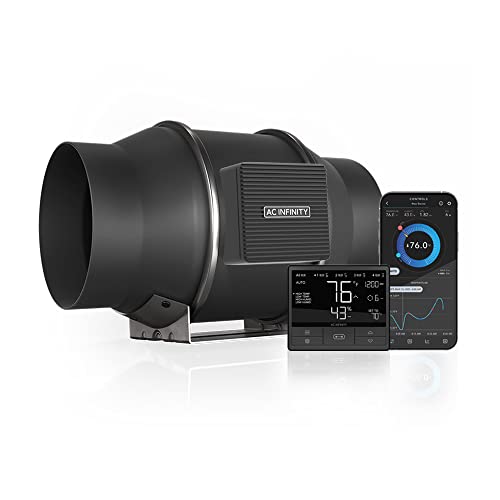
- Smart Ventilation: Dynamic temperature and humidity programming, timers, grow cycles, and scheduling.
- WiFi App Control: Remotely connect to the app to access climate data and set automation.
- Versatile Use: Designed to ventilate grow rooms, transfer heating/cooling, and exhaust odors.
Best for: Grow rooms needing automated climate control and remote monitoring. Limitations: Higher initial setup complexity and cost compared to basic models.
AC Infinity CLOUDLINE A6

- Quiet, Reliable Ventilation: Built with EC motor and a value package that mirrors CLOUDLINE quality.
- Includes Wired 10-Speed Controller: Practical control for consistent airflow tuned to the space.
- Compatibility: Works well with CLOUDLINE smart controllers for future upgrades.
Best for: Budget-conscious buyers who still want proven CLOUDLINE quality and controllability. Limitations: Lacks built-in WiFi; control relies on wired options unless paired with other devices.
VEVOR Inline Duct Fan 6-Inch — 400 CFM

- High Airflow: 400 CFM, suitable for larger areas or spaces requiring vigorous ventilation and dehumidification.
- Low Noise: Designed for quiet operation around 34 dB, making it workable in shared spaces.
- Energy Efficiency: AC motor optimized to balance power with energy use and service life.
Best for: Expansive grow rooms or spaces with challenging environmental control. Limitations: Higher airflow may require more robust ducting to minimize losses.
Buying Guide
Choosing the right grow room exhaust fan depends on space size, desired level of automation, noise tolerance, and energy considerations. Below are key purchase considerations to help refine your choice.
- Airflow needs: Measure your grow tent or room volume and plan for at least 1–2 exchanges per minute. Higher CFM is often better for larger spaces, but must be balanced with noise and duct length.
- Noise level: If the space shares a wall with living areas, prioritize models with lower dB ratings or soft-start features to reduce sound.
- Motor type and efficiency: EC motors offer efficient performance and longer life. PWM control helps fine-tune speed and energy use.
- Smart features: WiFi connectivity and app control enable automation, climate scheduling, and remote adjustments. Wired controllers are reliable and simple.
- Duct compatibility: Match the fan size (4″, 6″, etc.) to your ducting. Longer duct runs or many bends can reduce effective airflow, so consider slightly higher CFM models if routing is complex.
- Maintenance: Look for fans with accessible filters (carbon filters) and components that are easy to clean or replace to extend life.
Frequently Asked Questions
- What size fan do I need for a grow tent?
Evaluate tent volume in cubic feet and aim for at least 1–2 air exchanges per minute, selecting a fan with adequate CFM for the space and duct length. - Are smart fans worth it for grow rooms?
Smart fans offer automation and remote control, which can improve climate stability and reduce manual adjustments, especially in larger or multi-tent setups. - Is a higher CFM always better?
More CFM provides stronger ventilation, but can increase noise and energy use. Choose CFM appropriate to space and pair with proper ducting to minimize losses. - Should I choose EC motors over AC motors?
EC motors are generally more energy-efficient and offer smoother speed control, which is beneficial for long-term operation and precise climate control. - What is the benefit of a controller like the CLOUDLINE PRO T6?
It enables dynamic environmental programming, timers, and remote automation, useful for maintaining stable humidity and temperature in hydroponic systems. - Can I mix brands for a grow room ventilation setup?
Yes, but ensure compatibility in duct size, static pressure, and control interfaces so the system operates predictably and efficiently.