Finding a reliable HVAC gas leak detector starts with choosing a tool that matches your environment and leak risk. This guide highlights five top options ideal for homeowners, RV enthusiasts, DIYers, and professionals alike. Each product is evaluated for sensitivity, ease of use, and suited scenarios—from tight spaces to large residential systems. The following table summarizes the selected units and their best-use cases.
| Product | Best For | Key Feature |
|---|---|---|
| TOPTES PT520A Natural Gas Detector | Hard-to-reach areas and tight spaces | 17-inch gooseneck probe for precise localization |
| TOPTES PT199 Natural Gas Leak Detector | Portable quick scans around home appliances | Fast 0.5-second alarm with LCD red indicator |
| TopTes PT210S Gas Leak Detector | Probing with a compact, pen-style design | 4-inch probe; Percent LEL readout |
| Klein Tools ET120 Gas Leak Detector | Versatile testing with broad ppm range | Wide range 50–10,000 ppm; adjustable sensitivity |
| Elitech ILD-100H HVAC Refrigerant Leak Detector | Halogen refrigerants and R22/R410A systems | Heated diode sensor with TFT screen |
TOPTES PT520A Natural Gas Detector

The PT520A is designed to detect methane, propane, natural gas, LPG, and butane, with a 17-inch gooseneck that helps locate leaks in tight spaces such as basements, gas fireplaces, or storage tanks. Best for professional-style pinpointing or DIY use in hard-to-reach areas. The device responds in 0.5 seconds and provides a visual 7-bar LED display along with a 75 dB audible alarm that intensifies with gas concentration. Detection range spans from 50 to 10,000 ppm for methane. A caution: accuracy may vary in extremely dusty environments; keep the probe clean for best results.
Best for: Users who need long reach and precise source localization in tight spaces. Why selected: the extended probe length reduces the need for disassembly and helps quickly identify leak sources.
TOPTES PT199 Natural Gas Leak Detector
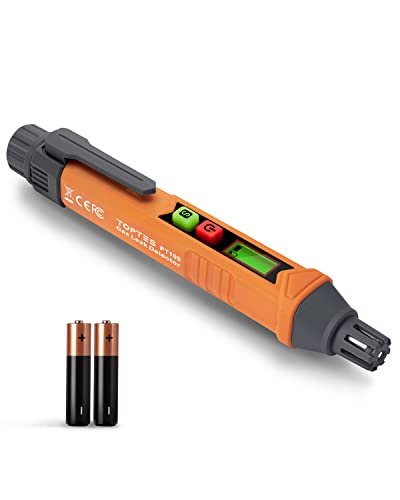
The PT199 is a portable gas leak detector focused on quick identification of combustible sources like methane, propane, and butane. It features a fast 0.5-second alarm and an LCD screen that turns red at higher gas levels. It includes two AAA batteries and a 30-second warm-up, with auto power-off after five minutes of inactivity. Caution: battery life may limit extended field use; consider carrying spare batteries for longer inspections.
Best for: Home inspections and quick checks around appliances. Why selected: compact, easy-to-use, and ready-to-scan with audible-visual alerts that help locate leaks fast.
TopTes PT210S Gas Leak Detector

The PT210S employs a four-inch probe in a portable pen-like form to detect multiple gases, reporting in Percent LEL. It supports quick confirmation within 0.5 seconds and shows a red screen with rising bar graphs as leaks intensify. It covers a detection range of 100 ppm to 5,000 ppm (1% LEL to 10% LEL). Best for: professionals who need a compact tool with clear LEL readings. Why selected: the Percent LEL readout provides a direct assessment of leak severity, aiding risk assessment and decision-making.
RectorSeal Better Bubble Advanced Leak Detector

Better Bubble is a spray leak locator designed to detect refrigerant gas, air, and oxygen leaks. It operates across varied surface temperatures from 20°F to 250°F and can be used on pipes, tanks, and condensers. It pinpoints leaks quickly and is easy to apply. Best for: HVAC technicians and homeowners testing refrigerant lines in varied conditions. Why selected: its versatility across refrigerants and air leaks makes it a strong complementary tool to electronic detectors.
Klein Tools ET120 Gas Leak Detector

The ET120 covers a wide detection range from approximately 50 to 10,000 ppm and offers adjustable sensitivity with High and Low modes. It features five red LEDs and 85 dB audible alerts that intensify as gas concentration rises. Best for: professionals needing adjustable sensitivity for different leak scenarios. Why selected: the wide range and tunable sensitivity provide flexibility for diverse jobs, from small leaks to larger system checks. Caution: ensure the device is properly calibrated to avoid false readings in highly variable environments.
Elitech ILD-100H HVAC Refrigerant Leak Detector

The ILD-100H uses a heated diode sensor and a TFT screen to display readings for refrigerants like R22, R410A, R134A, R1234YF, and other CFCs/HFCs. It offers higher sensitivity with adjustable High/Medium/Low levels and a maximum sensitivity around 0.1 oz/year. Best for: technicians working with refrigerant lines and wanting a visual TFT interface. Why selected: the heated diode sensor improves accuracy for halogenated refrigerants and the TFT display makes readings easier to interpret at a glance. Caution: higher complexity may require some training for optimal use.
Buying Guide
What should I consider when buying an HVAC gas leak detector?
Think about the environments you’ll inspect. For tight, hard-to-reach spaces, a detector with a long probe or gooseneck, like the TOPTES PT520A, helps locate leaks without disassembly.
How important is sensitivity and readout format?
Devices with Percent LEL readings (like the PT210S) provide a direct sense of leakage severity, while model-specific alarms (visual and audible) help you respond quickly. Adjustable sensitivity can reduce false alarms in busy work areas, as seen in the Klein ET120.
Should I prioritize portability or extended probing reach?
Portability favors quick checks around appliances or RV systems (PT199, PT177). For larger installations or vents and pipelines, a longer reach or a pen-style design (PT210S) balances mobility with precision.
Are refrigerant leak detectors necessary alongside combustible gas detectors?
Yes, especially for HVAC techs. Refrigerant detectors like the Elitich ILD-100H and RectorSeal Better Bubble complement combustible gas detectors by covering a broader leak spectrum across cooling systems and fire hazards.
What about battery life and power options?
Detectors often include batteries (e.g., PT199 includes 2x AAA). For frequent field use, prefer rechargeable units or models with long battery life to minimize downtime.
FAQ
- What is a common detection range for home gas leaks?
Most devices detect in the range of 50 to 10,000 ppm for methane or similar combustibles, with higher readings indicating greater leak risk.
- Do these detectors require calibration?
Some models require auto-calibration or a warm-up period; follow the manufacturer’s instructions to ensure accuracy (e.g., PT177 recommends a 30-second warm-up).
- Can I use a refrigerant leak detector for natural gas leaks?
Refrigerant-specific detectors focus on halogenated compounds; for natural gas or propane leaks, use a dedicated combustible gas detector or a detector with a broad hydrocarbon range.
- What is the advantage of a long probe?
A longer probe lets you detect leaks from a safe distance and reach behind appliances or into ducts without disassembly, reducing exposure risk.
- What should I test first in an apartment with a suspected gas leak?
Test around appliances, gas meters, and lines near basements or storage rooms. Use both visual and audible alarms to confirm suspected areas quickly.