Choosing the right inline duct blower helps you move air quickly without creating excessive noise. This guide highlights five high‑performing options ideal for grow rooms, bathrooms, kitchens, basements, and HVAC boosting. The picks balance energy efficiency, low noise, and simple installation. Best for compact spaces, budget-minded setups, or professional-grade ventilation, these models help you tailor airflow to your needs while keeping energy use in check. The following sections compare strength, noise, and suitability to make shopping easier.
Comparison Snapshot
| Product | Airflow | Motor Type | Best For | Notes |
|---|---|---|---|---|
| AC Infinity CLOUDLINE S8 PRO | Up to 80 CFM (typical use varies by setup) | EC motor | Grow tents, hydroponics, quiet spaces | 10-speed controller; energy efficient |
| Hon&Guan 6 Inch Inline Booster | 345 CFM | DC motor | Large rooms, bathrooms, kitchens | Low power, quiet operation |
| VEVOR Inline Duct Fan 6-Inch | 400 CFM | AC motor | Broader space exhausts, basements | Low noise, energy saver |
| VIVOSUN D4 4 Inch Inline Duct | 195 CFM | AC motor | Grow tents, attics, small spaces | Low noise, safety features |
| VIVOSUN M4 4-Inch Inline Duct Fan | 195 CFM | EC motor | Advanced control, hydroponics | PWM speed control, ETL listed |
AC Infinity CLOUDLINE S8 PRO, 8” Inline Duct Fan

The AC Infinity CLOUDLINE S8 PRO uses a PWM-controlled EC motor for quiet, energy-efficient performance. The 10-speed controller allows precise airflow management, making it suitable for hydroponic grow rooms, exhausted rooms, or cooling needs in equipment closets. Best for buyers who want tunable, low-noise operation with scalable control options. Limitation: performance depends on ducting and intake/output setup; no one-size-fits-all airflow guarantee.
Hon&Guan 6 Inch Inline Booster Duct Fan

Best for larger spaces requiring robust airflow with modest energy use. This 6″ inline booster delivers up to 345 CFM and operates at low power (19.2 W). It uses a durable plastic build and is designed for quick installation. Choose this if you need strong exhaust in basements, bathrooms, or grow rooms without a high energy bill. Caution: duct length and restrictions can affect actual airflow; verify compatibility with your system.
VEVOR Inline Duct Fan, 6-Inch

Best for larger rooms or tents needing a broad exhaust capacity. The 6-inch VEVOR model provides up to 400 CFM with a quiet operation and energy-conscious performance. It suits workshops, kitchens, and hydroponics setups that require strong, consistent airflow. Limitation: higher airflow may require more powerful controls or safety considerations to avoid excessive negative pressure in sensitive spaces.
VIVOSUN D4 4 Inch Inline Duct Fan
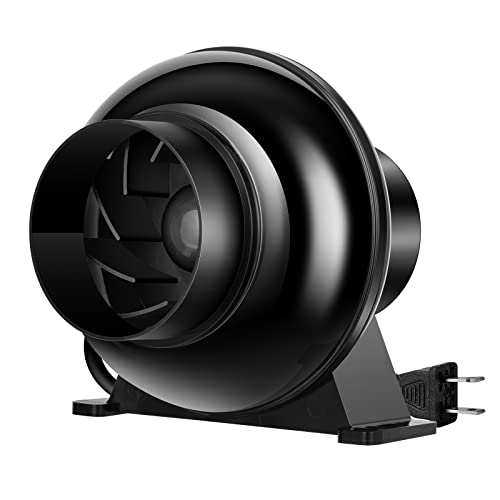
Best for compact grow tents and smaller spaces where quiet operation matters. The D4 delivers about 195 CFM with a flow-deflector design that reduces turbulence and noise to around 30 dB. It includes safety features and a flame-retardant junction box for added protection. Choose this if you need strong, steady ventilation without high noise levels. Limitation: performance is sensitive to duct length and impedance; ensure compatible ducting.
VIVOSUN M4 4-Inch Inline Duct Fan with EC Motor

Best for precise control and energy efficiency in hydroponic or HVAC tasks. The M4 uses an EC motor with PWM speed control, delivering 195 CFM at low noise (about 28 dB). It includes safety features like automatic reset and a flame-retardant junction box, making it suitable for sensitive installations. Choose this if you need adjustable speeds with reliable safety. Limitation: price can be higher than basic AC-motor models.
Buying Guide
What airflow do you actually need?
Airflow requirements depend on duct length, bends, and the space you’re ventilating. Higher CFM moves more air but may require more powerful mounts or controllers. For grow tents or bathrooms, aim for models in the 150–400 CFM range depending on size and exposure.
EC motor vs AC motor: what’s the difference?
EC motors offer better energy efficiency and precise speed control, often with integrated electronics. They typically run cooler and quieter than standard AC motors. If you value quiet operation and long-term energy savings, prioritize EC motor options.
How important is noise level?
Noise is a key factor in living or working spaces. Look for models listing decibel levels around 25–34 dB for quiet operation. Consider using vibration dampening and insulated ducting to further reduce sound.
What about installation and compatibility?
Check mounting options (inline vs wall-mount), connector sizes (commonly 4″ or 6″), and whether the unit suits your ducting length and bends. Some units include mounting feet or quick-release blades for easier maintenance.
Safety and durability considerations
ETL listings, flame-retardant junction boxes, and automatic reset features help prevent overheat risks. Durable housings and corrosion-resistant materials extend life in humid environments like bathrooms and grow tents.
What’s a practical buying approach?
Start with a target space and required airflow. Then compare motor types, noise, and controller options. If you need adjustable airflow with precise control, favor EC motors and multiple-speed controllers. For straightforward installations, a robust AC-motor unit with simple controls may suffice.
Summary of key buyer factors
- Airflow capacity (CFM) relative to space size
- Motor type and energy efficiency
- Noise level and mounting options
- Control features and compatibility with existing controllers
- Safety features and build durability
FAQ
- What is a typical CFM I should look for in a grow tent?
- Are EC motors worth the extra cost?
- Can I use any inline fan with existing ducting?
- How important is a speed controller?
- What safety features should I look for?
- Is vibration a concern with inline fans?
In grow tents, 150–300 CFM is common for small to mid-size tents, while larger setups may need 400 CFM or more depending on duct length and filtration.
Yes for applications prioritizing energy efficiency, precise speed control, and quieter operation over time.
Most are designed to fit standard 4″ or 6″ ducting, but always verify the connector size and length requirements for your system.
Speed control helps customize airflow, reduce noise, and save energy. It’s especially useful in environments needing variable ventilation.
Automatic reset protection, flame-retardant junction boxes, and ETL or equivalent listings indicate safer, more durable units.
Yes. Use anti-vibration mounts and properly secured ductwork to minimize noise and wear.