Answering the need for reliable off-grid cooling, these portable and windowless AC options are designed for tents, RVs, small cabins, and campers. Best for off-grid travelers and emergency setups, these units prioritize low power use, quiet operation, and self-contained cooling. The following picks are selected for portability, energy efficiency, and suitability in dry or remote environments.
| Product | Brand | Type | Best For |
|---|---|---|---|
| Xenjum 12V RV Air Conditioner | Xenjum | 12V DC, off-grid RV AC | Off-grid RVs, boondocking enthusiasts |
| FLOWBREEZE Windowless Portable Air Cooler | FLOWBREEZE | Windowless evaporative cooler | Hot, dry climates, indoor/outdoor use |
| CENSTECH Windowless Portable AC | CENSTECH | Windowless evaporative cooler | Bedrooms, small spaces, dry environments |
| DgtlMstr 3500 BTU Portable Camping AC | DgtlMstr | Portable camping AC, 4-in-1 | Tents, RVs, small cabins |
| Caulitar Portable Camping AC | Caulitar | 4-in-1 portable camping AC | Outdoor-minded campers, road trips |
Xenjum 12V RV Air Conditioner

Best for off-grid RV setups, this 11,000 BTU unit operates on 12V DC power. Features include a soft-start to minimize battery surge, allowing for up to 10 hours of cooling on a typical high-capacity battery. It emphasizes quiet operation (35 dB) and higher energy efficiency due to an inverter-style design. This selection suits travelers who rely on battery banks or solar and want rapid cooling in a compact form. A limitation is the off-grid compatibility depends on battery capacity and solar charging capabilities.
FLOWBREEZE Windowless Portable Air Cooler
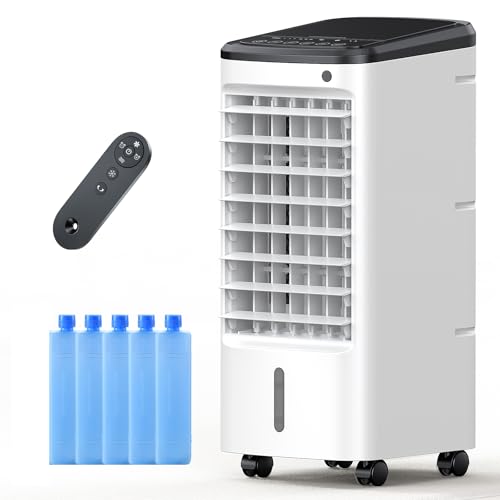
Best for dry indoor-outdoor spaces, this windowless evaporative cooler delivers rapid relief with a water-based cooling method and optional ice packs to boost chill. It combines a 3-in-1 function (cooling, humidifying, fan) with a long runtime of up to 12 hours on timer modes. It’s well suited for wire-free setups or places with limited access to conventional AC. A potential limitation is that evaporative cooling is most effective in low-humidity environments.
CENSTECH Windowless Portable AC

Best for bedrooms and compact spaces, this windowless evaporative cooler offers 3 speeds and 3 modes (Normal, Humidifying, Cooling). It employs a 2026 copper-motor upgrade for improved airflow, with a fast, strong cooling stream. Designed for easy setup and no hoses, it’s a practical pick for renters or campers who need flexible placement. A caveat is that performance depends on ambient humidity and airflow availability.
DgtlMstr 3500 BTU Portable Camping AC

Best for tents, RVs, and small spaces, this 3500 BTU unit provides rapid cooling in compact environments. It functions as a 4-in-1 system, combining air conditioning, dehumidifying, and fan modes with a sleep setting. It’s relevant for off-grid campsites where space and power management matter. A limitation is its smaller cooling capacity, making it ideal for tight spaces rather than larger rooms.
Caulitar Portable Camping AC

Best for outdoor-minded campers on the go, this 5200 BTU unit is a 4-in-1 system with a carrying handle for easy transport. It targets tents, RVs, and small cabins where a robust yet portable cooling option is needed. Choose this if you prioritize mobility and a balance of cooling power and energy efficiency. A caution is that outdoor use can expose the unit to dust and weather conditions; additional protection may be beneficial in harsh environments.
Buying Guide: Key Considerations For Off-Grid Cooling
- Power Source And Battery Dependency: Evaluate whether the unit runs on 12V, inverter-assisted AC, or requires standard power. Consider your battery bank and solar capacity when choosing off-grid capable models.
- Cooling Capacity vs. Space: BTU and cooling coverage should match the space you intend to cool. Small tents and campers do well with 1500–5000 BTU equivalents; larger cabins may require higher capacity or proximity to the unit.
- Humidity And Climate: Evaporative coolers work best in dry climates. If humidity is moderate to high, an alternative cooling method or a different model may be more effective.
- Portability and Durability: For road trips, weight, handles, and rugged construction influence how easily you can move and deploy the unit at campsites.
- Installation Flexibility: Windowless models reduce installation needs but rely on airflow paths and space for optimal cooling. Consider your intended camping or RV layout.
- Noise Levels: Sleep-friendly and work-friendly environments benefit from quieter operation. Look at dB ratings and fan modes to minimize disruption.
- Maintenance: Self-evaporating systems reduce manual draining but still require occasional cleaning of fans and pads to sustain performance.
Quick FAQ
- Q: Do off-grid AC units work without electricity?
- A: Some units run on 12V DC or rely on battery banks and solar, but most still need some power source. Check the product’s power specifications and your renewable setup.
- Q: Are evaporative coolers effective in humid climates?
- A: Evaporative coolers are less effective in high humidity; they work best in dry environments.
- Q: Can these units cool multiple rooms?
- A: Most portable or windowless units are designed for single rooms or small spaces; multi-room cooling typically requires separate units or a centralized system.
- Q: What maintenance is required for off-grid cooling?
- A: Regular cleaning of filters, pads, and fans; monitor water levels or condensate systems; ensure battery and solar systems are functioning properly.
- Q: How do I determine the right BTU for my space?
- A: Calculate square footage and consider insulation, climate, and ceiling height. For off-grid setups, margin your BTU choice to ensure effective cooling without overloading power systems.