Answer: For off-grid RV living, these 5 units deliver reliable cooling (and heating where offered) powered by 12V or solar-compatible setups. They’re best for campers who rely on battery power, solar panels, or vehicle energy, rather than shore power. The top picks below balance low energy use, quiet operation, compact size, and easy installation. A quick buyer’s table follows to compare essentials at a glance.
| Product | Cooling BTU | Heating BTU | Key Benefit | Best For |
|---|---|---|---|---|
| iRooVee 12V Air Conditioner | 11,000 | 3,500 | Ultra-quiet, quick comfort, off-grid ready | Cold climates with mixed heating needs |
| Somokg 12V Air Conditioner (Cool Only) | 11,000 | — | Soft start, long battery life, low noise | Dry, calm camping in heat |
| Somokg 12V Air Conditioner With Heating | 11,000 | 4,500 | All-season comfort in compact unit | Year-round boondocking |
| Xenjum 12V Air Conditioner (With Heater) | 11,000 | 4,500 | Low energy use, quiet operation | Off-grid camping with cold nights |
| Furrion Chill Cube 18K | 18,000 | — | Higher capacity, efficient for larger or multiple spaces | RVs needing strong cooling |
iRooVee 12V Air Conditioner With Heat

11,000 BTU cooling and 3,500 BTU heating provide year-round comfort. Powered by a vehicle battery, it claims up to 8 hours of cooling with a 12V 300Ah battery and 12 hours with a 12V 480Ah battery when parked. The unit uses a high-efficiency compressor and upgraded silent components for low noise. Best for: travelers needing fast cooling in hot climates and light sleepers requiring quiet operation. Limitation: performance depends on battery capacity; extended off-grid use requires sufficient capacity.
Somokg 12V Air Conditioner (Cool Only)
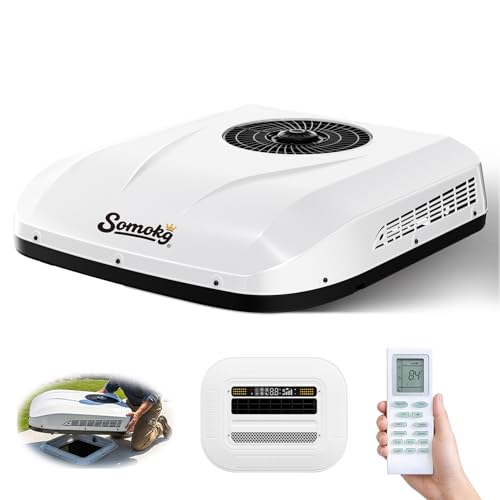
11,000 BTU cooling with a high-frequency compressor delivers rapid cooling. Features a soft-start function to reduce startup surge, enabling longer battery life and smoother operation. Best for: campers who want strong cooling while maximizing battery efficiency. Caution: the unit is listed as “cool only,” so heating capability is not included in this model.
Somokg 12V Air Conditioner With Heating

11,000 BTU cooling plus 4,500 BTU supplemental heating. The soft-start reduces startup surge, helping battery systems and solar setups. Best for: off-grid homes needing both cooling and heating without a generator. Limitation: heating output is supplemental rather than full-house, so extremely cold nights may require backup heating sources.
Xenjum 12V RV Air Conditioner (With Heater)
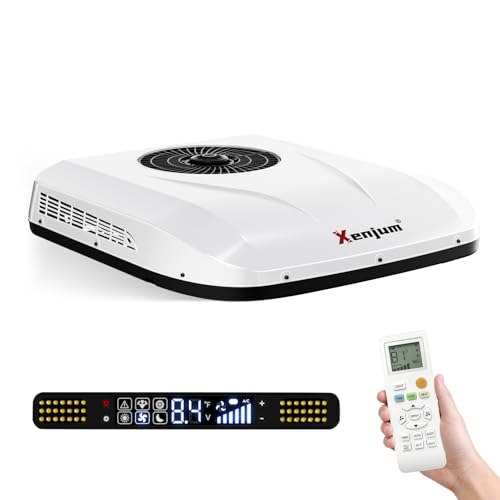
11,000 BTU cooling and 4,500 BTU heating with a soft-start design to minimize battery drain. Stated as ultra-low energy use with a quiet operation (about 35 dB). Best for: boondockers who want reliable climate control and long battery life. Caution: product notes emphasize compatibility with solar and battery setups; ensure your system can support peak startup currents.
Furrion Chill Cube 18k BTU Rooftop AC

High-capacity 18K BTU rooftop unit designed for larger RVs or ducted systems, with a quiet, variable-speed compressor for efficient cooling. Best for: campers needing robust cooling in larger spaces or multiple zones. Limitation: this is a unit only; additional components or installation hardware may be required for a complete setup.
Portable Tent AC Unit (6800 BTU)

6800 BTU cooling with 7500 BTU heating for outdoor-focused spaces. Includes cool and heat modes, plus dry and fan settings. Best for: tent setups, RV exteriors, or small cabins where portable, off-grid cooling is desired. Caution: designed for portable power sources; verify compatibility with your system for off-grid use.
Glosante Portable AC For Camping

Outdoor cooling with multiple modes designed for off-grid setups, including compatibility with battery systems. Best for: campers needing flexible, portable cooling in tents or small vans. Limitation: not always a direct roof-mount solution; suitability depends on your vehicle or tent configuration.
Buying Guide: Key Considerations For Off-Grid RV Air Conditioners
- Power availability: Match BTU needs with battery capacity (Ah) and solar input. Higher BTU units demand more energy; ensure your system can sustain peak loads.
- Heating needs: If you need year-round comfort, consider units with 4,500 BTU or more of supplemental heat. For cold climates, a separate heating plan may be necessary.
- Noise levels: Quiet operation (around 35–45 dB) improves sleep and camp ambiance. Check decibel ratings and fan design details.
- Installation: Roof-m mount vs. portable or ducted options affect space, weight, and compatibility with existing RV structures.
- Soft-start and peak surge management: Essential for protecting battery banks and inverters during startup.
- Off-grid compatibility: Look for 12V DC operation, compatibility with solar panels, and battery systems (Ah ratings) to avoid generator dependence.
- Unit size and space: Consider the RV’s interior volume and whether a single-unit or multiple-zone solution best fits your layout.
FAQ
- Q: Do these off-grid air conditioners require a generator?
- A: Many models are designed to run on 12V DC battery systems and solar, but a generator can supplement when high BTU cooling is needed or when battery capacity is limited.
- Q: Can I run heating on battery power?
- A: Some units provide supplemental heating (4,500 BTU or more); heavy heating may significantly reduce run-time on battery alone.
- Q: Are these easy to install in an existing RV roof?
- A: Installation complexity varies; some units are designed for straightforward bolt-on installation, while others may require additional components or professional setup.
- Q: How long will a 600Ah battery run cooling for?
- A: It depends on the BTU, efficiency, and outside conditions. Some models claim around 10 hours of cooling with large-capacity batteries in Eco Mode.
- Q: Is 18,000 BTU always better for off-grid use?
- A: Not always. Higher BTU means more energy consumption and larger space needs; choose based on the RV size and insulation quality.
- Q: Should I prioritize soft-start features?
- A: Yes. Soft-start reduces startup surge, protecting batteries and extending unit life, especially on off-grid systems.