Answering the search for effective room-to-room air transfer solutions, this guide highlights five widely compatible options. These fans are designed to move air between adjacent rooms, helping balance temperatures and reduce hot or cold spots. They suit various home layouts, from wood-stove heat distribution to cooling across connected living spaces. The following selections emphasize through-wall installation, adjustable airflow, and remote or thermostat control for convenient operation.
| Product | |||
|---|---|---|---|
| Apexicalo 300 CFM Through Wall Vent Fan (RTR300-CV) | Hardwired / Through-Wall | Balanced heating and cooling between adjacent rooms | Adjustable wall thickness fit (3.8″–7.4″) |
| suplife 8″ Room to Room Fan with Remote | Through-Wall / Remote | Quiet large-volume circulation | 33 ft remote control |
| Ehiair 8″ Room to Room Fan | Through-Wall / Remote | Energy-efficient airflow with reversible direction | 10 speeds, ETL certified |
| Apexicalo Hardwired 300 CFM With Temp Control | Hardwired / Temperature Control | Temporary or seasonal temperature balancing | Three modes: cooling, heating, continuous |
| ALORAIR 300 CFM One-Way Through Wall Vent Fan | Through-Wall / Remote | Consistent two-room air transfer with precise control | Built-in cooling & heating functions |
Note: All products above are designed for interior walls and offer variable airflow to adapt to different home layouts and climates. Each option supports operation between two connected spaces, such as a kitchen and laundry area, living room and bedroom, or adjacent rooms with temperature disparities.
Apexicalo Room to Room Fan With Remote Control

This 300 CFM through-wall fan provides three intelligent operation modes: cooling trigger, heating trigger, and continuous. It is designed for hardwired installation and fits wall thicknesses 3.8″–7.4″. Best for homeowners seeking fixed venting between rooms with precise climate control. A notable limitation is the requirement for electrical wiring, which may necessitate professional installation in some homes.
suplife 8″ Room To Room Fan With Remote

This 320 CFM unit is a quiet through-wall fan with a 33-foot remote, offering one-click control of power, speed (0–9), direction, and timer. It is ideal for homeowners who want simple operation and remote access to air transfer between two rooms. It is typically easier to install than fully hardwired models but may require a wall opening compatible with its 3.8″–7.4″ thickness range.
Ehiair 8″ Room To Room Fan With Remote

This 320 CFM through-wall fan emphasizes energy efficiency with a 10-speed DC motor and a reversible airflow design. It includes a multi-function remote up to 32.8 ft and supports adjusting airflow direction to accommodate seasonal needs. Best for homes seeking flexible direction control and a straightforward remote operation, though the setup may be more involved if wiring is required.
ALORAIR 300 CFM One-Way Through Wall Vent Fan

ALORAIR’s unit provides a fixed one-way air transfer with three modes and a precision thermostat (23°F to 104°F). Equipped with dual 7-blade fans, it delivers stable 300 CFM while maintaining low noise. Choose this if you need targeted single-direction airflow with temperature-triggered operation across seasons, but note the fixed direction may limit placement flexibility in some layouts.
ALORAIR 300 CFM Built-In Cooling & Heating Fan
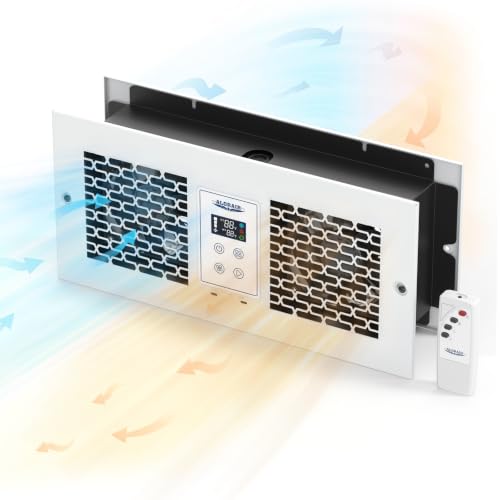
This unit combines cooling and heating alongside three modes: cooling, heating, and ventilation. It features a precision thermostat for temperatures from 23°F to 104°F and 300 CFM of airflow using dual seven-blade fans. Best for homes needing active temperature balancing between rooms while maintaining quiet operation; the integrated cooling/heating adds complexity and cost relative to basic transfer fans.
VEVOR Room to Room Fan With Remote

VEVOR offers a 300 CFM, dual-direction airflow through-the-wall fan with 10 speeds and temperature control. It supports installation in walls 3.74″ to 7.48″ thick. Best for homeowners seeking a wide speed range and precise temperature settings; avoid this if your wall structure cannot accommodate the provided opening size.
Buying Guide
What should I consider when choosing a room-to-room air transfer fan?
- Wall compatibility: Check the maximum and minimum wall thickness the unit can fit (common ranges include 3.8″–7.4″ or similar). Measure your wall opening before purchasing.
- Airflow needs: If you want fast balancing, prioritize models with 300 CFM or higher. For smaller spaces, 250–300 CFM is often sufficient.
- Installation type: Decide between hardwired and plug-in options. Hardwired models require electrical work but offer a cleaner installation; plug-in models are easier to install but may require a receptacle in the vicinity.
- Control features: Remote control, thermostat-based operation, and multiple modes (cooling/heating/ventilation) help tailor performance to seasons and room layouts.
- Noise and efficiency: Look for EC/DC motors or dual-blade designs that reduce noise and improve energy efficiency during operation.
- Direction control: Reversible airflow can help move air in and out of rooms depending on season, but some buyers prefer fixed-direction units for targeted venting.
FAQ
- What does a room-to-room air transfer fan do?
It moves air between two adjacent rooms to balance temperatures and reduce hot or cold spots without ductwork.
- Do these fans require professional installation?
Hardwired units typically require electrical work, while plug-in or simple wall-setup models may be DIY-friendly.
- What airflow rate is ideal for a typical home doorway connection?
Most setups target about 300 CFM for effective room balancing, depending on room size and insulation.
- Are reversible airflow features worth it?
Reversible airflow helps adapt to seasonal needs by directing intake or exhaust between rooms, improving overall comfort.
- Can these fans replace a central HVAC expansion?
They can supplement HVAC, especially in rooms with persistent temperature differences, but are not a full replacement for ducted cooling or heating in large homes.