Answering the question “which RV AC unit uses watts most efficiently?” this guide highlights five reliable options designed for off-grid and battery-powered setups. These selections emphasize low power draw, compatibility with 12V or inverter-based systems, and quiet operation. Ideal buyers include full-time boondockers, weekend campers with solar, and RVers seeking to minimize generator runs. The table below provides quick comparisons to help you pick the best match for your off-grid lifestyle.
| Product | BTU | Power Source | Best For | Notable Benefit |
|---|---|---|---|---|
| Xenjum 11k RV A/C | 11,000 BTU | 12V DC (battery powered) | Off-grid campers needing quiet, low-startup power | Soft-start, energy-efficient, up to 10 hours on a 600Ah battery |
| TUSOMA 18k BTU RV A/C with Heat Pump | 18,000 BTU cooling | 115V AC + 12V DC supply | RVs needing year-round cooling and heating | All-weather performance with heat pump |
| Countrymod 10k BTU 12V DC RV A/C | 10,000 BTU | 12V DC (battery powered) | Medium spaces with 12V power | Low power consumption with APP remote |
| VEVOR 15k BTU Non-Ducted RV A/C | 15,000 BTU | 115V AC (ductless roof) | Large RVs needing strong cooling | Three modes plus simple installation |
| COSTWAY 6.5k BTU Window RV A/C | 6,500 BTU | 115V AC (window) | Compact RVs and smaller spaces | Smart control and multiple modes |
Xenjum 11V RV Air Conditioner

Best for off-grid RVs relying on battery banks. The Xenjum unit provides 11,000 BTU cooling with a built-in soft start to reduce startup surges, preserving battery life. It runs on 12V DC, making it suitable for boondocking setups with substantial battery capacity. The manufacturer notes a quiet operation around 35 dB, supporting sleep and daily living without noise disruption. This option is ideal for campers prioritizing low-startup power, long runtime on battery, and compatibility with solar systems.
Who it’s best for: Off-grid travelers who want reliable cooling without generator-supplied power and who can sustain 10 hours of operation on a robust battery bank.
Limitations: Requires a compatible 12V battery and adequate solar support; efficiency relies on battery capacity and inverter quality.
TUSOMA 18k BTU RV A/C With Heat Pump

Best for medium-to-large RVs needing year-round climate control. The Tusoma rooftop unit offers 18,000 BTU of cooling and 10,236 BTU of heating, with all-weather performance and R32 refrigerant for efficiency. It requires both 115V AC and a 12V DC supply to operate properly, making it a fit for RVs with dual-power setups or shore power plus auxiliary battery support. This model suits those who want cooling and heating in one rooftop solution and can accommodate roof installation needs.
Who it’s best for: RVs in warmer climates or seasons where heating might also be beneficial during shoulder months, and where a roof-mounted, high-capacity unit is acceptable.
Limitation: Requires both AC power and DC power; not ideal for strictly off-grid or battery-only setups.
Countrymod 12V DC 10k BTU RV A/C
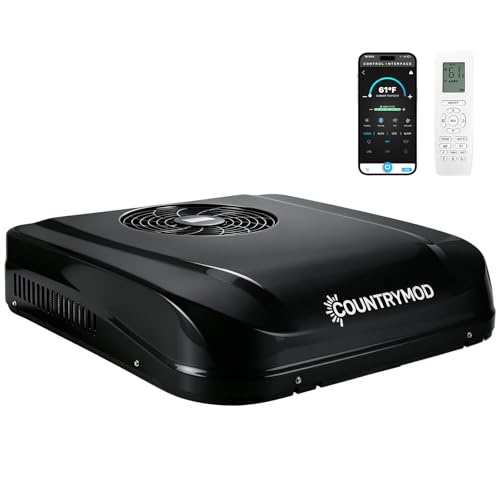
Best for compact or mid-sized RVs that prioritize battery-powered operation. This 10,000 BTU unit uses a 12V DC design with APP remote control. Reported power consumption is around 0.3 kWh per hour, suggesting strong efficiency relative to conventional AC units. The inverter design helps adjust compressor speed and temperature to maintain comfort while conserving battery life. This model fits RVs with modest space and a reliable battery setup.
Who it’s best for: RVers who want a streamlined, battery-powered cooling solution with app-based control and lower energy use.
Limitation: Lower BTU rating compared to larger rooftop units; may require roof space and mounting considerations.
Countrymod 10k BTU DC RV A/C (Variant)

Best for steady, battery-powered cooling in smaller to mid-sized RVs. The 10,000 BTU unit features an inverter design that automatically adjusts compressor speed for efficiency and comfort. With an estimated 0.3 kWh per hour energy draw, it extends battery life while delivering reliable cooling. The unit emphasizes quiet operation and even distribution of cooled air to reduce direct blasts.
Who it’s best for: Those who prioritize battery life and app-controlled features in a smaller RV footprint.
Limitation: Similar to the 10k variant above; ensure battery and solar support match expected runtime.
VEVOR 15k BTU Non-Ducted RV A/C

Best for larger RVs requiring robust cooling performance. The VEVOR unit provides 15,000 BTU with R32 refrigerant, designed to cool spaces up to about 129 square feet. It includes air distribution box, operation panel, and installation hardware for a roof-mounted, ductless setup. Modes include Auto, Cooling, and three-speed Fan, with a built-in timer. It is a straightforward option for campers with a roomy interior and roof space that can accommodate a larger rooftop unit.
Who it’s best for: Large campers or vans where maximum cooling power is desired without ducting.
Limitation: Requires 115V power; not ideal for battery-only off-grid use without substantial solar and storage.
TOSOT 16k BTU RV A/C With Heat Pump

Best for year-round RV comfort in shoulder seasons. The 16,000 BTU cooling capacity paired with a 12,500 BTU heat pump enables cooling and heating across a wide temperature range. It operates quietly at about 43 dB and supports ambient temperatures from 23°F to 115°F. This unit is suitable for RVs requiring strong cooling and reliable heating without a separate furnace, particularly when power supply is shore-based.
Who it’s best for: Campers who need flexible climate control with a built-in heat pump and WiFi/remote capabilities.
Limitation: Higher BTU units typically demand more electrical power; ensure power options align with usage patterns.
Buying Guide: Key Considerations For Choosing An RV AC Unit
- Power source compatibility: Determine if you will rely on shore power, generator, or battery/inverter. 12V DC units excel off-grid, while higher BTU models often require 115V AC or a capable inverter.
- BTU and space: Match BTU to your RV’s size and insulation. Oversized units waste energy; undersized units struggle to maintain comfort.
- Energy efficiency and start-up: Look for soft-start features and inverter-driven compressors to minimize battery draw and extend runtime.
- Noise levels: If sleeping or recording, aim for units with 40–45 dB or lower operation.
- Installation considerations: Roof-mounted vs window or ductless, mounting space, and compatibility with existing vents or air distribution boxes.
- Heating capability: In shoulder seasons, heat pumps can reduce furnace use. Check if the unit offers cooling only or all-season heating.
- Controls and smart features: APP remote control and WiFi compatibility can simplify management from inside or outside the RV.
- Maintenance and durability: Look for units with fewer moving parts and components designed for outdoor exposure and vibration.
Frequently Asked Questions
- Q: Which RV AC is best for off-grid power? A: 12V DC models such as Xenjum and Countrymod variants are designed for battery-powered operation, with lower startup surges and extended runtime when paired with sufficient battery capacity.
- Q: Do I need both AC and DC power for rooftop units? A: Some rooftop units require both AC and DC supplies for proper operation, while others run on DC only. Check the product specs and your power setup.
- Q: Can a high-BTU unit be used without shore power? A: Yes, but only if you have a powerful inverter and battery bank; otherwise higher BTU units typically rely on AC power to meet cooling demand.
- Q: How quiet are these RV AC units? A: Quiet operation often ranges from about 35–45 dB for select models, with some 43–45 dB units offering near-silent performance for sleeping areas.
- Q: Is heating included in these units? A: Some models include heat pumps (e.g., Tusoma, TOSOT) for year-round comfort, while others are cooling-only and require a separate heating source.
- Q: What installation considerations matter most? A: Roof clearance, vent compatibility, and whether the unit is ducted or non-ducted influence both performance and installation effort.