Answer: For reliable air conditioning in an RV, choose a generator that combines sufficient starting watts with steady running watts, RV-specific outlets, and reasonable run time. The top options below are best for campers who need to power an RV air conditioner, along with essentials like a microwave or lights. These units suit different buyers—from weekend campers needing portability to full-timers wanting propane or dual-fuel flexibility.
Summary table of selected products:
| Product | Best For | Fuel Type | Key Outlet Type | Approx Run Time (tankful/condition) |
|---|---|---|---|---|
| Westinghouse 4650 Peak Watt Portable Generator (RV Ready) | RV users needing robust peak power | Gas | TT-30R RV; L5-30R; 5-20R duplex | Up to 14 hours |
| Champion Power Equipment 4000-Watt Dual Fuel RV Ready | Quiet operation with fuel flexibility | Gas/Propane | RV-ready 30A outlet | Up to 10 hours on gas; up to 25 hours on propane |
| Oxseryn Power Equipment 4400 Watts Inverter | Quiet back-up for RVs and campsites | Gas | RV port; 120V ports; DC port | Up to 14 hours at 25% load |
| Westinghouse 4650 Peak Watt Dual Fuel Portable Generator | Gas or propane flexibility with RV outlets | Gas/Propane | TT-30R; L5-30R; 5-20R | Up to 14 hours per tank |
| WEN 5600-Watt Portable Generator | Budget-friendly power with transfer-switch readiness | Gas | RV-Ready and standard outlets | Up to 12.5 hours at half-load |
Westinghouse 4650 Peak Watt Portable Generator (RV Ready)
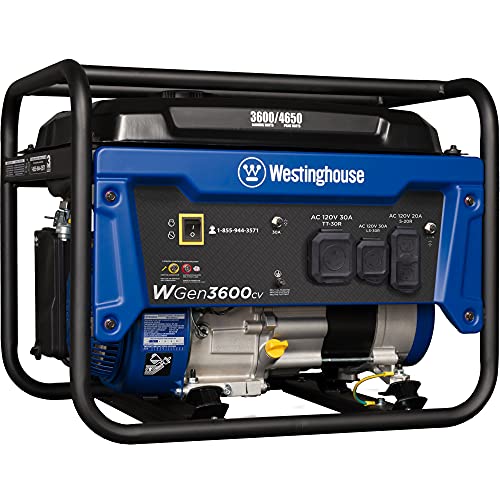
Power: 3600 running watts and 4650 peak watts. This model uses a recoil start and includes a four-gallon fuel tank with a fuel gauge. Run time reaches up to 14 hours per tank. Outlets include two 5–20R 120V duplex receptacles, one RV-ready TT-30R 30 Amp receptacle, and one L5-30R 30 Amp receptacle with rubber outlet covers for safety. It ships with oil, an oil funnel, a tool kit, and a user’s manual for easy setup out of the box.
Best for: RV travelers who need strong peak power to start air conditioners and run essential appliances, with dedicated RV outlets for direct campsite hookup.
Caution: Gasoline operation means monitoring fuel levels and emissions; ensure proper ventilation during operation and transport.
Champion Power Equipment 4000-Watt Dual Fuel RV Ready

Power: 4000 starting watts, 3000 running watts on gasoline; up to 10 hours on gas. It can also run on propane for extended runtimes and has CO Shield carbon monoxide auto shutoff for safety. The inverter-style design keeps noise to a minimum at about 64 dBA from 23 feet, which helps keep camp comfortable. The optional parallel kit (sold separately) allows connecting with another Champion inverter or power station for more output and longer runtimes.
Best for: Campers who value quieter operation and fuel flexibility, particularly when propane is readily available.
Caution: Parallel kit is optional; for larger power needs, plan additional equipment or a second generator.
Oxseryn Power Equipment 4400 Watts Inverter

Power: 4400 peak watts, 3400 running watts. Features multi-output ports including 2x 120V AC outlets, 1x 12V DC, and 1x RV port. It offers long runtimes—up to 14 hours at 25% load with ECO mode—and a 2-gallon fuel tank with a fuel gauge for quick fuel checks. The design emphasizes low noise for RV camping and home backup use.
Best for: RV owners who want a compact, quieter generator with multiple outlet options and visible fuel status.
Caution: Smaller tank means more frequent refueling on long trips; plan fuel stops accordingly.
Westinghouse 4650 Peak Watt Dual Fuel Portable Generator
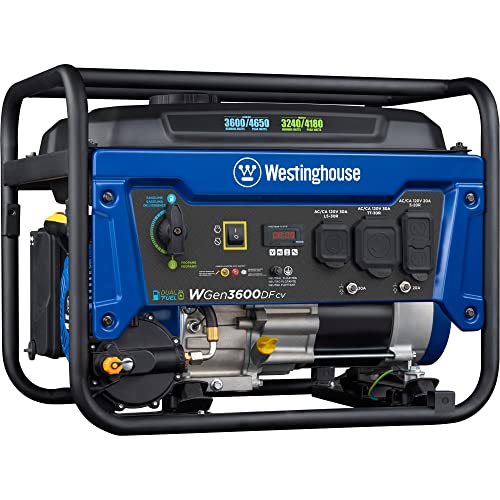
Power: 4650 peak watts with 3600 running watts on gasoline; 4650 peak watts with 3240 running watts on propane. It features a four-gallon fuel tank with a gauge and the same three RV/household outlets as the single-fuel sibling, plus rubber-covered outlets for safety. It’s designed to be a plug-and-play option with included oil, funnel, tool kit, and manual for quick setup.
Best for: Buyers who want dual-fuel flexibility in a compact RV-ready package, with the option to switch fuels based on availability.
Caution: Propane performance can differ from gasoline; verify fuel type compatibility for HVAC start-up needs.
WEN 5600-Watt Portable Generator
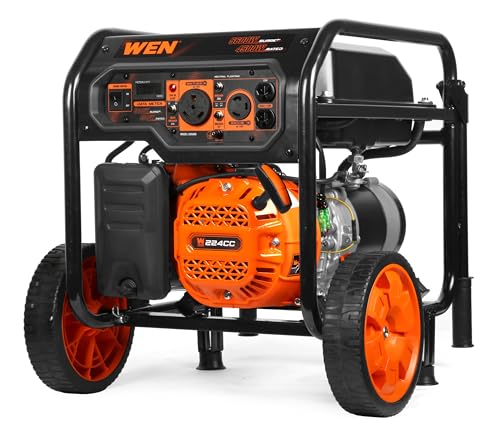
Power: 5600 starting watts and 4500 running watts. It includes a wheel and handle kit for portability and a four-gallon gas tank delivering up to 12.5 hours of half-load run time. This option is well-suited for RVs that require robust, reliable power for AC cooling and other essentials while staying within a reasonable budget.
Best for: Budget-conscious buyers who need substantial power with transportability and compatibility with transfer switches for home backup.
Caution: Higher power unit may require more space and louder operation—consider campsite rules and noise restrictions.
Buying Guide
What size generator do I need for an RV AC?
Choose a generator with sufficient starting watts for the air conditioner, plus extra to cover lights, fans, and misc devices. RV air conditioners typically need a surge wattage higher than running watts, so look for models with 3,500–5,000+ starting watts when pairing with a typical 13,500–15,000 BTU unit.
Gas vs. propane vs. dual fuel: which is best?
Gas provides the broadest availability and generally lower initial cost. Propane offers cleaner burning and easier storage in some setups, with the trade-off of slightly lower available power. Dual-fuel units add versatility, allowing you to use either fuel depending on circumstances or fuel availability.
Portability and noise: how to pick?
Inverter generators are typically quieter and more fuel-efficient at light loads, which is beneficial for RV camping. For larger power needs, a traditional portable generator may be necessary, but check campground noise policies and consider a unit with a noise-reduction design or a muffler system.
Outlets and RV compatibility: what to look for?
Ensure the generator provides an RV-ready 30A TT-30 outlet or at least a 30A receptacle suitable for your RV. Additional 120V outlets (5-20R) are helpful for running lights, chargers, and small appliances. Rubber outlet covers and a durable power cord increase safety and longevity.
Run time and fuel capacity: how long will it run?
Higher tank capacity or efficient engine design increases run time between refuels. If you plan long trips, consider units with 8–12 hour runtimes at half-load as a baseline, and verify fuel gauge accuracy and oil-change requirements.
FAQ
Will a generator run my RV air conditioner on hot days?
Yes, if the generator provides sufficient starting watts for the AC compressor and enough running watts for continuous operation.
Is dual-fuel better for RV use?
Dual-fuel adds flexibility if one fuel type becomes scarce or expensive, potentially improving overall reliability.
What sound level should I expect?
Quiet inverter models often run around 50–65 dBA at a practical distance; traditional open-frame models can be louder.
Do these generators require maintenance?
All require basic maintenance such as oil checks, air-filter inspection, and spark plug replacement per the manual. Always follow manufacturer guidelines.
Can I parallel two generators?
Some models offer optional parallel kits that let you combine power for higher output and longer runtimes.
Do I need a transfer switch for home backup?
For home backup use, a transfer switch simplifies connection to your electrical panel and improves safety, but is not required for RV use.