Self-rinse coil cleaners help keep air-conditioning coils clean without lengthy downtime. This guide highlights top options for different needs—from no-rinse evaporator cleaning to targeted condenser care—so buyers can pick the right foam-and-foam-cleaner for their system. Best for homeowners and pros who want quick, effective coil cleaning with minimal rinsing. We note which cleaners are best for evaporators, which work for condensers, and where a no-rinse approach matters most.
Product snapshot
| Product | Best For | Notes |
|---|---|---|
| Nu-Calgon 417175 Evap Foam | No-rinse evaporators | Self-rinsing foam with corrosion inhibitors |
| Leak Saver Foam Blaster AC Coil Cleaner (3 Pack) | Evaporators and condensers | High-pressure, deep-penetrating foam; evaporator no-rinse, condenser light rinse |
| Frost King ACF19 Foam Coil Cleaner | General coil cleaning | Heavy-duty foam cleans coils, blades, and filters |
| ComStar Coil Safe Evap Coil Cleaner | Industrial/commercial use | Self-rinsing, neutral pH, non-toxic |
| Simple Green Foaming Coil Cleaner | Residential and light commercial | Foaming cleaner, gallon size |
Nu-Calgon 417175 Evap Foam

Nu-Calgon 417175 Evap Foam liquefies dirt, grease, oil, and other residues quickly and easily. It is fortified with corrosion inhibitors, making it safe for use on metals and various materials. The fast-breaking foam is completely self-rinsing, reducing downtime and simplifying maintenance. Best for evaporator coils where a no-rinse approach saves time and minimizes condensate carryover.
Who it’s best for: contractors and do-it-yourselfers who want a reliable no-fuss evaporator cleaner. Why selected: proven self-rinsing action and corrosion protection help protect sensitive metal surfaces. Limitation: may require secondary rinse if very heavy deposits are present on older systems.
Leak Saver Foam Blaster AC Coil Cleaner Foam Spray

This professional, deep-penetrating formula uses a high-pressure, focused spray pattern to drive cleaner into the coil before foaming. It liquefies grime and buildup after penetration, helping restore system efficiency and leaving a mild fresh scent. It’s designed for evaporators with no rinse and condensers with light rinse requirements.
Best for: vehicles and buildings requiring thorough access to hidden buildup. Better for: deeper embedded grime where typical foams don’t reach. Choose this if: you want a high-penetration cleaner that finishes with minimal rinsing for evaporator sections and accepts light rinsing for condensers. Caution: ensure proper ventilation during application due to concentrated foam and fumes.
Frost King ACF19 Foam Coil Cleaner
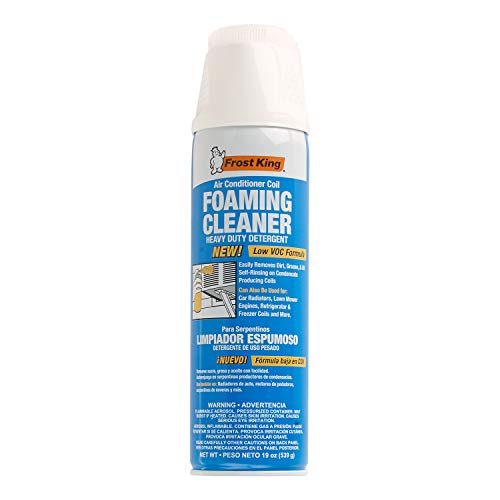
Frost King ACF19 uses heavy-duty foam to dissolve grease, oil, and dirt. It clean coils, fan blades, and reusable air filters, and it neutralizes odors from standing water in drain pans. Best for: homeowners cleaning residential systems with straightforward coil access. Better for: coil surfaces with mixed debris, including odor-causing residues. Limitation: may require additional rinse in heavy-duty deposits or for difficult odor cases.
ComStar Coil Safe Evap Coil Cleaner

ComStar Coil Safe Evap Coil Cleaner is a self-rinsing, neutral pH, non-toxic formula designed for commercial and residential coils alike. It provides powerful grease removal while remaining safe on hard surfaces. Best for: facilities requiring a safe, non-toxic cleaner with easy rinsing. Better for: stainless and aluminum coil surfaces due to neutral pH. Caution: verify compatibility with sensitive gasket materials before use.
Simple Green Foaming Coil Cleaner

Simple Green Foaming Coil Cleaner comes in a gallon size for broader projects. It’s a foaming cleaner designed to lift dirt and grime from coils while the stable foam helps dwell time on stubborn deposits. Best for: users who prefer a widely available consumer-grade option with straightforward usage. Limitation: larger volume may be less convenient for small or single-coil maintenance tasks.
Buying Guide: Key Purchase Considerations
- No-rinse vs. light rinse: For evaporator coils, no-rinse formulas save time and reduce condensate carryover. For condensers, liquids that require light rinsing may be more effective at removing deeper grime.
- Foam strength and penetration: High-penetration foams are better for deeply buried grime, while milder foams work well for routine maintenance without masking odors.
- Material safety: Look for corrosion inhibitors and neutral pH on cleaners marketed as safe for metals, aluminum, and coated surfaces to prevent damage over time.
- Industrial vs. residential use: Commercial-grade formulas often offer stronger degreasing; residential options are typically gentler but adequate for routine cleaning.
- Does it neutralize odors?: Some products neutralize drain-pan odors, which is a practical consideration for occupied spaces.
- Safety and ventilation: Some foams release fumes or require ventilation; ensure appropriate application area and PPE as needed.
FAQ
- What is self-rinse coil cleaner?
– It is a cleaning foam or liquid designed to break down grime on HVAC coils and rinse away automatically or with minimal additional rinsing. - When should I choose no-rinse evaporator cleaners?
– Choose no-rinse options for evaporators when downtime must be minimized and condensate drainage will carry away residues. - Can I use coil cleaners on all coil materials?
– Most cleaners are formulated to be safe on metals like aluminum and copper; always verify neutral pH and corrosion inhibitors for sensitive materials. - Are there safety concerns with foam cleaners?
– Yes; ensure adequate ventilation, avoid skin contact, and follow product instructions for proper application to prevent slips and irritation. - What’s the main difference between evaporator and condenser cleaners?
– Evaporator cleaners commonly do not require rinsing, while condenser cleaners may require light rinsing after application to remove residues.