Find the right hybrid solar inverter for powering an air conditioner and other essentials. This guide highlights five top options, each best for different setups: battery-less or AGM lithium-ready systems, home backup, and off-grid cabins. The featured products balance pure sine wave output, MPPT charging, and compatibility with common battery chemistries to support cooling and everyday loads.
The following quick table compares key aspects to help you choose faster.
| Product | Best For | Key Feature | Battery Type Compatibility |
|---|---|---|---|
| SUMRY Hybrid Solar Inverter, 4000W | Battery-powered or battery-less setups | Built-in 140A MPPT, 5600W PV input | Lead-acid, AGM, LiFePO4 |
| Aninerel 4200W Solar Hybrid Inverter | Higher continuous output, Li-based systems | 120A MPPT, up to 6200W PV input | LiFePO4, Li-ion |
| Anjfylque 12000W Hybrid Inverter | Whole-home backup, large loads | Dual MPPT, 500V input | Various battery chemistries |
| Anern 6500W Hybrid Solar Inverter | Medium to large off-grid systems | 6500W pure sine, 120A MPPT | Lead-acid, Li-ion, LiFePO4 |
| VEVOR 3000W Hybrid Inverter | Compact off-grid or small loads | 100A MPPT, 4000W PV input | Lead-acid, Li-ion, LiFePO4 |
SUMRY Hybrid Solar Inverter, 4000W

Best for moderate loads where pure sine wave output and reliable MPPT charging are priorities. This model provides 4000W continuous power with an 8000W peak, suitable for running air conditioners, fans, and essential electronics during outages. The built-in 140A MPPT charge controller supports up to 5600W PV input at 350VDC, delivering high efficiency. It includes a glass-top LCD display for real-time monitoring and a user-friendly interface. Caution: Check total load to stay within the inverter’s rated output to avoid tripping during high-demand periods.
- Pure sine wave output minimizes interference with sensitive devices.
- Glass cover with a large LCD panel for easy status review.
- PV input and MPPT specs support flexible solar configurations.
Best for: Home backup or cabins needing dependable AC support with a battery-ready or battery-less setup.
Aninerel 4200W Solar Hybrid Inverter

Best for higher continuous power needs with flexible battery choices. This unit delivers 4.2kW continuous power and up to 8.4kW surge, with a maximum PV input of 6200W and 120A MPPT charging. It operates as pure sine wave inverters and can work without a battery when PV input remains sufficiently high. It supports LiFePO4 battery communication and EQ balancing to improve longevity. Caution: If using without a battery, ensure PV input exceeds the threshold to sustain loads.
- 120A MPPT charging for strong solar harvest.
- Battery-friendly communications with LiFePO4 systems.
- High PV input tolerance supports varied solar arrays.
Best for: Household loads with a LiFePO4 or similar battery setup seeking robust power during sunny days.
Anjfylque 12000W Hybrid Inverter

Best for whole-home backup and larger off-grid systems. This split-phase inverter delivers up to 12kW continuous power and 24kW peak, with dual MPPT trackers and 500V PV input. It supports lithium and lead-acid batteries via BMS, enabling flexible configurations. It’s suitable for powering air conditioning units, pumps, and multiple appliances during outages. Caution: Higher power units require adequate PV capacity and proper cooling for sustained performance.
- Dual MPPT for versatile solar layouts.
- High PV input capacity expands solar harvest potential.
- Broad battery compatibility with BMS support.
Best for: Homes with significant backup needs and mixed battery chemistries looking for scalable power and cooling support.
Anern 6500W Hybrid Solar Inverter
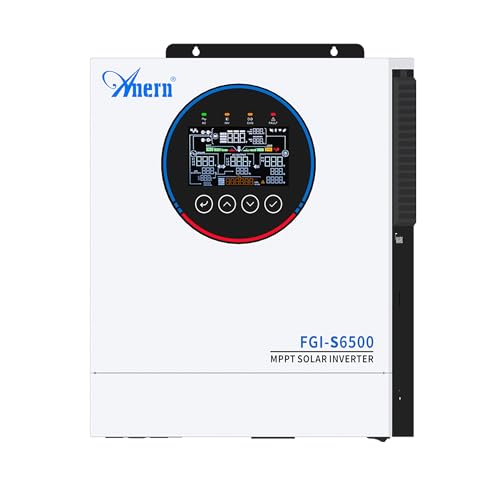
Best for medium-to-large off-grid systems needing strong pure sine wave output. This 6500W solar inverter comes with a built-in 120A MPPT controller and supports up to 9000W PV input power. It can work with 48V battery stacks, including lithium and lead-acid varieties, and offers automatic restart when AC power is restored. Caution: Check PV array size and network capacity to prevent oversizing the system beyond design limits.
- Integrated MPPT controller for efficient solar charging.
- High PV input capacity supports large solar arrays.
- Automatic restart on grid restoration helps reliability.
Best for: Installations where a robust 48V system must support home appliances and cooling with flexible battery options.
VEVOR Hybrid Solar Inverter, 3000W

Best for compact off-grid setups with multiple battery types. This 3000W pure sine wave inverter includes a built-in 100A MPPT controller, supports up to 4000W PV input, and accepts 60–500V DC input. It is compatible with lead-acid, Li-ion, and LiFePO4 batteries. Caution: Check the inverter’s continuous rating against your air conditioner’s running load to avoid overloading.
- 2-in-1 inverter and controller for streamlined setups.
- High PV input range with 100A MPPT charging.
- Broad battery compatibility.
Best for: Smaller homes or cabins needing reliable inverter support for cooling and essential appliances.
Buying Guide
What to consider when selecting a solar hybrid inverter for an air conditioner:
- Power rating and surge capability: Air conditioners draw high startup currents. Choose an inverter with a continuous rating comfortably above the AC load and a surge rating that exceeds startup needs.
- Pure sine wave output: Ensures sensitive electronics run smoothly and extends device life.
- MPPT charging and PV input: Higher MPPT current and PV input capacity improve solar harvest, especially in mixed weather.
- Battery compatibility: Ensure compatibility with your battery type (AGM, GEL, LiFePO4, Li-ion) and whether the system supports battery-less operation for day-to-day loads.
- System configuration: Single-unit vs. parallel-ready designs. Parallel capability enables higher total power for larger homes or multiple A/C units.
- Monitoring features: LCD or app-based monitoring helps track performance and solar generation in real time.
- Protection features: Look for overload, overtemperature, and short-circuit protection to safeguard equipment.
- Installation environment: Consider ventilation, heat dissipation, and safety in enclosed spaces near HVAC equipment.
Frequently Asked Questions
- What is a hybrid solar inverter? A device that combines an inverter with an MPPT solar charger, allowing solar power to run appliances and charge batteries even when grid power is available or not.
- Do I need batteries to use a hybrid inverter with an air conditioner? Not always. Some units can operate in battery-less mode with sufficient solar input, but batteries extend runtime during outages.
- Can a hybrid inverter power an air conditioner? Yes, when sized correctly for the AC unit’s startup and running load, it can power the compressor and cooling system.
- What should I pair with a 12,000W inverter? A high-capacity PV array and appropriate battery bank, along with proper system ventilation and protection devices, to support sustained operation.
- Is it better to choose a dual-MPPT model? Dual MPPT increases solar harvesting flexibility, especially in rooftop configurations or when panels face different directions.
- How do I estimate my needs? Sum the running watts of electronics plus the AC’s startup watts, then select an inverter with a comfortable margin above that total.