Answering your search for efficient solar roof exhaust fans, this guide highlights five top options ideal for shedding heat, reducing attic temperatures, and improving overall comfort. These fans are best for homeowners seeking energy-free cooling, small-business workshops needing venting, and greenhouse owners aiming to lower humidity. The selections emphasize reliability, weather resistance, and smart features that optimize performance under varying sun exposure.
Summary of chosen products (quick reference):
| Product | Best For | Key Benefit |
|---|---|---|
| iLiving Hybrid Ready Solar Roof Attic Exhaust Fan | Large homes, high airflow needs | Smart thermostat; wide coverage |
| VEVOR 35W Solar Attic Fan | Attics with auto temp control | MPPT optimization; automatic cooling |
| DC HOUSE 32W Solar Attic Fan | Medium to large spaces | Huge coverage; durable shell |
| Hon&Guan Solar Attic Fan | Flexible mounting and continuous operation | Adjustable panel; dual power modes |
| VEVOR 42W Solar Attic Fan | Smart control and remote operation | Temp/humidity sensing; weatherproof |
iLiving Hybrid Ready Solar Roof Attic Exhaust Fan

This 14″ 40-watt unit delivers up to 1150 CFM and covers up to 2900 square feet. It includes a Smart Thermostat control with a 50°F-122°F range and Enable/Disable feature, plus an IP68 waterproof brushless motor for durability. A configurable solar panel angle (0°, 15°, 30°, 45°) helps optimize sun exposure. Best for large, sun-exposed attics where automated temperature management matters. Limitation: higher airflow might require careful ducting in tight spaces.
VEVOR 35W Solar Attic Fan

This model offers 2400 CFM with an MPPT controller, designed for metal and masonry roofs. It features a built-in thermostat and automatic operation during the day to cut cooling costs. Best for large attics or spaces where automatic temperature-based venting is desired. Limitation: relies on solar conditions; performance can vary with cloud cover.
DC HOUSE 32W Solar Attic Fan
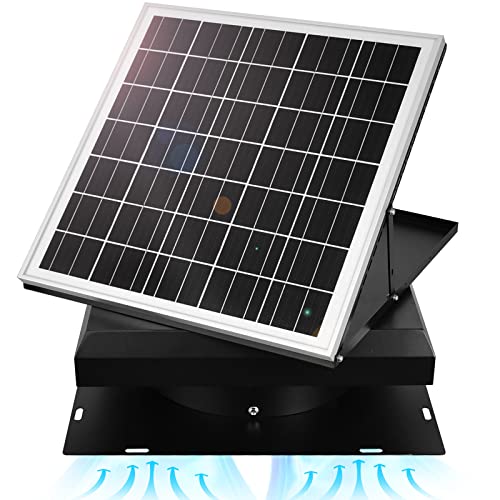
Offering up to 3000 sq ft coverage and 2500 CFM, this unit uses a brushless copper motor and IP68 shell for weather resistance. Best for large spaces needing robust airflow and durable construction. Limitation: described as weatherproof, but long-term outdoor exposure should be considered in extreme climates.
Hon&Guan Solar Attic Fan With Thermostat
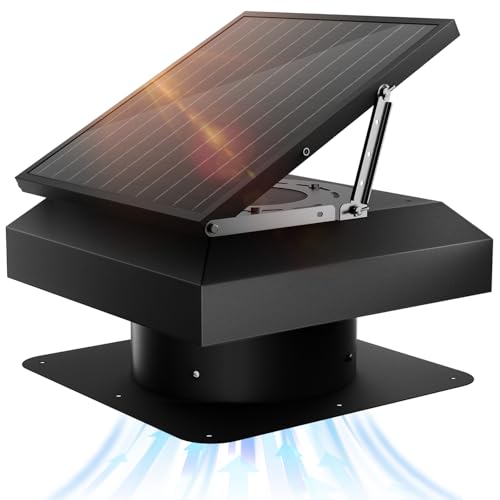
This 12″ fan provides up to 2000 CFM and cools up to 2500 sq ft. It features a dual power option with a thermostat-enabled auto-start and a 2-mode control. Best for users who want both solar and AC support with a thermostat-based auto-start. Limitation: Mode 2 requires AC adapter and manual speed control for some operation modes.
VEVOR 42W Solar Attic Fan

With 2800 CFM, built-in temperature sensors, and remote control, this model is designed for smart, all-weather operation. It switches from solar to electric at sunset and operates 24/7, including on cloudy days. Best for tech-forward buyers seeking remote management and sustained cooling. Limitation: remote control range may vary by environment.
Buying Guide
What to consider when choosing a solar roof exhaust fan:
- Cool area coverage: Match the unit’s CFM rating to the size of the space you need to ventilate. Higher CFM generally means faster heat removal but can be louder and more expensive.
- Solar panel efficiency and angle: Look for adjustable panels or designs that maximize sun exposure in your climate. MPPT controllers improve performance in variable light.
- Thermostat and automatic operation: A thermostat ensures the fan runs only when needed, saving energy. Some models offer auto-start at a set temperature or 24/7 operation via AC backup.
- Durability and weather resistance: IP ratings (such as IP65 or IP68) and brushless copper motors generally indicate long service life in outdoor environments.
- Power options: Decide between solar-only, solar with AC backup, or hybrid controls. Consider whether you need remote or smart control features.
- Noise level: If noise matters, compare decibel ratings or look for models with quiet operation designs.
- Ease of installation: Evaluate mounting options, roof compatibility, and wiring requirements. Some units are easier DIY installs than others.
Common buyer scenarios
- New homeowners with large sun-facing attics: prioritize high CFM and smart control to auto-vent as temperatures rise.
- Rural or remote properties: choose fully solar solutions with weatherproof construction and minimal maintenance.
- Greenhouse owners: value humidity sensing and continuous operation capabilities to manage air exchange efficiently.
Installation considerations
Before installing, verify roof structure, ensure water-tight mounting, and plan for cable routing. If using AC backup or remote control features, ensure compatibility with existing electrical systems and local codes.
FAQ
- What is a good CFM for an attic per square foot? A typical attic benefits from 1 CFM per square foot; higher ceilings or larger heat loads may require 1.5–2 CFM per square foot.
- Do solar attic fans work on cloudy days? Many models include an AC backup or switch to electric power for partial operation during low-sun conditions.
- Can I install a solar attic fan myself? Many units are designed for DIY installation, but always follow the manufacturer’s instructions and local building codes.
- How do thermostats improve energy savings? Thermostats prevent unnecessary operation by starting the fan only when interior temperatures exceed a threshold.
- Are solar attic fans loud? Some models operate quietly, while higher-CFM fans may produce more noticeable noise; compare decibel levels when noise is a concern.
- What maintenance is required? Periodic cleaning of vents and ensuring the motor remains free of debris typically suffices for most models.