Looking for a reliable thermostat on/off switch to automate your heating or cooling devices? These digital thermostat outlets provide precise temperature control, simple setup, and built-in safety features. This guide highlights five versatile options ideal for greenhouses, reptile tanks, attics, and home brewing. Each product is evaluated for who it’s best for, why it was chosen, and practical limits to consider.
Summary table of selected products
| Product | Best For | Why It Stands Out |
|---|---|---|
| BN-LINK Digital Cooling Thermostat Controller | Attic fans and cooling devices | Simple three-button setup; clear display; long probe and cord |
| DEWENWILS Digital Temperature Controller (15A) | Greenhouses and incubators | Wide range (-40℉ to 210℉); robust safety features |
| BN-LINK Reptile Thermostat Controller | Seedling mats and reptile tanks | Clear display; durable probe; 40–108°F range |
| WILLHI WH2408 Temperature Controller | Terrariums, aquariums, and seed mats | Two-knob setup; memory during outages; versatile modes |
| Inkbird ITC-308 Digital Temperature Controller | General heating/cooling setups | Dual relay; simple °C/°F display; dual readouts |
BN-LINK Digital Cooling Thermostat Controller

The BN-LINK thermostat outlet is designed for effortless cooling control. It uses a probe, a digital display, and a simple three-button interface to set the desired temperature. It supports both Fahrenheit and Celsius units, making it accessible for American users. Best for buyers who want quick setup and a visible status indicator in dim spaces, such as attics or crawl spaces.
Best for: Attic fans, exhaust fans, and small cooling devices. The unit includes a 4.92 ft temperature probe and a 3.94 ft three-prong power cord for flexible placement. A potential limitation is its single-sensor approach, which may be less precise for evenly cooling large rooms compared with multi-sensor systems.
DEWENWILS Digital Temperature Controller
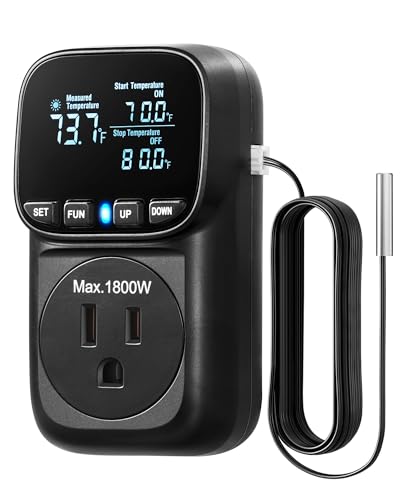
This DEWENWILS model emphasizes power and safety with a 15A output, capable of handling up to 1800W. It features a clear VA display for easy reading in dim environments and supports both heating and cooling modes. Best for greenhouses, incubators, or home setups needing a broad temperature range with strong protection against overload.
Best for: High-power heating or cooling needs with reliable display visibility. Limitations include a larger footprint and the need for careful placement to avoid ambient temperature interference affecting readings.
BN-LINK Reptile Thermostat Temperature Controller

Designed for heating devices such as reptile heating mats, seedling heat mats, and heat lamps, this BN-LINK unit offers an easy 40–108°F control range. It includes a bright display and a sensor probe with a long cord for flexible installation. Best for hobbyists who need a compact, reliable control for sensitive equipment like terrariums or propagation beds.
Best for: Seed starting, reptile tanks, and small incubators. Caution: It’s intended for heating devices; using it with cooling equipment may require a different configuration.
WILLHI WH2408 Temperature Controller

The WILLHI WH2408 provides a straightforward two-knob interface for setting temperatures with a wide range (-58°F to 230°F). It supports a variety of applications, including terrariums, greenhouses, incubators, and homebrewing setups. Best for users who value a simple, memory-preserving design that reduces setup time after power outages.
Best for: Versatile use across hobby and small-scale professional environments. Limitation: The unit’s stated ambient range is broad; ensure probes are correctly placed to avoid reading drift in large or irregular spaces.
Inkbird ITC-308 Digital Temperature Controller

The Inkbird ITC-308 features dual relays for simultaneous heating and cooling control, with a convenient dual-display window showing measured and set temperatures. It supports both Celsius and Fahrenheit displays and is well-suited for general heating/cooling setups, including fermenters and greenhouses. Best for buyers needing a straightforward, two-stage control in a compact module.
Best for: Homebrewing, fermentation, and general temperature control. Consideration: It’s a basic unit without advanced timing functions found in some competitors, which may be a limitation for complex cycling needs.
Buying Guide: How to Choose the Right Thermostat On Off Switch
- Temperature range and precision: Check the unit’s range and accuracy. If you need strict control for seedlings, reptiles, or fermentation, choose models with tight tolerances (±1°F to ±0.1°F where possible).
- Power handling: Match the device’s amperage and wattage to your heater or cooler. Higher-power devices (>15A) require sturdy outlets and safe wiring practices.
- Display and readability: Look for clear VA or LCD readouts, especially in low-light spaces. Dual-display models show both current and set temperatures.
- Sensor placement and length: Probes should be placed away from direct heat sources and airflow to avoid false readings. Longer cords offer flexible placement in larger spaces.
- Control logic: Decide between simple on/off (two-state) or more advanced features like countdown timers, cycle modes, and memory during outages. Dual-relay models support heating and cooling simultaneously.
- Durability and safety: Look for devices with rugged housings and certifications appropriate for dry environments. Some units are better suited for greenhouses, incubators, or reptile habitats.
- Ease of setup: Favor models with intuitive interfaces and minimal menus. Three-button interfaces or two-knob setups shorten initial configuration time.
- Intended use: Some thermostats are designed primarily for heating, others for cooling, and several support both. Ensure the product’s usage aligns with your application (e.g., seed mats vs. air cooling).
Frequently Asked Questions
- What is a thermostat on/off switch used for? It automatically powers a connected device on or off when the ambient or set temperature is reached, providing hands-free temperature control.
- Do these devices require professional installation? Most are plug-and-play with standard outlets, though high-power applications may require safe electrical handling and adherence to local codes.
- Can I use these for both heating and cooling? Several models support both heating and cooling modes; verify the product specifications to ensure it matches your needs.
- What should I consider for accurate readings? Place the sensor away from direct sunlight, vents, or heat sources to prevent skewed readings; extendable probes help with placement.
- Are these units safe for use in humid environments? Choose models designed for dry locations; some probes are moisture-tolerant but housings may not be waterproof.
- What’s the difference between a digital thermostat and a basic outlet timer? A digital thermostat provides precise temperature control with feedback, while a basic outlet timer only follows a set on/off schedule without sensing ambient temperature.