This guide answers which wall-mount solar attic fans deliver reliable cooling, energy savings, and easy installation. The top picks below are best for small to medium attics, garages, sheds, greenhouses, and workshops where off-grid operation or daytime cooling matters. Each product is analyzed for airflow, durability, and ease of use to help you choose the right vent fan for your space.
| Product | Best For | Key Benefit |
|---|---|---|
| VEVOR Gable Mount Fan | Large attics up to 1850 sq ft | High airflow with adjustable thermostat |
| SHENVITASO Solar Exhaust Fan | Small to medium sheds and greenhouses | Solar with power adapter option for day/night use |
| KingMiKi 25W Solar Exhaust Fan | Small spaces, off-grid needs | Very compact with strong 430 CFM output |
| VEVOR 42W Solar Attic Fan | Medium to large spaces, continuous cooling | MPPT regulator and remote control for smart operation |
| iLiving Hybrid Solar Roof Attic Exhaust | Smart control enthusiasts | Thermostat controls and 1150 CFM capacity |
VEVOR Gable Mount Fan With Thermostat

The VEVOR Gable Mount Fan offers 1300 CFM across spaces up to 1850 square feet, making it a strong option for larger attics, garages, or workshops. Its adjustable thermostat turns the fan on or off based on ambient temperature, reducing energy waste and supporting a green cooling strategy. The durable steel housing resists corrosion, while aluminum blades maintain rigidity for long-term performance. Best for buyers seeking high airflow with energy-efficient automation in a roof or gable setup. A potential limitation is the need for compatible mounting hardware and electrical connections in some roof configurations.
SHENVITASO Solar Exhaust Fan With 25W Panel

This solar exhaust fan combines a 25W solar panel with an 8-inch fan, delivering up to 430 CFM at around 2300 RPM. It includes a power adapter for use when solar input is insufficient, ensuring operation at night or during cloudy days. An anti-backflow valve helps seal the space when inactive. Best for small to medium spaces like sheds, greenhouses, and chicken coops where flexible power options and quiet operation matter. Caution: higher wind exposure can affect performance; placement should minimize shading.
KingMiKi 25W Solar Exhaust Fan
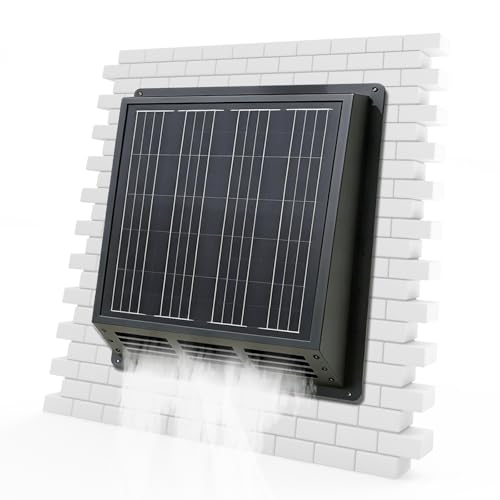
KingMiKi’s 25W solar exhaust fan pushes up to 430 CFM at 2500 RPM with a compact 12x13x3.5-inch footprint. It runs entirely on a monocrystalline solar panel, starting at sunrise and stopping at dusk with no batteries or wiring. The IP68/IP67 weatherproof housing and waterproof motor support outdoor use in various climates. Best for remote spots like barns, small greenhouses, or RV compartments where off-grid operation is essential. Limitation: may be less effective in deeply shaded areas or during overcast days.
VEVOR 42W Solar Attic Fan

The VEVOR 42W Attic Fan uses an MPPT regulator to maximize sun exposure and achieve up to 2800 CFM. It includes a smart temperature and humidity controller, reducing risk of overheating and improving indoor comfort. The system can switch between solar and electric modes at sunset and is operable via a remote control up to about 9.75 meters away. Best for spaces that demand steady cooling with smart, year-round control. Caution: installation may require professional wiring for optimal electric fallback integration.
PEAKROCK 25W Solar Powered Exhaust Fan
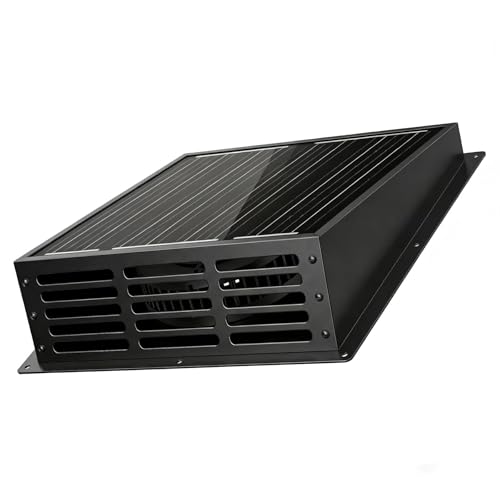
PEAKROCK offers a 25W solar-powered exhaust fan delivering up to 430 CFM at 2500 RPM. Its 13×13-inch footprint and dual-mode installation make it suitable for attics, greenhouses, and sheds. It uses a 12V monocrystalline panel and requires no batteries or wiring, starting at sunrise. Best for off-grid cooling in remote structures where a compact, dependable ventilator is needed. Limitation: performance can vary with cloud cover and sun angle.
iLiving Hybrid Ready Smart Thermostat Solar Roof Attic Exhaust

The iLiving hybrid system combines solar operation with smart thermostat control, providing up to 1150 CFM of cooling for spaces up to 2900 square feet. The unit includes adjustable solar panel positioning for optimal sun exposure, IP68 waterproof motor protection, and a long warranty. Best for buyers who want programmable cooling and reliable performance across mixed weather. Caution: higher airflow units may require more secure mounting and proper clearances for safe operation.
Buying Guide
What should you consider when choosing a wall mount solar attic fan?
Airflow needs: Measure attic or space size to estimate required CFM. Larger spaces benefit from higher CFM or multiple fans. Consider whether you need continuous cooling or intermittent operation based on occupancy and climate.
Power source options: Decide between solar-only operation and solar-assisted electric fallback. Systems with MPPT or smart thermostats optimize performance in variable sun conditions.
Durability and weatherproofing: Look for weatherproof housings, corrosion resistance, and protective grills. Outdoor-ready motors reduce maintenance and extend life.
Installation and compatibility: Check mounting type (gable or wall), and ensure existing roof clearance, wiring access, and mounting hardware compatibility. Some units require professional installation for optimal electrical integration.
Control features: Thermostats, humidity sensing, and remote controls simplify operation and can improve energy savings. Consider whether you need automatic on/off behavior based on temperature or humidity.
Maintenance needs: Aluminum blades, rust-resistant housings, and easy access for cleaning help maintain performance. Regular inspection of seals and wiring prevents issues over time.
Frequently Asked Questions
How many CFM do I need for my attic?
Choose a fan providing enough airflow to move the attic air several times per hour. For example, 1000–1500 CFM suits mid-size attics, while larger spaces may require 2000+ CFM or multiple fans.
Can these fans operate at night?
Some models include a power adapter for daytime use and can run at night with electric fallback; others are designed for solar-only operation and may pause at night without a connected power source.
Are wall-mount solar attic fans easy to install?
Installation varies by model and roof type. Many units use standard gable or wall mounting, but you may need sealing, flashing, and electrical connections for safe, weatherproof operation.
What maintenance is required?
Regularly inspect for loose hardware, clean blades, check seals, and ensure motor covers are intact. Weatherproof units typically require less frequent maintenance but still benefit from periodic checks.
Do these fans save energy?
Yes. By using solar power or solar-assisted operation, they reduce or eliminate electricity costs for attic ventilation, especially in sun-rich climates.