Answering your search for window heat pumps with inverter technology, this guide highlights five top options ideal for different spaces and needs. These units use inverter compressors to adjust cooling and heating output for consistent comfort and energy savings. Best for: large rooms, energy-conscious homes, apartments with window-access limits, and homes needing flexible year‑round temperature control. Below, you’ll find a quick product comparison, detailed sections, and a buying guide to help you pick the right model.
Summary of Selected Products
| Product | Best For | Approx. Room Size | Notes |
|---|---|---|---|
| Midea Inverter Window AC With Heat (12,000 BTU) | Large rooms up to 550 sq ft | Up to 550 sq ft | Energy Star, smart control, heat function |
| Midea 8,000 BTU Smart Inverter Window AC With Heat | Medium rooms up to 350 sq ft | Up to 350 sq ft | Energy Star, smart control, app/voice |
| GE Profile ClearView Inverter Window AC (10,300 BTU) | Quiet operation in windows with full view | Up to 450 sq ft | Inverter tech, ultra-quiet |
| ZAFRO U Shaped Inverter Window AC (12,000 BTU) | Quietest window option with full app/voice control | Up to 450 sq ft | Ultra-quiet 32dB, energy saving |
| Garvee 14,000 BTU Inverter Portable (Dual Hose) | Large spaces without window constraints | Up to 700 sq ft | Inverter, dual-hose, quiet operation |
Midea Inverter Window AC With Heat – 12,000 BTU

This 12,000 BTU Midea unit combines strong cooling with dehumidification and supplemental heat, suitable for spaces up to 550 sq ft. It uses inverter technology to balance performance and energy savings and can be controlled via a digital LED display, remote, app, or voice assistants. Best for: open living areas and apartments that require reliable heating in shoulder seasons. Caution: heat pump function declines below 41°F outside temperatures, limiting winter heating effectiveness in very cold climates.
Midea 8,000 BTU Smart Inverter Window AC With Heat

Engineered for mid-sized rooms up to 350 sq ft, this unit adds heat alongside cooling and dehumidification for year‑round comfort. Features include five modes, three fan speeds, a 24‑hour timer, and energy‑savvy inverter technology that can reduce energy use by up to 35% compared with non-inverter standards. Best for: improving energy efficiency without sacrificing comfort in medium spaces. Caution: heat pump function requires outdoor temperatures above 41°F for operation.
GE Profile ClearView Inverter Window AC – 10,300 BTU
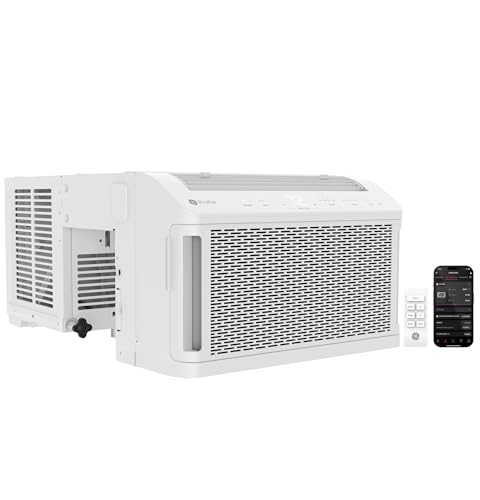
This unit preserves the full window view while delivering cooling to spaces up to 450 sq ft. Inverter technology reduces noise and improves energy efficiency, with a quiet operation level as low as 40 dB. It offers remote control, Wi‑Fi smart features, and compatibility with voice assistants for convenient hands-free operation. Best for: rooms where people value natural light and low noise. Caution: larger window openings are needed for installation, and efficiency depends on proper sealing and clear window space.
ZAFRO U Shaped Inverter Window AC – 12,000 BTU

The U‑shaped design places the noisy compressor outside the window, reducing interior noise to a whisper-quiet level of 32dB. It uses inverter technology for energy efficiency and can be controlled via the ZAFRO app, voice assistants, or a standard remote. Best for: bedrooms, nurseries, or any room requiring minimal noise. Caution: ensure your window structure can accommodate the U‑shaped form and check your window‑width compatibility before purchase.
Garvee 14,000 BTU Inverter Portable Dual Hose

While not a window unit, this portable option uses inverter technology for energy savings and features a dual-hose design to cool up to 700 sq ft efficiently. Best for: spaces without window access or where installation of a window unit is impractical. Caution: portability comes with more footprint and potential setup complexity compared with fixed window units.
Buying Guide: Key Considerations For Window Inverter Heat Pumps
- Room size and BTU match: Choose BTU that corresponds to your space. Overpowered units can waste energy; underpowered units won’t maintain comfort.
- Heat operating temperature: Some window heat pumps require outside temperatures above a threshold (commonly 41°F). Plan for shoulder seasons accordingly.
- Inverter benefits: Inverter technology modulates compressor speed for steady temperatures and lower energy use compared with non-inverter units.
- Installation space: Ensure window dimensions, sill strength, and clearance fit the unit’s height, width, and exhaust design (especially for U‑shaped models).
- Smart features: App control, voice assistant compatibility, and timers can improve daily comfort and energy management.
- Noise levels: Inverter models are typically quieter, but size and design still affect interior sound. The ZAFRO U option emphasizes ultra-low noise.
- Maintenance: Look for washable filters and accessible panels to simplify routine cleaning and performance maintenance.
Frequently Asked Questions
- What is an inverter window air conditioner with heat?
– It uses an inverter compressor to adjust output, delivering cooling and heating with improved energy efficiency and more stable temperatures. - Can a window heat pump operate in freezing weather?
– Many models require outdoor temperatures above a certain Celsius/°F for heating; check the product specs for your climate. - Are window units better than portable models for energy efficiency?
– Inverter window units typically offer better efficiency for fixed installations, while portable units provide flexibility but may use more energy per BTU in some cases. - Is a U‑shaped window unit louder or quieter than standard designs?
– U‑shaped designs reduce interior noise by placing the compressor outside the window, often resulting in quieter operation inside the room. - Do these units include smart home integration?
– Several options support app control and voice assistants. Verify compatibility with your preferred ecosystem before purchasing. - What should I consider when choosing BTU for a window unit?
– Assess room size, ceiling height, sun exposure, insulation, and occupant heat generation to avoid over or under‑cooling.