As an Amazon Associate, this site earns from qualifying purchases through the product links below. These are comparisons of documented features, not claimed hands-on tests.
For a laundry or water-heater area, choose a leak alarm by where escaped water will reach the sensing points and who can respond when it sounds. The Basement Watchdog BWD-HWA suits a local audible warning with a separate wired sensor, while the GoveeLife 1s kit adds gateway-dependent remote notifications at several locations.
Neither device stops every leak or replaces a correct appliance, pan, drain, and plumbing installation. This shortlist compares documented features and exact inspected packages, with no claim that this site performed a flooding test or verified notification delivery in your home.
Map the water path before buying sensors
Look at the accessible floor, equipment pan, nearby drain, and barriers around the washer or water heater. A leak may collect behind an appliance, stay inside a pan, or follow a floor slope away from the spot where you would conveniently place an alarm.
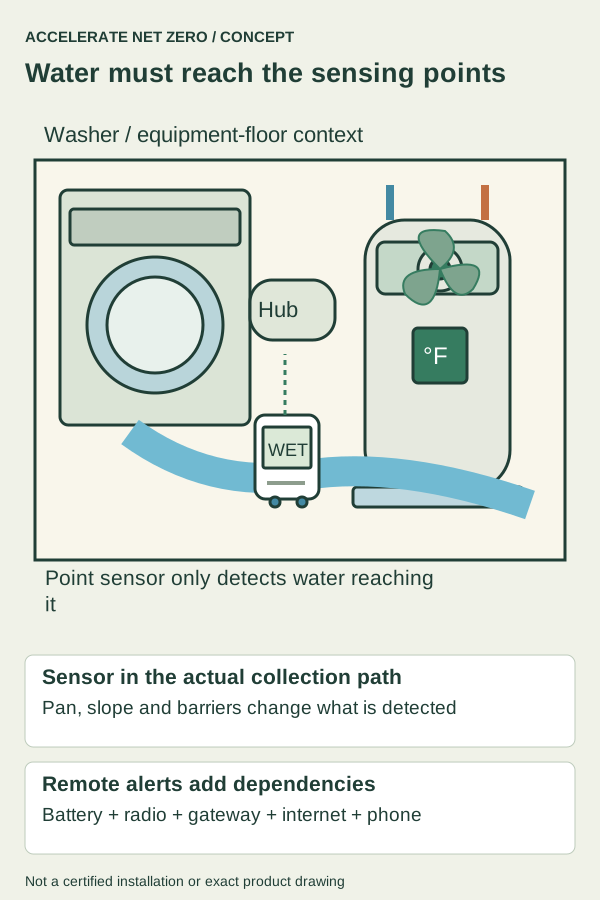
Do not assume one sensor watches an entire room simply because it sits near the equipment. Water must reach the sensing arrangement, so the relevant question is which path the device can detect and which paths remain outside it.
Keep required appliance clearances, drains, relief discharge, and service access unobstructed. The sensor should fit the intended environment without modifying a safety component, reaching into electrical equipment, or creating a trip hazard with a wire.
If you see active water, arrange the appropriate repair rather than using the alarm as permission to keep running the appliance. Detection is an additional warning layer, while an existing leak is already evidence that something needs attention.

Basement Watchdog BWD-HWA: a local warning with sensor reach

The BWD-HWA's manufacturer documentation describes a detachable sensor connected by a six-foot wire. That arrangement is relevant when the sensing location is awkward to see or reach but the alarm body can occupy a more accessible suitable position.
Choose it if someone is normally nearby and a local audible warning fits the response plan. The separate sensor can help you consider the actual collection point instead of forcing the entire alarm body into a cramped space beside the appliance.
The listed loud alarm is a product specification, not proof that you will hear it through closed doors, running laundry equipment, headphones, or another floor. Use the exact instructions for testing and verify audibility in the actual occupied home with appropriate consideration for the loud sound.
Plan the wire route so it does not interfere with the washer, moving parts, doors, service, or walking paths. A longer reach is useful only while the wire and sensor can remain in a safe, stable arrangement.
Skip this model if your key requirement is a remote phone warning while the home is empty. The BWD-HWA is not the manufacturer's separate Wi-Fi product, and a similar brand name does not add unlisted notification features to this exact alarm.
GoveeLife Water Leak Detector 1s: several locations with remote alerts
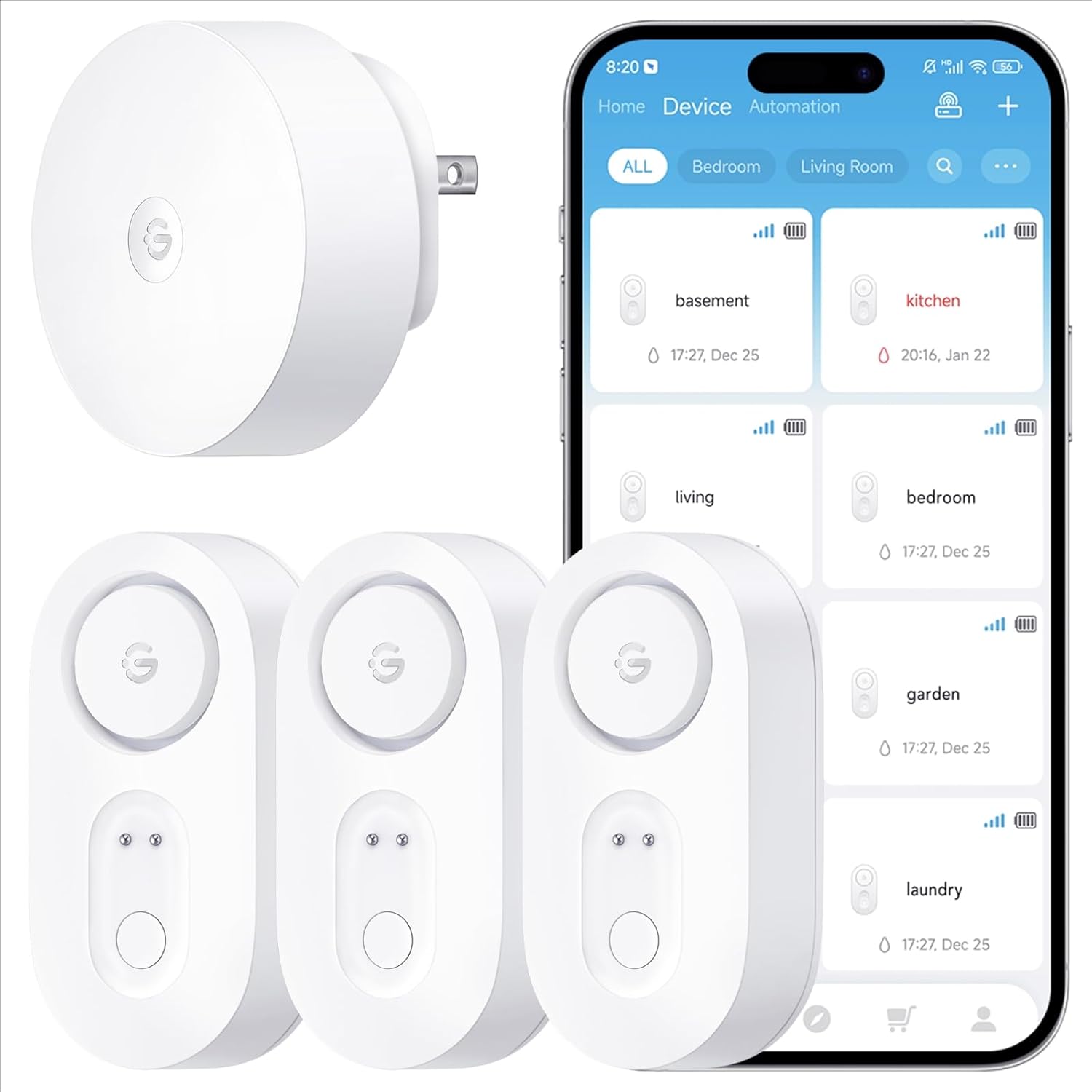
The inspected three-pack shows an H5044 gateway with three H5059 sensors in the matching primary image. Govee's documentation identifies the gateway as necessary for intelligent functions, so this is a kit comparison rather than a recommendation for an unconnected replacement-sensor pack.
Choose it if you need to check more than one suitable equipment-floor location and want remote notifications when the connection path is working. The gateway requires supported 2.4 GHz Wi-Fi, and the system's sensor compatibility needs checking before you add another model.
The remote chain includes the sensor, its battery, radio link, powered gateway, home network, internet service, app account, notification permissions, and the phone's own connection. A product's advertised range does not prove reliable delivery through your home's particular walls or during a power or internet outage.
Govee also documents a local alarm, which is useful as a separate warning path under the supported conditions. It still requires appropriate placement and testing, and muting an alert does not establish that the water source has stopped.
Skip this kit if you want an automatic shutoff valve or assume it directly controls your washer or water heater. The reviewed package is detection equipment; any shutoff solution needs its own compatibility, installation, and response design.
Compare the warning path, not only the loudness
| Decision | BWD-HWA | GoveeLife1s kit |
|---|---|---|
| Sensing arrangement | Separate sensor on six-foot wire | Three H5059 point sensors |
| Warning architecture | Local audible alarm | Local alarm plus supported gateway notifications |
| Network role | No remote network feature specified | H5044gateway + supported2.4GHzWi-Fi |
| Not included as a function | Automatic shutoff or phone warning | A shutoff valve or guaranteed internet delivery |
A local alarm can be simpler because it does not depend on the home's internet service to make sound. That simplicity is valuable only if someone can hear the warning and respond appropriately when the equipment area is wet.
A remote kit can be more useful for an empty home or an equipment room far from occupied spaces, while adding network and account dependencies. Decide who receives the alert and what they can safely do rather than treating a notification as the completed response.
Do not rank the two by untested speed, reliability, or coverage from marketing numbers. The meaningful difference here is the documented architecture and placement arrangement, with actual household performance still requiring the manufacturer's supported checks.
Remember that a laundry cycle can be noisy and the utility-room door may normally be shut. Those real conditions belong in the audibility and response plan instead of testing only in a silent room with every door open.
Place the sensing points where water can arrive
For a washer, consider accessible areas connected to the hose, appliance base, or pan's likely collection path without pulling equipment unsafely or disturbing connections. A sensor outside a pan may remain dry while water collects inside it, and the opposite arrangement has its own limits.
For a water heater, discuss the pan, condensate route where present, and other accessible water paths with the installer. Do not block a drain, alter a relief discharge, or attach a sensor to a hot or prohibited surface to make a location appear covered.
Keep the exact sensor's permitted orientation and environment in view, particularly where its contacts must face a particular surface. A photograph of an alarm standing neatly beside equipment does not prove the sensing points can encounter the first escaped water.
Where the path is uncertain or concealed, ask a plumber or appliance professional for help understanding the arrangement. A sensor plan can remain honest about uncovered areas rather than claiming full-room protection from one convenient location.
Test the complete response without creating a leak
Follow the manufacturer's test procedure rather than loosening a hose, opening a relief valve, or deliberately spilling water around electrical equipment. Record the date, battery status, local alarm result, and any remote notification result you actually observe.
For the connected kit, confirm the alert at the phone under the intended settings and check the manufacturer's guidance for loss of connection. Do not assume an app showing the device online proves that every notification method reaches every household member.
Assign a response person and an appropriate backup contact for periods when the home is empty, without sharing access beyond what is needed. A warning delivered to someone who cannot reach the property may require a different response plan from one heard by someone standing nearby.
Keep testing and battery maintenance in an ordinary household reminder, and recheck placement after cleaning, appliance service, or moving stored items. Sensors can be displaced quietly, so the original setup is not a permanent guarantee.
When neither alarm is enough
Choose a different professionally designed arrangement if you require automatic shutoff, coverage of concealed piping, supervised monitoring, or detection across a path these point sensors cannot reach. A leak alarm can complement that work, but it should not substitute for required installation or repair.
For ordinary laundry and water-heater use, the choice is between a well-placed local warning and a tested connected warning chain. Select the exact package that fits the response you can sustain, while keeping drainage, equipment safety, and the underlying water source at the center of the plan.
Sources & further reading
- Basement Watchdog: BWD-HWA Water Alarm — Detachable six-foot sensor connection; local alarm architecture and owner instructions.
- GoveeLife: Water Leak Detector 1s — H5044 gateway and H5059 sensors; intelligent functions require gateway; notification dependencies.
- ENERGY STAR: Heat Pump Water Heater Design Considerations — Model-specific air access, cooler discharge, noise, space and condensate design.
- The Basement Watchdog BWD-HWA water alarm with detachable sensor,single — Exact selected model/package and directly hosted primary image inspected in Chrome on October24,2026.
- GoveeLife Water Leak Detector1s,H5044gateway+3H5059sensors — Exact selected model/package and directly hosted primary image inspected in Chrome on October24,2026.
Sources checked October 24, 2026. Product details can change; confirm the exact model and listing before purchase.