As an Amazon Associate, this site earns from qualifying purchases through the product links below. These are comparisons of documented features, not claimed hands-on tests.
For a simple room-temperature comparison, choose the TempPro TP50 single unit when you want a local display with high-and-low records, or the TP49 three-pack when you need separate displays in several rooms at the same time. The placement and comparison method matter as much as the package.
This shortlist is limited to inexpensive local-reading instruments, using the exact inspected Amazon variants and relevant manufacturer material. It is not a laboratory comparison, a calibration service, or a claim that either instrument can diagnose an HVAC fault.
Decide between moving one instrument and keeping several in place
A single instrument can help you explore one room carefully, but moving it between rooms introduces settling time and changes the observation time. If the afternoon sun or HVAC cycle changes during that move, the readings are not a simultaneous room comparison.
Several instruments avoid that timing mismatch, while introducing the possibility that their individual readings differ even in the same place. Start by comparing them together under stable conditions and recording any consistent difference without declaring one a reference standard.
Write the question first: you might want to compare bedroom and hallway conditions overnight, or understand whether an office warms during work hours. That determines whether you need several concurrent displays, high-and-low memory, or an entirely different logging system.
Do not buy additional sensors merely to make a dashboard look complete. You need a repeatable observation location and a record you can maintain, not a large collection of numbers whose origin and timing are unclear.

TempPro TP50 single unit: a local record for one room

The inspected TP50 listing shows a single temperature-and-humidity display with high-and-low records and ordinary placement options. It suits a room where you can check the screen regularly and want some context beyond the current reading.
Choose it if you are mainly watching one bedroom, office, or living area and are prepared to write the time and conditions in a separate log. The screen's stored extremes can prompt a question about what happened while you were away, while your event notes help interpret it.
Do not assume a high or low value includes a timestamp or a full curve unless the exact instructions establish that function. Knowing a room reached an extreme does not by itself tell you whether the event occurred during sunshine, an open window, or a moved sensor.
The current Amazon title and image use the TempPro brand, while older manufacturer material may use ThermoPro. Match the exact model and supplied instructions, and do not transfer new CORE features such as calibration or backlighting from a differently described current manufacturer page into this inspected listing.
The practical limit is the single location: carrying it from room to room can answer exploratory questions, but it is a poor substitute for concurrent readings when conditions change quickly. If you need unattended time-series data or remote checking, choose a documented logger rather than assuming the TP50 supplies those functions.
TempPro TP49 three-pack: several room displays

The inspected TP49 package contains three compact local-display units, shown together in the matching primary product image. That makes it a relevant candidate when your question involves several rooms at the same observation time.
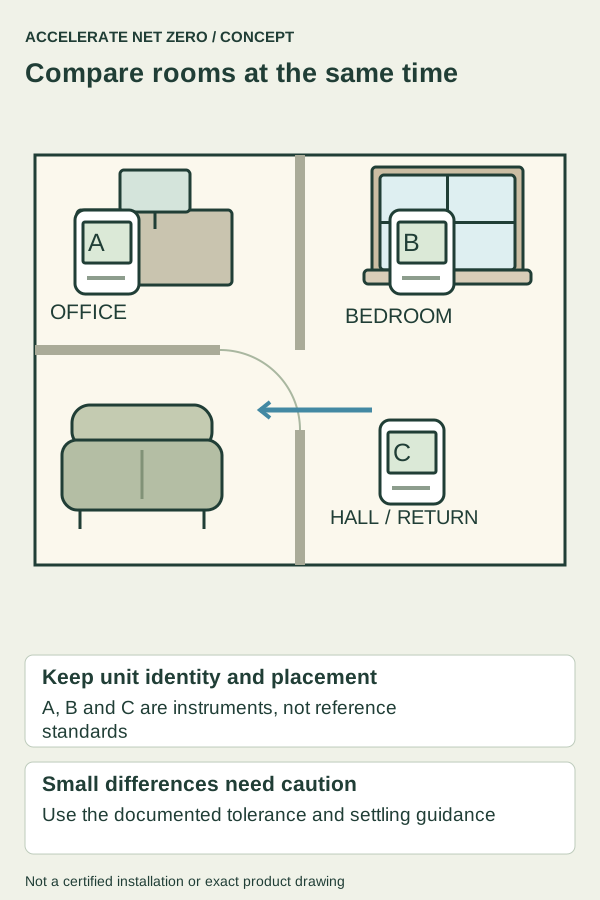
Label the instruments A, B, and C in your notes and assign each to a named location. Keep the supplied instructions and record any battery replacement or move, because a location comparison is only useful while you know which unit produced each number.
Choose this set when you can read the screens yourself and want a simple arrangement without assuming a gateway or app is included. The listed tabletop, magnetic, and hanging options offer placement flexibility, but the mounting method still needs to suit the actual surface and household.
Skip it if you need one central display showing every room, automatic exports, or a remotely visible overnight graph. Three independent screens give you more locations, while they do not automatically create a connected monitoring system.
The listing's accuracy wording mixes Fahrenheit and Celsius in a way that deserves checking against the supplied manual before relying on a precise tolerance. This comparison therefore does not rank the set as more accurate than the TP50 or treat small differences as a confirmed room condition.
Use the package to support the observation
| Question | TP50 single unit | TP49 three-pack |
|---|---|---|
| One room at a time | Local current and high/low display | One of three independent displays |
| Concurrent room comparison | Requires another instrument | Three locations at the same time |
| What remains manual | Event notes and reading time | Unit identity, location and reading time |
| Choose another type | Unattended logging or certified measurement | Central remote display or automatic exports |
For one room's ordinary daily pattern, the TP50's displayed extremes may be the more relevant feature. For a bedroom-hallway-office comparison, the TP49's three locations may matter more than keeping a larger local display in only one room.
Neither approach makes sensor placement optional. Keep the instruments away from direct sunlight, supply jets, hot electronics, and local moisture sources when your question concerns representative occupied-room conditions.
A magnetic mounting option can be convenient, but the chosen metal surface may itself be near an appliance or a cold exterior condition. Select the location for the air you want to observe rather than choosing the first place the magnet will stick.
If a child or pet can reach the instrument, choose a secure location and follow battery-safety instructions. Do not trade stability or accessible battery protection for a position that looks better in a photograph.
Establish a sensible comparison before separating the units
Put the units near each other in one stable location with air around their sensing openings, and let them settle according to their instructions. Record their displayed temperatures and any stated tolerances instead of immediately averaging the numbers into an assumed truth.
If one unit differs consistently, keep that observation attached to its identity. Do not apply an improvised offset or calibration procedure unless the exact instrument supports it, and do not call a kitchen-table comparison a certified calibration.
Then move each instrument to its chosen room, allow settling, and make readings at the same useful times. Your first notes should include room use, door position, sunshine, and system settings so the comparison has context.
If the difference is small relative to the documented uncertainty, describe it cautiously. A large-looking decimal on an LCD does not prove the room changed by that exact amount or that a thermostat needs replacing.
Work through a three-room afternoon
Imagine your office feels warm, the hallway seems comfortable, and the bedroom is used only at night. With three stable locations, you can record all three in late afternoon and note that the office has sunshine, a closed door, and running computers.
That record gives you a focused question about the office without assuming the HVAC system is undersized. If you had carried one instrument through the rooms over an hour, changing weather and system cycles would make the comparison less direct.
For a single-room overnight concern, a logger could be more useful than either manual arrangement. Decide whether the missing information is the extreme, its timing, or the entire pattern before buying extra local displays.
Keep humidity readings in context too, because relative humidity depends on temperature. The instruments can help you describe room air, while they do not measure wall moisture, detect every hidden leak, or establish that air quality meets a health standard.
When neither choice is appropriate
Choose a different instrument if you need certified accuracy, automatic recording, remote access, water-resistant use, or conditions outside the exact product's operating limits. A consumer room thermometer should not be repurposed as a food-safety or medical device because a sales page lists many possible uses.
If the room has an active leak, unsafe equipment behavior, or a persistent comfort issue, address that condition through the appropriate help. A clearer temperature record can support the conversation without replacing the investigation.
Check the exact package and current instructions before purchase, especially where product naming has changed. The best fit here is the instrument arrangement that makes your actual room question easier to answer with repeatable, honestly interpreted readings.
Sources & further reading
- ThermoPro: TP-50 Model Manual — Legacy model instructions and local reading context; current CORE page not substituted for the inspected Amazon package.
- TempPro: TP49 Three-Pack — Independent local displays, mounting methods and ambiguous mixed-unit headline accuracy wording.
- NWS: Discussion on Humidity — Relative humidity depends on temperature; saturation and dew point relationships.
- TempPro TP50 Digital Hygrometer Indoor Thermometer, single unit — Exact selected model/package and directly hosted primary image inspected in Chrome on October24,2026.
- TempPro TP49 Digital Hygrometer Indoor Thermometer,3 pack — Exact selected model/package and directly hosted primary image inspected in Chrome on October24,2026.
Sources checked October 24, 2026. Product details can change; confirm the exact model and listing before purchase.