As an Amazon Associate, this site earns from qualifying purchases through the product links below. These are comparisons of documented features, not claimed hands-on tests.
Choose weatherstripping by the moving joint, available mounting surface, seal profile, and the space it must compress into when the door closes. For this limited shortlist, Frost King's V25WA offers a shaped rubber profile, while M-D 02071 offers a compressible open-cell foam strip.
These are individual roll products you can use in a suitable weatherstripping project, rather than complete repair kits for every door. The comparison uses exact Amazon models and manufacturer information, with no claimed hands-on durability or measured energy-saving test.
Decide whether a replacement strip is the right job
This guide assumes you have already checked the door's ordinary operation and identified the location where a compatible replacement seal belongs. If the leaf sags, rubs badly, fails to latch, or has damaged framing, address that condition before asking a thicker strip to compensate.
Distinguish the moving joint from a stationary crack around trim. Caulk may be relevant to a suitable stationary joint, while weatherstripping is chosen for a location where the parts move and the material needs to compress, flex, or slide as designed.
Also distinguish a door-bottom assembly, an existing kerf-mounted seal, and an adhesive strip on a stop. Their mounting methods differ, and neither roll below is an automatic replacement for every proprietary bottom, threshold, or inserted profile.
If the opening is fire-rated, part of a shared building, or subject to specific performance requirements, consult the responsible manufacturer or qualified professional. Do not apply a generic strip in a way that changes a required door's latching, closure, ventilation, or certified assembly.

Frost King V25WA: a shaped rubber seal

The inspected V25WA listing identifies a white D-section rubber self-stick strip, 5/16 inch wide, 1/4 inch thick, and 17 feet long. Its shaped section makes it a candidate when the approved mounting location and closing space suit that profile.
Choose it if you want a defined compressible rubber shape and can prepare a compatible surface according to the product instructions. Before buying, inspect the profile drawing and where the adhesive face will sit, rather than assuming a white strip replaces any white seal already on the door.
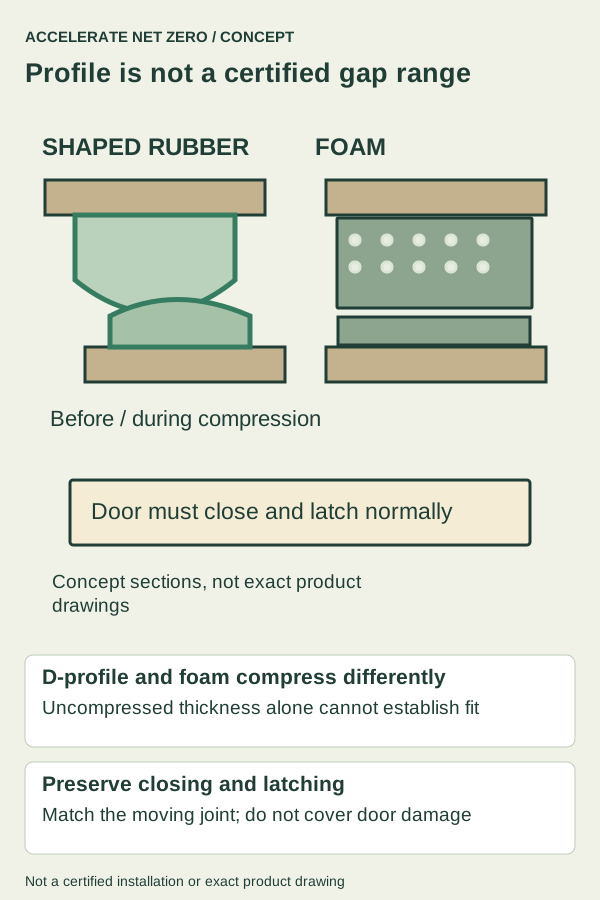
The printed thickness is an uncompressed material dimension, not a verified universal gap range. You need the actual product instructions and a fit check to establish that the door can close and latch normally with the seal in its intended position.
Frost King's product family contains other profiles and colors, so keep the V25WA identity attached to the Amazon link. Do not substitute a P-section, ribbed strip, or different thickness based on a similar product-family photograph.
Skip this option if your existing seal requires a specific inserted or mechanically fastened profile, the surface is unsuitable for its adhesive, or the door would have to be forced shut. A larger compression force is not proof of a better seal or a reason to accept poor latch operation.
M-D 02071: an open-cell foam alternative

The exact inspected Amazon technical table identifies model and manufacturer part number 02071. M-D's manufacturer catalog describes this model as adhesive low-density open-cell foam, with a 1/4-inch thickness, 1/2-inch width, and 17-foot length.
Choose it only where that material and mounting arrangement suit the intended door or window application. Its compressibility can be relevant to a suitable uneven contact area, but it should not become a way to hide a damaged or poorly aligned opening.
The catalog consulted is an older manufacturer document, so confirm the supplied roll's current label and installation instructions before cutting or applying it. The exact Amazon model check helps bind the identity, while it does not justify inventing a current weather-exposure rating or expected life.
Open-cell foam and a shaped rubber section are different material choices, not a simple higher-versus-lower quality ladder. Consider the manufacturer's permitted location, contact action, moisture exposure, and expected wear at that specific joint.
Skip it where you need a documented water-management component, a proprietary replacement profile, or performance claims the exact product does not establish. This strip is not structural repair, a drainage detail, or permission to seal an intentional air path.
Compare the profile against the closing space
| Check | Frost King V25WA | M-D02071 |
|---|---|---|
| Material/profile | Shaped rubber, D-section | Low-density open-cell foam |
| Listed dimensions | 5/16inW ×1/4inT ×17ftL | 1/2inW ×1/4inT ×17ftL, archived maker catalog |
| Mounting | Self-stick; compatible prepared surface | Self-adhesive; check current supplied instructions |
| Do not infer | A universal certified gap range | A water-management rating or fixed lifespan |
Look at the full path of closure, including the hinge side, latch side, and top, because the contact geometry can differ. A strip that seems acceptable at one corner may create resistance elsewhere or peel as the door moves.
Check the product's intended compression and placement instead of stacking layers to consume a large gap. Multiple layers can change the way the adhesive and material behave, and they are not an automatic substitute for the correct profile or a door repair.
Keep the latch test part of the acceptance check: the door should close and latch as intended without relying on extra force or defeating hardware. If it no longer does, stop and reassess the product and underlying opening rather than trimming randomly until it appears tolerable.
For a rented property, get the required permission and agree on the treatment before removing existing material. A removable-looking adhesive product can still affect finishes or leave residue, so follow the building's arrangements and the product's surface guidance.
Prepare the surface as the instructions require
Read the installation conditions for the exact roll, including suitable surfaces, cleaning, drying, temperature, and application. An adhesive strip applied to damp, dirty, loose, or incompatible material may fail even when its profile would otherwise suit the joint.
Do not cover rot, loose paint, corrosion, or active water damage with a new seal. Those conditions need the appropriate repair, and concealing them can make the next inspection harder without resolving the problem.
If removing old material could disturb hazardous paint or another suspect material, get qualified advice before scraping or sanding. A weatherstripping task should not silently turn into a hazardous-material project because you wanted a cleaner adhesive surface.
Plan the lengths and corners before you remove backing, and follow the manufacturer's joining and cutting instructions. You want continuity at the intended seal line without stretching, bunching, or obstructing drainage and hardware.
Evaluate fit before claiming a result
After a permitted installation, check ordinary opening, closing, latching, and the intended contact along the joint. Look for material dragging, peeling, bunching, or being displaced by the door's motion rather than judging only the appearance with the door open.
Recheck after ordinary use and relevant weather, because a strip can look tidy immediately after application while later movement reveals a poor fit. Keep the packaging and instructions so you can identify the exact product if a problem appears.
Do not promise a particular reduction in bills from replacing one seal. Air leakage and energy use depend on the whole building, weather, equipment, and behavior, and neither a new strip nor a draft sensation supplies a measured savings figure.
If the draft remains, return to the observed location instead of automatically adding thicker material. The remaining issue may be outside the treated moving joint, or it may require a different repair that the roll was never intended to provide.
When neither roll fits
Choose neither when the door needs alignment or structural repair, the existing assembly requires an exact proprietary part, the surface or exposure is outside the instructions, or safe closure would be compromised. Also leave required ventilation, combustion air, drainage, and specialized door performance to the appropriate design.
Your best choice is the profile and material supported for the actual joint, with normal door operation preserved. Buy the exact model only after that fit is established, rather than choosing a roll because its uncompressed thickness happens to resemble a visible gap.
Sources & further reading
- Frost King: Rubber Weatherseal Family — Shaped rubber profiles; exact V25WA dimensions and white package verified separately in Chrome Amazon listing.
- M-D Manufacturer Catalog, 2011, p. 11 — Archived primary product description:02071 open-cell adhesive1/4in×1/2in×17ft; current label must be checked.
- ENERGY STAR: Identify the Problems You Want to Fix — Air-sealing work requires relevant combustion-safety and ventilation consideration.
- Frost King V25WA D-Section White Weatherseal,5/16inW×1/4inT×17ftL — Exact selected model/package and directly hosted primary image inspected in Chrome on October24,2026.
- M-D Building Products02071 Open-Cell Foam Weatherstrip Tape,one17ftroll — Exact selected model/package and directly hosted primary image inspected in Chrome on October24,2026.
Sources checked October 24, 2026. Product details can change; confirm the exact model and listing before purchase.