An HVAC filter label tells you several different things: its dimensions, its particle-removal rating, its intended direction of airflow, and sometimes a replacement reminder. Read each part separately, then match the replacement to your equipment's instructions rather than choosing by the largest number on the package.
A filter that looks close enough on a store shelf may not fit your actual rack. A higher particle-removal rating also does not establish that your system can accommodate that particular filter's resistance to airflow.
Find the equipment instructions first
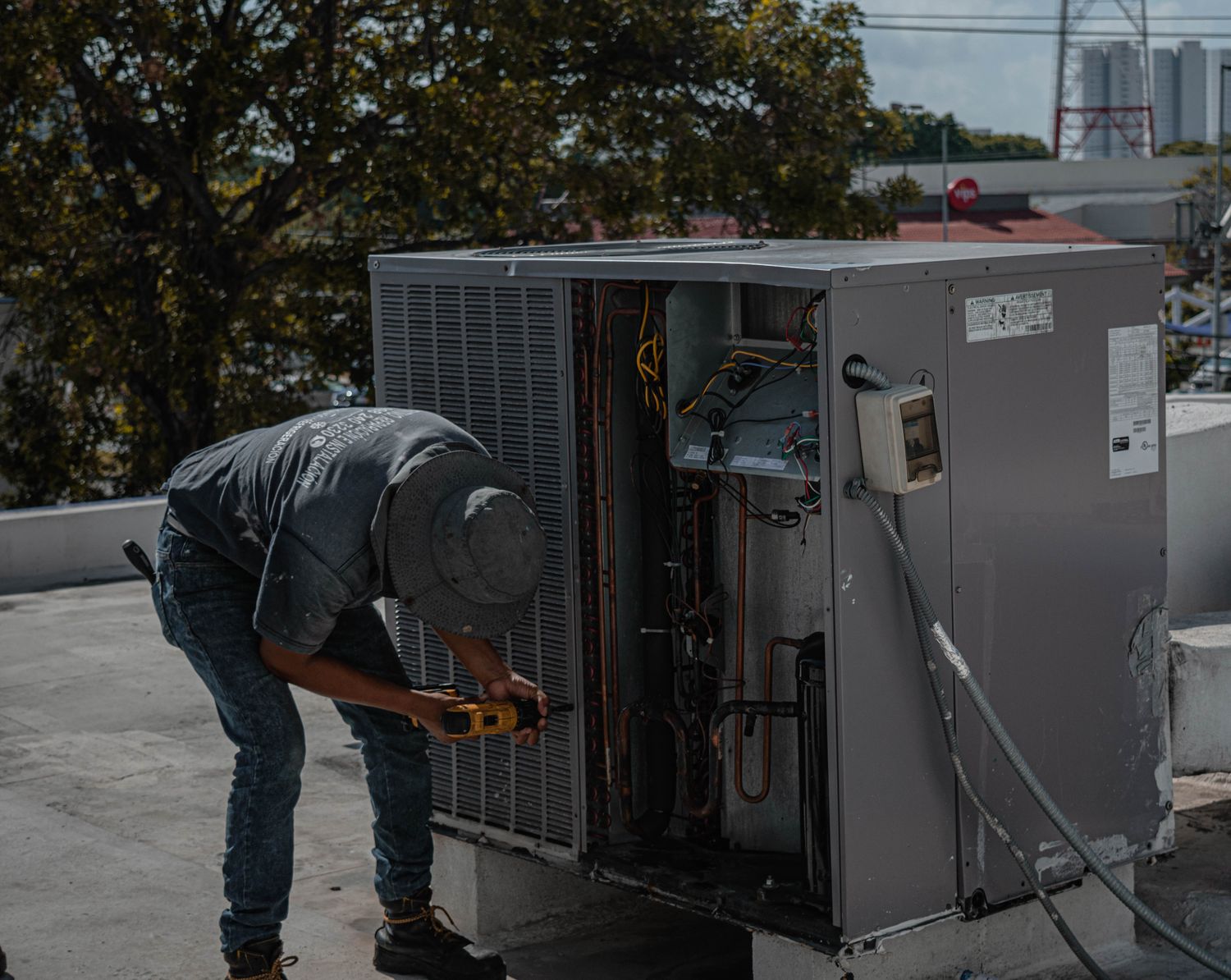
Identify the equipment and filter location from the homeowner manual or service record before removing anything. Some systems have a filter at a return grille, some use a cabinet, and unfamiliar access should be left to a qualified professional.
Follow the specified shutdown and access procedure whenever the filter is intended for homeowner replacement. Do not reach into operating machinery or assume that opening a random panel is equivalent to opening a designated filter door.
If the previous installer left a recommended replacement part number, keep it with the equipment model information. That gives you something specific to check when a retailer lists several nominally similar filters with different actual dimensions or media designs.
For a rented home or shared building, confirm who is responsible for the filter and which equipment serves your space. A visible grille in your apartment does not automatically mean you should alter a central system maintained by the building.
Separate nominal size from actual size
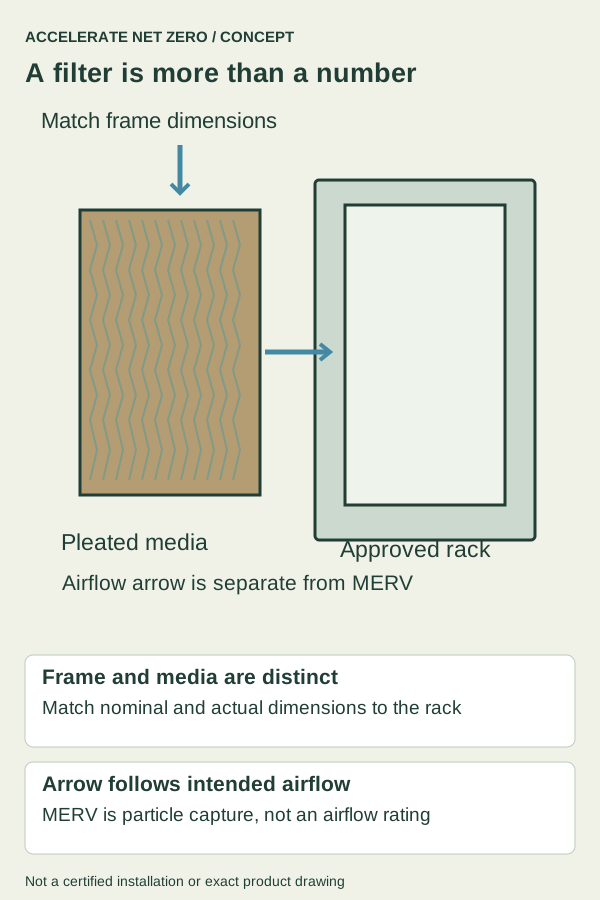
The large size printed on a package can be a nominal description rather than the exact measured dimensions. Read the smaller actual-size information and compare it with the required replacement, including thickness, instead of assuming every “one-inch” filter is identical.
Record length, width, and depth in a consistent order and keep the units attached. A photograph of the old frame label can help, but remember that the previous filter might itself have been the wrong size.
Check how the approved filter sits in the rack or grille without bending, crushing, or leaving a bypass gap. EPA advises a snug fit so air does not leak around the filter, which is a different requirement from forcing an oversized frame into place.
Do not cut a disposable framed filter to make it fit unless the exact product and equipment instructions explicitly support that use. Altering a frame can leave gaps or weaken it, and a tidy-looking edge does not establish the intended sealing or airflow performance.
Read MERV as a particle-removal rating
EPA explains that MERV reports a filter's ability to capture particles in specified size ranges using a standard test method. It is useful for comparing filtration performance, but it is not a direct measure of airflow, filter life, whole-home air quality, or compatibility with your system.
You may also see proprietary rating systems on retail filters. Keep the original rating name attached rather than assuming a number from one scale equals the same number from another or inventing a conversion from package colors.
Look for the actual product specification and the system manufacturer's guidance when comparing filters. A package slogan about allergens does not tell you the pressure drop at your system's airflow, and a medical-sounding claim should not replace the equipment decision.
If you want more efficient particle filtration, EPA recommends MERV 13 or the highest level your system can accommodate. Ask an HVAC professional when you cannot establish that compatibility, rather than assuming the highest-rated retail option must be the best fit.
Do not confuse thickness with a universal upgrade
A deeper media cabinet can use a different filter design from a thin return-grille filter. You cannot substitute one for the other merely because the length and width look similar, and adapting a cabinet belongs to the equipment design rather than a shopping improvisation.
Likewise, two filters of the same nominal dimensions can have different media and airflow characteristics. Compare the exact product information if you are switching types, especially when the equipment manual or service record specifies a particular replacement.
If the rack, door, or filter frame appears damaged, report that condition instead of using tape and cardboard to hide the gap. A filter that stays upright is not necessarily installed as intended, and improvised supports can interfere with access or operation.
Take a clear photograph of the complete approved installation before closing the access point, if that can be done safely. It can help you repeat the correct arrangement later without needing to remember which side of the frame faced the blower.
Follow the airflow marking
Many filters carry an airflow arrow, which should match the intended direction of air through that filter location. Use the equipment instructions or verified system arrangement to establish that direction instead of guessing that arrows always point upward or toward the room.
The printed branding orientation is not a substitute for the arrow. A filter can have readable text while facing the wrong way, and different access locations make a universal visual rule unreliable.
If the arrow is missing or the instructions are unclear, ask the manufacturer or service provider before installing it. A short clarification is more useful than creating a household rule based on the orientation of the last filter, which may not have been correct.
After replacement, close and secure the intended access door as instructed. If the door no longer closes normally, stop and recheck the part and installation rather than operating with the panel loose or forcing the latch.
Treat replacement intervals as instructions to check
Read the manufacturer's maintenance schedule and any conditions attached to it. A retail phrase such as “up to” a certain number of months is not a guarantee that your filter remains suitable for that period under every home condition.
Keep a record of the installation date, exact filter, and inspection findings rather than relying only on a calendar alert. Pets, renovation dust, system use, and local events can change what the filter encounters, but do not invent a new universal interval from those possibilities.
If the filter becomes unusually dirty quickly, describe the timing and recent household changes to the service provider. Repeatedly replacing it can be necessary maintenance while still leaving the reason for the unusual loading unresolved.
Do not wash a disposable filter because it looks reusable, and do not apply fragrances, cleaners, or coatings to the media. Reusable products have their own cleaning and drying instructions, which need to be followed for the exact design.
Make the next purchase straightforward
Create a small replacement note with the equipment model, approved filter model or specification, nominal and actual dimensions, rating, airflow direction, and maintenance instructions. Keep a photograph of the package label so a renamed retail listing does not erase the details you relied on.
Imagine a store offers two filters both marked 20 × 25 × 1, but their actual dimensions and ratings differ. Your note lets you compare them with the approved requirement instead of choosing the one with the more impressive marketing number.
If the system has airflow noise, weak delivery, or an unresolved comfort problem, mention that before changing filter type. The right conversation may involve the rack, ductwork, blower, and filtration goal together rather than a simple higher-versus-lower rating choice.
Keep the purpose realistic: a correctly selected filter supports the intended system operation and particle filtration. It does not repair leaks, remove every pollutant, diagnose health symptoms, or replace ventilation and source control in the home.
When ordering several replacements, compare the delivered package with your saved specification before opening every filter. A retailer substituting a nearby size or a different media type can interrupt an otherwise reliable maintenance routine, so keep the actual product identity visible in the household record.
Sources & further reading
- EPA: What Is a MERV Rating? — MERV particle-capture basis and compatible higher-efficiency filter selection.
- EPA: Ducted Air-Source Heat Pumps and Filtration — Whole forced-air arrangement determines compatibility; snug filter fit without crushing or bypass.
Sources checked October 24, 2026. Product details can change; confirm the exact model and listing before purchase.