One warm room does not automatically mean your air conditioner needs replacing. Begin by confirming the pattern, then look at room use, sunlight, accessible airflow, and the difference between the affected room and the thermostat's location.
You can gather useful clues without opening equipment or changing ductwork. The aim is to give a professional a clear room-specific problem to investigate if ordinary accessible checks do not explain it.
Make the complaint specific
Write down which room feels warm, where you sit, and when the difference is most noticeable. A bedroom that becomes uncomfortable only after several hours with the door closed presents a different question from a sunroom that warms quickly on bright afternoons.
Measure temperature at a repeatable occupied location away from a direct supply stream or sunlit sill. If you compare it with another room, use comparable locations and allow a moved instrument to settle according to its instructions.
Keep the thermostat setpoint beside the measurements, but do not treat the setpoint as the measured temperature in every room. The control responds to its own sensing arrangement, and some systems also use selected remote sensors or scheduled averaging.
Describe comfort separately from temperature because a draft, direct sunshine, humidity, and activity can change how the room feels. “Warm while working at the west-facing desk” gives you more information than “the room is bad” even before you buy a meter.
Check what the room is gaining
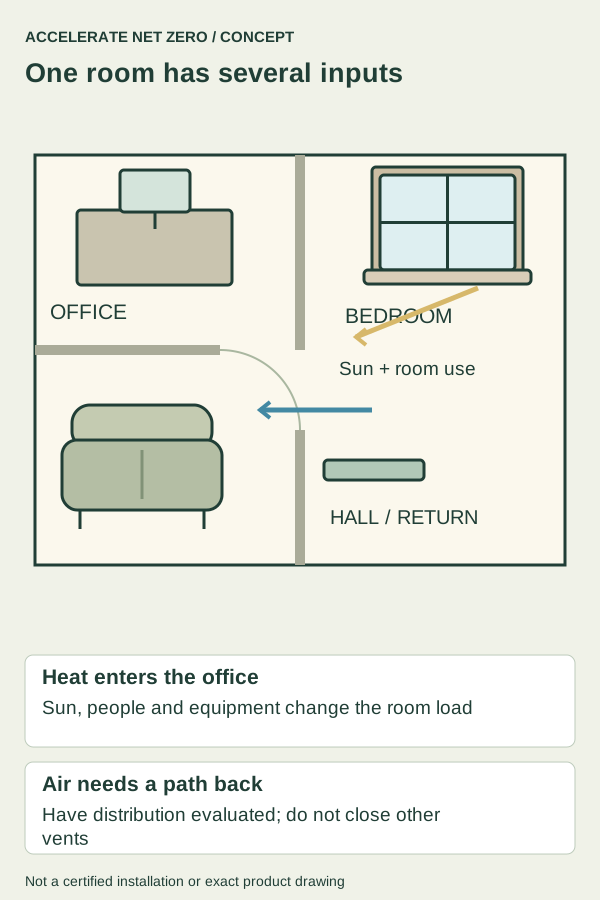
Look at the window exposure during the uncomfortable period rather than judging only from the room's morning appearance. Sun reaching the desk, sofa, or floor can make the afternoon experience different even when the central thermostat sits in a shaded hallway.
Note ordinary heat-producing activities such as people gathering, computers running, or cooking in an adjacent open area. You do not need to estimate an exact heat load to recognize that a spare bedroom used as an office now has a different daily pattern.
If you change coverings to explore the sunshine connection, use them safely and keep ventilation openings unobstructed. Observe the result over comparable periods rather than claiming a particular curtain produces a guaranteed temperature drop.
Think about changes to the room since the system was designed: an addition, enclosed porch, new wall, converted attic, or altered occupancy. A room that was added later may need a design review rather than simply a more aggressive thermostat setting for the original house.

Look at accessible supply and return paths
Identify the room's visible registers and grilles, then check whether furniture, rugs, curtains, or stored belongings block them. Keep their intended openings clear, and avoid putting your hand or tools inside a grille to investigate concealed equipment.
Distinguish a supply outlet from a return grille if you know the system layout, but leave uncertain openings labeled uncertain in your notes. The direction of a draft on one visit is not enough to map an unfamiliar house reliably.
Record the usual door position and whether the room has an apparent return path. A room's air must be considered as part of the whole distribution system, which is why a closed-door complaint can lead to different questions from a complaint that remains with the door open.
Do not start closing other rooms' vents to force air toward the warm room. Changes to the distribution network can affect airflow and equipment operation elsewhere, so ask a qualified professional before using register closures as a balancing strategy.
Check the maintenance information you already have
Review when the HVAC filter was last checked and what the equipment instructions require. If filter access is designed for homeowner maintenance, follow that procedure; if access requires opening an unfamiliar equipment compartment, use professional help.
A dirty or poorly fitted filter is relevant to overall system operation, but it does not prove why one room differs. Record its size, type, installation date, and any uncertainty rather than replacing it with the highest rating you can find as an experiment.
Look for recent service notes, error messages visible on the normal control, or a change in how the system sounds. You can report a new noise or longer operating period without diagnosing a motor, refrigerant charge, or control fault from that observation alone.
If the problem began directly after maintenance or renovation, include the timing in the service request. That sequence may help the professional decide what to check first, while still leaving room for an unrelated cause.
Understand why ducts belong in the conversation
ENERGY STAR identifies poorly performing duct systems as a possible contributor to rooms that are too hot or cold. That makes duct design, leakage, insulation, and airflow relevant questions for a professional rather than a homeowner conclusion from a weak-feeling register.
Ask what measurements would distinguish a room heat-gain issue from a distribution issue. A useful investigation might need more information than the sensation of airflow at a grille, particularly when parts of the duct system run through inaccessible or unconditioned spaces.
Avoid applying ordinary cloth-backed tape or improvised sealants to concealed or unfamiliar system components. You want an appropriate documented repair that considers the system, not a cosmetic patch that makes a joint look finished while leaving the actual problem unresolved.
Also keep combustion and ventilation considerations in view when building or duct changes are proposed. You do not need to perform those tests yourself, but you should ask who evaluates the effects of the proposed work on the home as a whole.
Work through a desk-room example
Imagine a back bedroom becomes your weekday office, with the door closed and two computers in use. It feels warmer after lunch, while the hallway thermostat reaches its setting and the rest of the home seems comfortable.
You record the room and hallway at comparable times, keep the sensor off the sunny desk, and note door position and sunshine. You also find that a cabinet partially covers the visible register, so you restore its clear space according to the intended room layout.
If the room remains uncomfortable, you now have a better service description than “AC is weak.” The professional can examine the room's changed use, solar exposure, supply and return arrangement, and system design without assuming the entire unit is undersized.
If the whole house begins struggling instead, that is a new observation worth reporting rather than forcing it into the original one-room explanation. A useful investigation can change direction when the evidence changes.
Ask for a result you can verify
When a repair or modification is proposed, ask what problem it addresses and how the result will be checked. A measured airflow or design explanation is more useful than a promise that a larger unit or a stronger fan will automatically make every room comfortable.
If replacement equipment is discussed, ask how the room and the rest of the house enter the sizing calculation. You should not have to choose system capacity from floor area alone or accept a one-room complaint as sufficient evidence for a larger system.
After the work, revisit the original room at comparable times with the same basic observations. Weather and use will vary, so look for a consistent improvement rather than declaring success from one mild morning.
Keep the record short and practical enough to use again when seasons change. A room that improves in cooling weather may still need a separate heating-season check, because the conditions, equipment operation, and household use can be different.
If the complaint occurs only at one chair, compare that occupied spot with another ordinary place in the same room before describing the entire room as equally warm. Direct sunshine on your body and a room-wide temperature difference are different observations that deserve separate notes.
Sources & further reading
- ENERGY STAR: Benefits of Duct Sealing — Duct design and sealing can be relevant to uneven room temperatures.
Sources checked October 24, 2026. Product details can change; confirm the exact model and listing before purchase.