On many thermostats, Fan Auto runs the circulation fan when the system calls for it, while Fan On requests continued fan operation. Check your equipment and control manual before treating that description as a complete rule, because schedules, circulation modes, and accessories can change what the system does.
The choice involves more than whether you like a breeze. Think about filtration, room temperature distribution, moisture behavior, electricity use, and the system's intended ventilation arrangement before changing the setting.
Separate the fan from heating and cooling
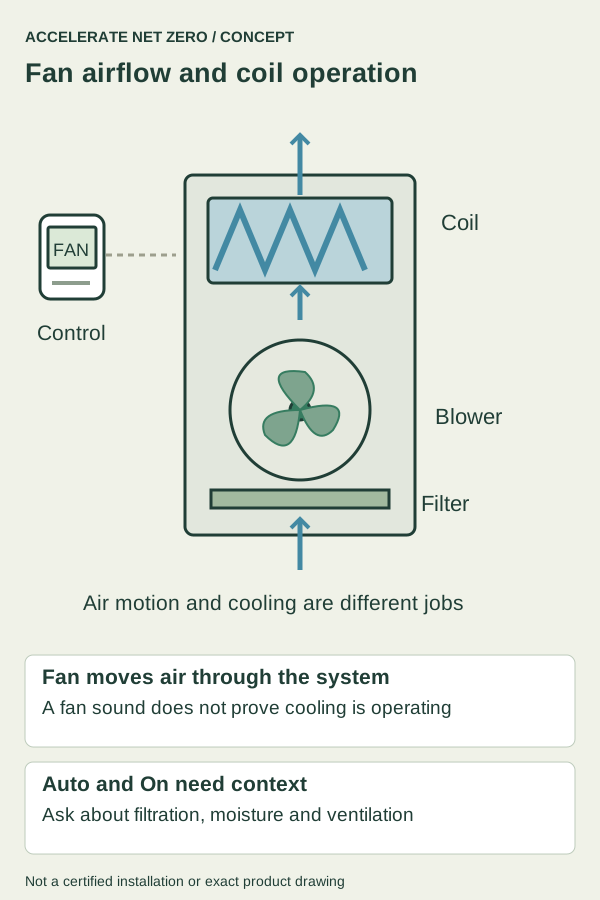
The indoor fan moves air, while the heating or cooling equipment changes its condition when those functions operate. Hearing airflow at a grille does not prove that the compressor or burner is running, so record the thermostat's mode and indications as well as the sound.
You may see Heat, Cool, Auto, Off, Fan Auto, Fan On, or a separate circulation option on the same control. Do not confuse automatic heating-and-cooling mode with the fan's automatic setting, because the word “Auto” can appear in more than one part of the interface.
Look up the exact control model and find the section explaining fan behavior. If your system has a communicating controller, multiple zones, or an installer-configured schedule, ask the service provider which settings you can change and what each one affects.
Write down the current setting before experimenting with an ordinary homeowner control. A photograph of the normal screen can help you restore the intended setup, without changing installer menus or configuration values you do not understand.
Decide what you want the fan to accomplish
If your concern is a temperature difference between rooms, describe that problem before assuming more fan time is the answer. Additional circulation may be relevant, but blocked registers, room heat gain, duct design, and return paths can require different attention.
If your concern is particle filtration, remember that air must pass through the intended filter for that system to filter it. EPA notes that longer HVAC fan operation can provide more filtration, while also increasing electricity use and potentially affecting cooling-season humidity control.
If your concern is an odor or a moisture source, circulating air does not remove the cause. A fan setting cannot repair a leak, clean contaminated materials, or prove that required outdoor ventilation is operating correctly.
That difference in goals matters because an action that helps one objective may not be the best overall arrangement. A useful conversation with a professional asks how the home should manage comfort, filtration, and ventilation together instead of optimizing one screen setting in isolation.

Keep moisture in the cooling-season discussion
The cooling system's moisture behavior depends on the equipment and controls, so avoid a universal claim that continuous fan operation always dries or always wets a home. EPA specifically identifies less reliable humidity control as a possible concern with longer HVAC run time during cooling.
If the house feels sticky, record temperature, relative humidity, the fan setting, and when cooling appears to operate. Keep the sensor in one representative location rather than moving it beside a supply outlet to obtain a more dramatic reading.
Also record showers, cooking, open windows, and other relevant events. A percentage that changes after you alter the fan does not isolate the fan's effect if the weather and household moisture sources changed at the same time.
Ask the technician whether the exact system has a recommended cooling-season fan strategy or humidity-control feature. That answer can depend on coil behavior, blower programming, controls, and ventilation integration that a generic thermostat article cannot determine for you.
Understand what the setting cannot establish
Fan On does not automatically mean the house is receiving fresh outdoor air. Many residential forced-air arrangements primarily recirculate indoor air, while intentional outdoor-air equipment may have separate controls or a specific integration with the HVAC system.
Do not infer the ventilation design from the presence of a fan button, and do not close or block an unfamiliar intake to reduce a draft. Ask which device supplies outdoor air, how it is controlled, and what owner checks its manufacturer permits.
Likewise, a higher filter rating does not automatically make longer fan operation appropriate. The filter must fit the system's airflow capability and rack, and the overall strategy still needs to consider the home's conditions.
Keep health concerns separate from equipment claims that your observations cannot support. A room feeling fresher or a display showing more fan hours does not prove that pollutant levels meet a particular target or that a medical risk has been resolved.
Compare settings without creating a confusing experiment
For an ordinary permitted setting comparison, start by writing down the question and the system-specific guidance. Keep your normal temperature settings steady and observe the same room locations, noting weather, activities, and any changed door positions.
Use a short log of room temperature, relative humidity, comfort, and the selected fan setting. If the control reports runtime, label it as reported runtime rather than assuming it measures the exact energy used by the motor.
Do not compare a quiet unoccupied weekday with a crowded cooking-heavy weekend and attribute everything to the fan. You can learn from ordinary household observations while acknowledging that they are not a controlled equipment test.
Stop the comparison if you notice a problem such as unusual noise, an error indication, persistent dampness, or overheating, and follow the equipment instructions. You do not need to continue an experiment to prove a concern that already warrants service.
Ask about electricity with the right boundaries
A fan that operates longer uses energy, but the amount depends on the motor, speed, controls, and operating conditions. Do not calculate a household cost from an unrelated fan's wattage or assume a product brochure describes your installed blower's actual use.
If the cost matters to the decision, ask what system-specific data or measurements are available. A qualified professional can advise on appropriate measurement without requiring you to open panels, clamp conductors, or insert an appliance meter into hardwired HVAC equipment.
Keep the bill comparison separate from a device measurement because a utility bill includes all household loads and may have different billing days or rates. A higher total charge after changing a setting is a reason to investigate, not proof of the fan's exact contribution.
You also need to include the purpose of the extra operation when judging value. An agreed filtration or ventilation strategy should be evaluated as a whole rather than abandoned solely because the fan now runs when cooling is not active.
Use a realistic service conversation
Imagine the upstairs bedrooms feel uneven and the household changes Fan Auto to Fan On to see whether circulation helps. The rooms feel somewhat different, but humidity also appears higher during a week of muggy weather.
Bring that complete account to the technician instead of asking whether Fan On is simply “good” or “bad.” Ask about the distribution system, the recommended fan program, the humidity-control arrangement, and whether required outdoor ventilation depends on the blower.
If a different program is recommended, ask how to recognize its normal operation and which settings should remain unchanged. That gives the household a usable routine instead of a rule remembered without the conditions that made it appropriate.
Revisit the original comfort question after the setting is settled and any needed service is complete. The best result is an understood operating strategy for your equipment and home, with clear reasons for the fan behavior you see.
If your thermostat offers a timed circulation percentage, ask how that mode differs from continuous On before using it as a compromise. Write down the exact option name and recommended program, because a percentage shown by one controller may not describe the same behavior on another.
Sources & further reading
- EPA: Guide to Air Cleaners in the Home — Filtration complements source control; fan runtime involves electricity and cooling-season humidity tradeoffs.
Sources checked October 24, 2026. Product details can change; confirm the exact model and listing before purchase.