Plan a space heater's location before you plug it in, with the room in the arrangement you will actually use. You need the manufacturer's clearances, a suitable wall outlet, stable placement, a clear cord route, and a routine that keeps the heater attended.
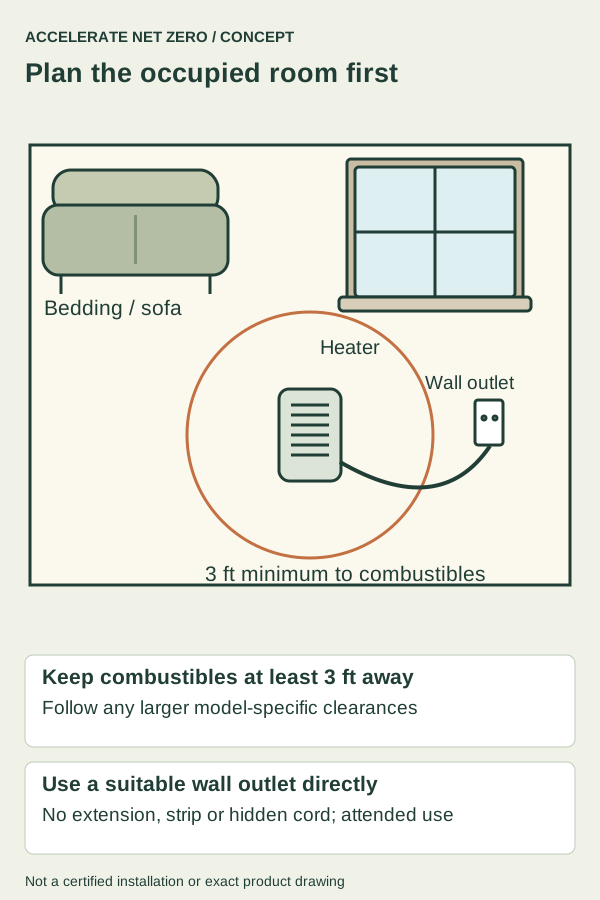
CPSC advises keeping portable heaters at least three feet from combustible items and plugging electric heaters directly into a wall outlet, never an extension cord or power strip. Treat those basics as part of the room plan, while following any additional requirements in the exact heater's instructions.
Start with the occupied room
Look at the room when the bed is in use, the chair is pulled out, the curtain hangs normally, and the door swings open. A heater position that looks clear in an empty room may become crowded as soon as someone sits down or puts a bag on the floor.
Identify beds, sofas, curtains, papers, clothing, and other items that can burn. Measure the actual clear space rather than estimating it from a photograph or assuming a small heater needs only a small buffer.
Keep the heater away from routes where someone could kick it, trip over it, or move an object into its clearance area. Think about children, pets, mobility aids, and anyone who may not notice or respond quickly to a hot appliance.
If the room cannot provide a suitable location, do not force a heater into the plan. A different comfort strategy or an assessment of the main heating system is a better next step than accepting a placement you already know will be difficult to maintain safely.
Use the exact instructions for the supporting surface
Read where the selected heater may stand and how its base must be assembled. Do not put it on furniture, bedding, or an unstable improvised platform to aim it more conveniently unless the exact design is specifically intended and instructed for that placement.
Check that the surface and base remain stable under ordinary household movement. An assembled heater should not depend on a stack of books, a wedged cord, or a partly opened drawer to keep it upright.
Keep air inlets and outlets unobstructed according to the manual, including any clearance required behind or above the unit. The visible hot face is not necessarily the only part whose surroundings matter.
If a manufacturer requires clearances larger than a general safety reminder, follow the model's requirements. A diagram in a general article illustrates the planning question; it cannot certify a location for every heater on the market.

Inspect the outlet location before choosing the spot
Find a wall outlet the heater's supplied cord can reach without an extension or power strip. The direct-wall requirement means you cannot choose a distant corner first and solve the reach problem later with an accessory lead.
Do not use adapters, splitters, smart plugs, appliance energy meters, or remote switching accessories unless the heater's instructions explicitly permit the exact arrangement. A component's large advertised wattage is not a substitute for permission to place it in this heater's supply path.
If the outlet, plug, or cord is damaged, loose, discolored, unusually hot, or otherwise abnormal, stop use and seek appropriate qualified help. Do not keep trying nearby outlets or replace a breaker with a different rating to make repeated tripping stop.
The heater's electrical requirements and the circuit's condition belong in the decision, especially in an older room. Ask an electrician when you cannot establish a suitable supply rather than assuming an outlet is adequate because another appliance once worked there.
Keep the cord visible and out of traffic
Route the supplied cord as the manual directs, without running it under a rug, carpet, or furniture where it can be hidden or damaged. CPSC specifically warns against concealed cord routes under rugs or carpeting.
Open the door fully and pull out the chair during your placement check so you can see whether either contacts the cord. The practical test is the room's ordinary movement, not just whether the cord looks tidy while everything is closed.
Do not pinch the cord through a doorway or use a furniture leg to hold it in place. If the safe heater location and the reachable outlet cannot coexist without a hazardous route, the room is telling you that this setup does not fit.
Keep the unplugging point accessible so you can follow the shutdown instructions without reaching behind hot equipment or moving heavy furniture. Convenience matters here because a routine that is awkward to follow is easier to neglect when you are tired or leaving quickly.
Plan for an attended session
CPSC advises turning portable heaters off before sleeping and not leaving them running unattended. Choose a use routine that includes switching off when you leave the room, with the manufacturer's cool-down and unplugging instructions followed where applicable.
A timer, thermostat, tip-over switch, or overheat protection does not turn an unsuitable location into a suitable one. These features are additional controls, while the room arrangement and supervision still need to meet the instructions.
Think about who will be nearby and able to respond if something changes. Do not rely on someone who is sleeping or unable to react quickly to manage the heater, and do not use an app notification as a substitute for attendance.
Keep a specific end to the session, such as switching off before leaving the desk or going to bed. A clear household habit is more dependable than assuming you will remember after a remote control has been misplaced or a routine changes.
Keep water and special locations out of guesswork
Do not assume a portable heater is appropriate for a bathroom, laundry area, damp basement, or outdoor location. Read the exact permitted-use instructions, and use equipment specifically intended for the location only as directed.
A nearby sink, wet floor, drying clothes, or a splash path can make a seemingly convenient warm corner unsuitable. The fact that the heater is electric rather than fuel-burning does not remove electrical and fire considerations.
Never use a heater to dry clothing by draping fabric over it or moving a rack into its clearance area. If the goal is faster laundry drying, choose an appropriate drying arrangement rather than repurposing a room heater into a device the instructions do not describe.
If your concern involves persistent cold and dampness, investigate the building and main heating conditions. A portable heater can change how a room feels while leaving the water source, ventilation issue, or heating fault unresolved.
Work through a home-office layout
Imagine the only reachable outlet is beside the desk, but the chair rolls backward into the proposed heater clearance. Moving the heater behind a curtain or adding a power strip would create a different problem, so neither is a suitable way to preserve that position.
Instead, reconsider the desk arrangement and check whether a fully compliant placement is possible with the supplied cord. If it is not, leave the heater out of the room and address comfort through another appropriate route.
Before each use, look for changes such as a delivered box, pet bed, laundry basket, or visiting child's play area. A placement decision is only useful while the required clear space remains available in the occupied room.
Keep the model manual accessible and check applicable product recall information for the exact heater. A careful room plan supports safe use, but damaged, recalled, or unsuitable equipment still needs to be removed from service according to the relevant instructions.
Use the same placement check after moving the heater into another room, even within the same home. A different outlet position, longer curtain, softer floor covering, or narrower walking route can change whether the arrangement works, so the earlier room's decision should not transfer automatically.
Sources & further reading
- CPSC: Portable Heater Precautions — Three-foot combustible clearance, direct wall outlet, unattended and sleeping cautions.
- CPSC: Winter Heating and Fire Safety — No cords beneath rugs; heater clearance and direct wall connection.
Sources checked October 24, 2026. Product details can change; confirm the exact model and listing before purchase.