Prepare for an HVAC replacement quote by describing your home, the comfort problems you want addressed, and the work you expect the proposal to include. Ask for a system design and written scope that you can compare, rather than choosing only between outdoor model numbers.
A useful proposal explains why the equipment fits your home's heating and cooling needs and how it will be installed and checked. It also makes exclusions visible so that a lower initial figure does not hide essential electrical, duct, drainage, or control work.
Write a home brief before the visit
List the rooms that are uncomfortable, when the concern occurs, and what has changed since the existing system was installed. Include additions, window replacements, substantial insulation or air-sealing work, converted spaces, and changes in how rooms are used.
Bring available utility history and equipment service records, while recognizing that bills reflect weather, rates, and household behavior as well as the system. They provide context, not a complete heating-load calculation or a promise of future savings.
Write down the priorities that matter to you: dependable comfort, noise at a bedroom, humidity concerns, room control, service access, or a planned future renovation. A contractor cannot compare those priorities fairly if the conversation begins and ends with a desired brand.
Keep the existing model information if safely accessible, but do not assume the replacement must have the same capacity. The old installation might have been poorly sized, and the home may now have different needs.
Ask how the load will be determined
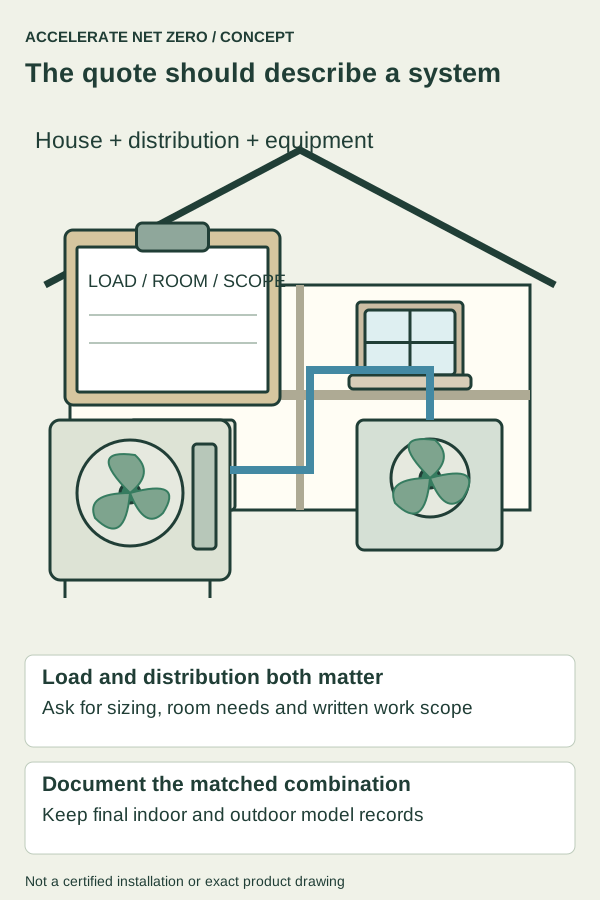
ENERGY STAR advises proper system sizing and points to a Manual J calculation for the home's heating and cooling requirement. Ask what information the contractor will collect and how the calculation informs the proposed equipment rather than accepting floor area alone as the explanation.
You do not need to perform the calculation yourself, but you should understand its assumptions. Ask how the home's construction, windows, insulation, air leakage information, design conditions, and room uses are represented where relevant.
If an enclosure upgrade is planned, tell the contractor before final equipment selection. A design based on the house before major work can answer a different question from a design for the house you intend to have after that work.
Request a clear description of capacity at the conditions that matter for your location, especially for heat-pump heating. An advertised operating limit is different from the amount of heat the system can deliver to your home at that temperature.

Compare complete equipment combinations
Ask for the indoor unit, outdoor unit, coil, controls, and relevant accessories to be identified by exact model. A split system's documented performance belongs to a specific combination, so a brochure's highest family rating is not enough to describe the quoted installation.
AHRI advises checking that indoor and outdoor equipment are a certified match and asking for the relevant certificate or reference number. Keep that record with the proposal rather than trying to reconstruct the combination after equipment arrives.
For a heat pump with backup or dual-fuel heat, ask how those parts coordinate and what is included in the price. The control arrangement, electrical requirements, and homeowner operating instructions deserve explicit treatment rather than a vague note saying “standard hookup.”
If a thermostat is proposed, confirm the functions it must support, including stages, accessories, zoning, and any proprietary communication. A smart thermostat's brand familiarity does not establish compatibility with the complete system.
Put distribution and moisture questions in the scope
Ask whether the existing ducts, returns, filter cabinet, and accessible air paths will be evaluated for the new equipment. A replacement unit connected to an unresolved distribution problem may not address the room complaint that started the project.
If duct modifications are recommended, request their locations and intended purpose in writing. You should know whether the quote includes a particular return path or sealing work, or whether those items remain an additional investigation after installation.
For humidity concerns, ask how sizing, equipment operation, ventilation, and controls will be considered together. Avoid asking for a larger unit as a presumed solution, because comfort and moisture performance involve more than nominal capacity.
Include condensate routing and any required drain protection in the proposal's description. You do not need to design those details yourself, but you should know who is responsible for providing a suitable, code-compliant arrangement and verifying it.
Identify the other trades and permissions
Ask who handles electrical work, permits, inspections, refrigerant work, plumbing connections, and any building alterations required for the proposal. Responsibility should be clear before the installation date rather than discovered when a crew cannot complete the connection.
If the project changes fuel use or removes combustion equipment, ask what happens to the remaining venting and related systems. Do not accept an assumption that removing one appliance has no effect on anything else without the appropriate qualified review.
For an apartment, condominium, or rented property, confirm ownership approvals and rules affecting outdoor placement, penetrations, noise, and common systems. A technically suitable product can still be incompatible with the property's installation restrictions.
Record protection and cleanup responsibilities as well, including access routes, disposal of old equipment, and restoration of disturbed finishes. These practical details can materially change the work you are comparing even when the quoted equipment is similar.
Ask what commissioning will show
Have the contractor explain the startup and verification work included for the exact system. Ask which results you will receive and how the installer will confirm operation, airflow, controls, drainage, and other requirements specified by the manufacturer and local rules.
Do not substitute a quick demonstration of cold air for a documented installation check. A register feeling cool does not establish that the matched system, distribution, refrigerant conditions, or controls meet the intended setup.
Connect commissioning to the rooms and concerns in your original brief. If a back bedroom drove the project, ask how its performance will be assessed rather than assuming a normal hallway reading proves the room problem is resolved.
Ask for a homeowner handover with maintenance access, filter information, normal sounds and indicators, approved settings, and service contact details. A technically complete installation should also leave you able to operate the system as intended.
Make the proposals comparable
Create one comparison sheet with the equipment combination, capacity rationale, distribution work, electrical scope, controls, permits, commissioning, warranties, exclusions, and total installed price. Mark missing items as missing rather than filling them from the contractor's general reputation.
If an operating-cost estimate is included, ask for its rates, weather assumptions, existing-equipment baseline, and treatment of backup heat. Treat it as an estimate under those assumptions rather than a guaranteed reduction in your particular bill.
Imagine one quote includes a return-path correction and another lists only a new outdoor unit and coil. The prices do not yet answer the same scope question, so ask for clarification before deciding that the lower figure represents better value.
Keep incentives separate until eligibility, timing, product requirements, and the responsible program have been verified for your location and project. You can compare the underlying work first and then evaluate any current financial assistance with accurate supporting documentation.
Leave the visit with the open questions visible
Before choosing, ask each contractor to resolve the missing details that affect compatibility, safety, comfort, or total scope. A short written clarification can be more valuable than another product brochure with performance figures for a different configuration.
Select the proposal you can understand and verify against your home's needs, with a clear responsibility for installation and follow-up. Keep the brief, final quote, certificates, and handover documents together so future service starts from the system actually installed.
Sources & further reading
- ENERGY STAR: Air-Source Heat Pumps — Heating and cooling heat-transfer direction; proper sizing and Manual J.
- AHRI: Air-Conditioning and Heat Pump Efficiency — Matched indoor/outdoor combinations and certificate/reference-number check.
Sources checked October 24, 2026. Product details can change; confirm the exact model and listing before purchase.