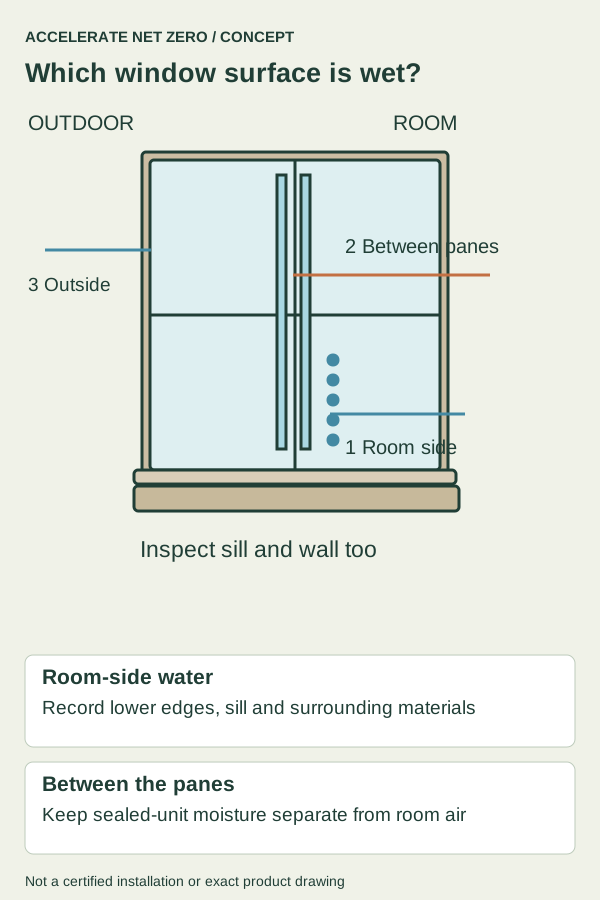
Before changing the thermostat or buying a dehumidifier, find out where the window water actually sits. Condensation on the room side, water on the outdoor surface, and moisture trapped between panes are different observations that should not be collapsed into one diagnosis.
Record the side, time, weather, room conditions, and surrounding materials, then dry accessible wet surfaces as appropriate. If water is entering around the frame or repeatedly wetting the building, arrange the relevant investigation instead of assuming the glass is simply fogging.
Locate the water without disturbing the window
Look from inside first and note which surface appears wet. If you can safely reach the room-side glass, an ordinary wipe can help establish that the visible film is on that surface; do not lean outside, remove glazing, or climb to prove where an inaccessible patch is located.
If the moisture remains between sealed panes, record that distinction and contact the window manufacturer or a qualified repair professional. Changing indoor humidity settings is a different action from evaluating a sealed glazing unit or a building-water leak.
Look at the sill, trim, lower corners, and nearby wall, not only the center of the pane. A neat band of droplets on glass, swollen trim, a wet wall after rain, and a stain below the opening provide different clues even when they happen near the same window.
Photograph the whole opening and a close view of the water while keeping a written note of the date. A tight photograph of droplets can lose the frame, room layout, and direction of the pattern that would help someone understand the situation later.
Connect the surface to the surrounding air
Condensation can form when a surface is cold enough relative to the adjacent air's dew point. This is why room temperature, moisture conditions, and the temperature of the window surface all matter, rather than just the humidity percentage on a meter across the room.
Your ordinary room sensor does not measure the temperature at every edge of the glass. A reading that looks acceptable elsewhere in the room cannot prove that the coldest part of the window is above the local condensation condition.
Pay attention to curtains, blinds, deep sills, and furniture near the opening because the local arrangement can differ from the open room. You are describing an observation, not establishing that any particular furnishing caused a defect or that moving it will cure the problem.
If you change a curtain position to observe the pattern, keep the rest of the routine reasonably steady and record the change. Changing ventilation, heating, humidification, and window coverings together may produce a difference without revealing which action mattered.

Use a short morning record
Check the affected window at a consistent time, such as before breakfast, and note whether moisture is absent, a light film, droplets, or pooling. A few clearly described mornings can be easier to interpret than a long list of percentages collected without any window observations.
Add the room's temperature and relative humidity from a stable instrument location, plus the outdoor weather and overnight activities. Mention unusual events such as indoor laundry drying, visitors, cooking late, or a humidifier running for the first time that season.
Include whether the room door was open and whether coverings were closed, especially when only one bedroom is affected. Do not treat a different room with different windows and occupancy as a perfect control, but use it to identify questions worth asking.
Avoid inventing precision in your descriptions: “a narrow wet strip at the bottom corners” is useful without estimating a water volume. The record should help you find a pattern, not turn an unmeasured observation into a laboratory result.
Look for a recent source of added moisture
Think about showers, cooking, indoor laundry, and any change in the way your home is used. Confirm whether bathroom and kitchen exhaust actually carry air outdoors, and use equipment according to its intended operation rather than assuming every fan removes water vapor.
If you use a humidifier, record its setting and operating time along with the window pattern. EPA advises reducing humidifier use when it causes condensation; the presence of a humidifier does not prove it is responsible, but it is a relevant part of the record.
Do not block required ventilation or disable a whole-house system to see whether the window gets better. Changes to ventilation can affect other parts of the home, and a local improvement is not enough evidence that a system-wide alteration is appropriate.
If the moisture appears after a leak or building work, describe that sequence clearly. A convenient explanation about cold weather should not cause you to ignore water that started after roofing, siding, window replacement, or plumbing work.
Distinguish a pattern across windows
Compare the affected opening with other accessible windows at the same time. Note orientation, room use, window coverings, and whether the water is on the same surface, while resisting the temptation to declare the wettest window defective from a single morning.
A kitchen window after cooking and a closed guest-room window overnight are not equivalent conditions. Your comparison becomes more useful when it describes those differences explicitly instead of ranking the windows only by the amount of visible fog.
Also note whether the problem changes with outdoor weather, wind-driven rain, or a particular activity. Water after rain deserves a building-water question, while morning droplets during cold weather may lead to a different investigation of surfaces and indoor moisture.
Repeated moisture between panes belongs in its own category because it is not simply room air condensing on accessible glass. Keep that observation separate in your photographs and service request so that the first conversation starts with the correct location.
Address wet materials while you investigate
Dry accessible wet surfaces promptly, and protect furnishings from ongoing drips without covering up the evidence of a recurring problem. EPA's moisture guidance emphasizes fixing water problems, so the record supports repair rather than becoming a reason to postpone it.
Check nearby materials for damage, softness, staining, or visible growth without opening concealed cavities yourself. If damage is extensive, water may be contaminated, or hidden mold is suspected, use qualified help appropriate to the condition instead of treating it as a routine glass-cleaning task.
For a rented home, report the exact opening, the location of the moisture, and any damage to the property manager. Keep dated photographs and a factual description, avoiding an unsupported diagnosis that might distract from the visible problem that needs attention.
If an active leak reaches electrical equipment or creates another immediate hazard, prioritize safety and the appropriate emergency response. You do not need to finish a week of logging before acting on an obvious unsafe condition.
Bring a focused question to the next visit
Prepare a short description such as “room-side droplets at two lower corners on cold mornings, with wet trim” rather than simply “bad windows.” Include photographs, room readings, relevant activities, and any recent changes in equipment or building work.
Ask the professional what evidence distinguishes condensation from water entry and what parts of the opening need inspection. If a repair or replacement is proposed, request a clear explanation of the problem it addresses rather than assuming new glass automatically resolves every moisture condition.
You can then judge the next step against the observed pattern and revisit it after the work. A dry window on one mild afternoon is encouraging, but repeated checks under comparable conditions provide a more meaningful view of whether the original concern has improved.
Sources & further reading
- NWS: Discussion on Humidity — Relative humidity depends on temperature; saturation and dew point relationships.
- EPA: Use and Care of Home Humidifiers — Use when needed, moisture limits, tank care, minerals and steam precautions.
- EPA: Ten Things You Should Know about Mold — Repair water sources and address moisture; wet materials and condensation.
Sources checked October 24, 2026. Product details can change; confirm the exact model and listing before purchase.