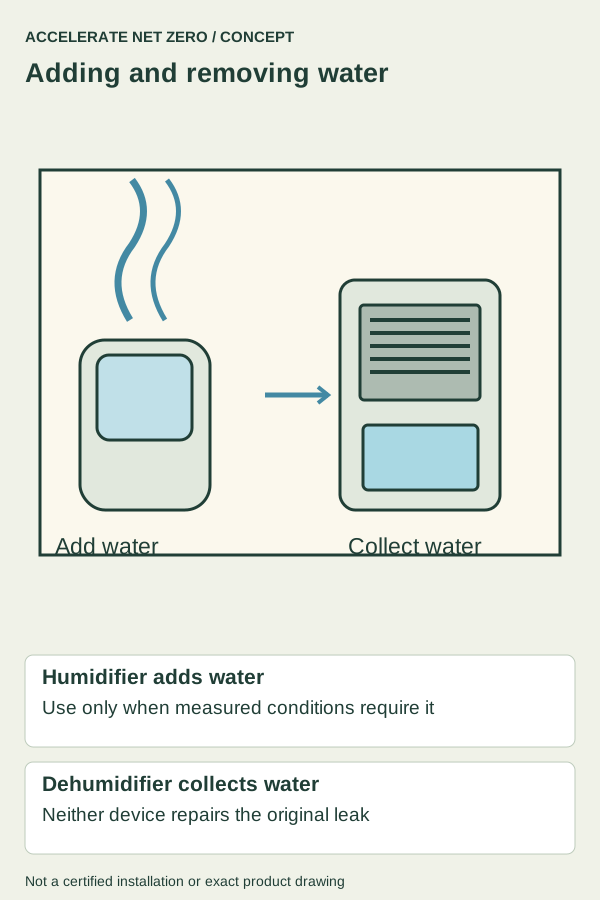
A humidifier adds moisture, while a dehumidifier removes it, so choosing between them starts with identifying the condition you actually have. Measure room temperature and relative humidity over several ordinary periods, then connect those readings to the room, season, and visible clues.
A dry throat, a sticky feeling, or a damp window can each prompt an investigation, but none automatically identifies the right appliance. Your goal is to avoid adding water to a moisture problem or buying a dehumidifier to address a concern that has another cause.
Start with the room and the season
Choose the room where you notice the problem rather than measuring only beside the main thermostat. A basement laundry area and an upstairs bedroom can differ, especially when doors stay closed or household activities add moisture in one location.
Put the instrument somewhere repeatable away from direct supply air, sunlight, and water outlets. Read the instructions for settling time, and record temperature alongside the humidity percentage so that warming or cooling does not disappear from the explanation.
Use an ordinary routine for the first observations instead of changing settings every hour. You want to know what happens during showers, cooking, sleeping, and normal heating or cooling before you add a new appliance to the pattern.
Season is context rather than a verdict. You might expect a heating-season dryness concern, but a hidden leak, a cold surface, or a poorly exhausted activity still deserves attention if the actual evidence points that way.
Ask whether the problem is water entering the building
Look at accessible areas for active leaks, staining, damp furnishings, and recurring wet patches. A dehumidifier can collect water from room air while the original leak keeps wetting the building, which is why a filling tank is not proof that the underlying problem is fixed.
If you find water after a plumbing event or rain, record its location and timing and arrange the appropriate repair. Do not wait for a humidity display to confirm something you can already see on the floor, ceiling, or window surround.
Consider daily moisture sources as well: showers, cooking, indoor laundry drying, and appliances with intended outdoor venting. Check that you understand the actual ventilation arrangement before assuming an operating fan is carrying moisture outside.
Your accessible observations can guide the next call without requiring you to open walls or dismantle HVAC equipment. Describe “damp baseboard after rain” or “bedroom readings rise after evening showers” rather than labeling either pattern a confirmed equipment fault.

When a humidifier is worth considering
If repeated measurements and the room's conditions support adding moisture, consider a humidifier you can maintain reliably. EPA advises using one only when conditions require it and avoiding indoor relative humidity above 50 percent during humidification.
That guidance is a ceiling for this use, not a promise that every window or wall will remain dry below it. If condensation appears, reduce or stop humidification and investigate the surface conditions rather than insisting that a number on the display makes the setup acceptable.
Think about where the water will go before you choose a convenient table. The mist or discharge must not wet curtains, carpet, furniture, or the wall, and the appliance needs a stable location with the clearances specified in its instructions.
A bigger tank may reduce refill frequency, but it does not remove the need for water changes and cleaning. If you are unlikely to carry, empty, dry, and maintain the device, that practical limitation belongs in the buying decision before optional lighting or app features.
Match the humidifier type to the care you can provide
EPA notes that ultrasonic and impeller humidifiers can disperse minerals and microorganisms from their tanks. Lower-mineral water and proper care matter, so check the manufacturer's water and cleaning instructions instead of treating all bottled water as equivalent to distilled water.
Steam devices involve hot water or steam, which adds a burn consideration around children and vulnerable household members. An evaporative design has its own consumables and maintenance requirements, so the absence of visible mist does not mean it needs no care.
Before purchase, look at the fill opening, tank shape, replacement components, and the steps for drying everything. A device that is awkward to empty in your actual sink may be inconvenient every day even if its headline capacity looks attractive.
Do not add fragrances, disinfectants, or cleaning chemicals to the operating water unless the exact instructions permit them. Cleaning a tank and breathing whatever the unit emits are different situations, and a homemade mixture can introduce a new problem.
When a dehumidifier deserves attention
Repeated elevated moisture readings or damp conditions may justify investigating dehumidification alongside the water source and ventilation. Choose a unit for the intended room conditions, drainage arrangement, and manufacturer's operating limits rather than selecting only by the largest number on a box.
Decide whether you will empty a tank or use an approved continuous drain before bringing the appliance home. A drain route that looks convenient in a sketch may be obstructed by a door, create a trip hazard, or require a pump or connection the selected model does not provide.
Place the unit where its air inlet and discharge have the specified clearances. Squeezing it behind stored boxes can make maintenance and tank removal difficult, and a locked utility closet may be a poor match for the room you actually need to manage.
Look at the room temperature range in the instructions, particularly for a cool basement or seasonal space. A collection-capacity claim is tied to specified test conditions, so do not assume the same daily tank volume in every room or use it as a direct measure of the leak rate.
Read the controls as part of the system
The humidity number on an appliance's control panel comes from its own sensing location. Compare it cautiously with a separate room meter, because the two instruments may sit in different airflow and have different response times or tolerances.
Set the equipment as the manufacturer directs, then judge the room with repeatable observations rather than constantly nudging the setpoint. If the equipment behaves unexpectedly, note whether it is collecting water, cycling, showing an error, or reaching a full-tank condition.
You can make a useful record without opening the unit or overriding a protection device. If it trips a circuit, leaks, smells abnormal, or has a damaged cord, stop using it and follow the instructions for qualified service rather than improvising a workaround.
Never make the humidifier and dehumidifier compete simply because two displays disagree. Establish the room's conditions and the reason for each device first, otherwise you can spend energy adding and removing water without resolving the original concern.
Build a decision you can revisit
Imagine a bedroom feels dry during heating weather, while the adjoining bathroom window is wet after showers. You might need to examine local exhaust and moisture movement before deciding that the whole floor needs more humidity.
In a different home, a cool basement might remain damp despite a comfortable upstairs reading. That calls for basement-specific observations, attention to water entry, and equipment that suits that space rather than moving the upstairs humidifier downstairs by habit.
Write down the condition you want to change, the evidence supporting it, and what would make you stop or reassess. That creates a more useful plan than buying two opposite appliances and hoping their automatic settings will decide what your home needs.
If the measurements remain confusing, or dampness and comfort problems persist, take the record to an appropriately qualified building or HVAC professional. A room appliance can be a helpful tool, but it cannot replace identifying a leak, evaluating ventilation, or addressing a building defect.
Sources & further reading
- EPA: Use and Care of Home Humidifiers — Use when needed, moisture limits, tank care, minerals and steam precautions.
- EPA: Ten Things You Should Know about Mold — Repair water sources and address moisture; wet materials and condensation.
Sources checked October 24, 2026. Product details can change; confirm the exact model and listing before purchase.