Relative humidity tells you how close the air is to saturation at its current temperature, while dew point gives you a temperature associated with its moisture content. Keep both ideas in view when you compare a cool basement, a warm bedroom, and the weather outside.
You do not need to become a weather forecaster to use the distinction. You mainly need to stop assuming that the smaller percentage always identifies the air that would bring less moisture into your home.
Why the percentage needs a temperature
The National Weather Service explains that dew point is the temperature to which air must cool, at constant pressure, to reach saturation. Relative humidity changes with temperature, so a percentage viewed by itself leaves out an essential part of the comparison.
Think about a report that simply says a room is at 50 percent relative humidity. Until you know whether the room is warm or cool, you cannot use that number to make a fair comparison with another place at a different temperature.
You can see the practical consequence when a bedroom warms in afternoon sunshine. Its relative humidity may fall during that period even though nobody ran a dehumidifier, removed a wet towel, or deliberately changed ventilation.
That falling percentage should prompt a look at the accompanying temperature, not an immediate conclusion that the home has dried. Your log becomes much more informative when each humidity reading sits beside a temperature from the same instrument and time.
What dew point adds
A higher dew point indicates more moisture in the air under ordinary weather comparisons. This makes it a useful companion to relative humidity when you are looking at outdoor air on two days with quite different temperatures.
Suppose one evening feels pleasantly cool after a hot day, and you are tempted to open every window to dry the house. The cooler temperature alone cannot answer whether the incoming air will help with your indoor moisture concern.
Check the weather's dew point as part of that decision, while remembering that a distant weather station does not measure the exact air at your open window. Treat the report as context rather than pretending it is a precision reading from your particular doorway.
The same caution applies to a weather app that lists a large humidity percentage overnight. The percentage may rise as the air cools, so reading it as a direct statement that the night suddenly contains dramatically more water would oversimplify what is happening.
Read a changing room without chasing the display
Choose one repeatable room location away from a supply jet, direct sunlight, and a humidifier outlet. Record the displayed temperature and relative humidity before trying to explain a change, and include the time and the event you think might be connected.
For example, “the room warmed while afternoon sun reached the windows” is a useful observation. If the percentage falls at the same time, you can investigate temperature as part of the explanation before crediting a fan with removing moisture.
A circulating fan and a device that removes water from the air perform different jobs. Feeling a breeze on your skin does not establish that water has left the building, just as a changing percentage does not reveal which physical process caused the change.
If your instrument calculates dew point, check that this is a derived display based on its temperature and humidity sensors. A calculated value inherits their uncertainty, so extra decimal places on a screen do not give you a more accurate household measurement.
Separate air moisture from a wet surface
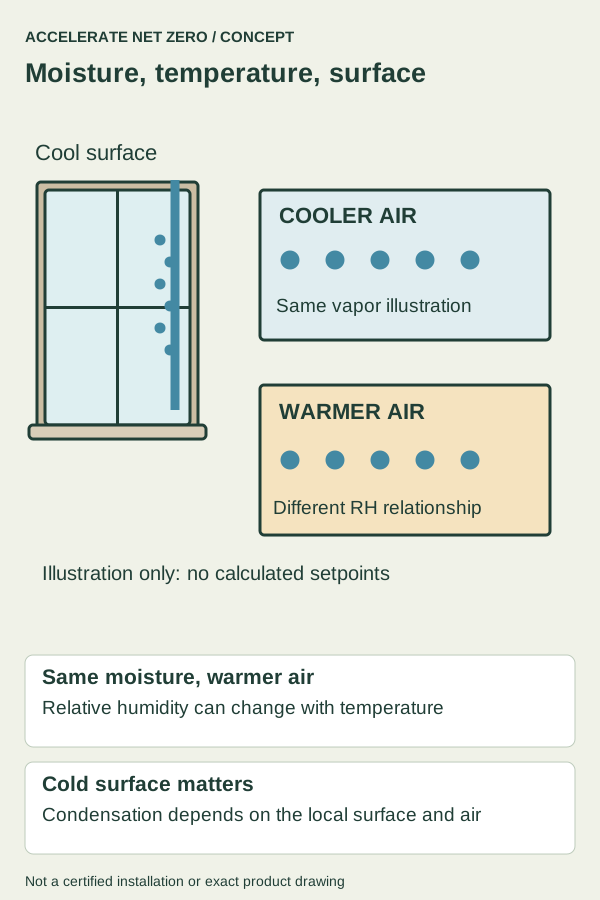
Condensation involves the condition of a surface as well as the surrounding air. A cold window, pipe, or metal frame can develop moisture even though a sensor across the room reports something that looks ordinary for the room as a whole.
Use the condensation as a reason to examine the local situation rather than as an automatic verdict on your heating system. Note which surface is wet, which side of a window carries the water, when it appears, and whether nearby materials are becoming damp.
The dew point concept helps explain why the temperature of that surface matters. It does not let you calculate an accurate window-surface temperature from a single handheld humidity reading or prove that a particular wall assembly is safe from moisture.
If you have a recurring problem, give a qualified professional the room readings and photographs of the surface pattern. Those two kinds of evidence complement each other, whereas repeatedly photographing the same display can miss what the building is showing you.
Avoid an unfair indoor-outdoor comparison
A common mistake is comparing an indoor percentage with an outdoor percentage when the temperatures differ substantially. The numbers look as though they share a simple scale, but they describe how close each air sample is to saturation at its own temperature.
Instead, put the temperature, relative humidity, source, and time for both locations in your notes. If dew point is available, keep it in the same units for both locations and state whether one value came from a local instrument and the other from a weather station.
Do not mix Fahrenheit and Celsius without noticing the units, especially when an app and a room meter use different defaults. An apparently dramatic change can turn out to be a units problem or a different reporting time rather than a meaningful change in conditions.
You can also make an unfair comparison by checking outside at dawn and inside after a sunny afternoon. Pair observations as closely as practical, and describe the remaining limitation instead of presenting the comparison as a controlled experiment.
Choose a useful response to each pattern
If the temperature changes while the percentage moves in the opposite direction, first review heating, cooling, sunlight, and sensor placement. That pattern alone does not tell you that a water source has appeared or disappeared.
If a repeatable moisture concern follows showers or cooking, investigate the activity and the intended exhaust arrangement. You still need to confirm whether the fan actually vents outdoors rather than merely assuming that every fan removes indoor moisture.
If a wet patch follows rain, focus on the building-water observation instead of trying to explain it entirely through the room's relative humidity. A weather-related leak and condensation can look similar in a quick photograph while needing very different investigations.
If the only concern is that an app labels the evening “humid,” connect that label to your actual question. Outdoor comfort language is not a prescription for your indoor settings, and your household may experience the same room differently because of activity, clothing, and airflow.
Work through one ordinary evening
Imagine you return to a warm house and switch on cooling while preparing dinner. You record the living room temperature and humidity, note the cooking period, and take another reading later from the same shelf rather than carrying the meter into the kitchen steam.
The temperature and percentage change together, but the two readings cannot divide the result into cooling, moisture removal, cooking, and incoming outdoor air. Your best conclusion is the observed pattern, with a note about the activities that make a simple cause-and-effect claim uncertain.
On another evening, you keep the same observation location and record the different weather and cooking pattern. Over time, this comparison can help you ask a more focused question about comfort without turning the log into an invented performance test.
Use the numbers to improve the next decision, not to seek a single perfect percentage for every season and surface. Relative humidity, dew point, visible moisture, and the way you use the room each contribute information that the others cannot supply alone.
Sources & further reading
- NWS: Dew Point vs. Humidity — Dew point definition and comparison of moisture across different temperatures.
- NWS: Discussion on Humidity — Relative humidity depends on temperature; saturation and dew point relationships.
- EPA: Guide to Air Cleaners in the Home — Filtration complements source control; fan runtime involves electricity and cooling-season humidity tradeoffs.
Sources checked October 24, 2026. Product details can change; confirm the exact model and listing before purchase.