Use an EnergyGuide label to compare the stated energy use of suitable appliances, then check the capacity, features, test assumptions, and your local energy price. The yellow label is a comparison tool, while the estimated operating cost is not a promise about your own bill.
Start by identifying products that actually meet your household's needs and installation requirements. A low energy figure on an appliance that is too small, cannot open fully, or lacks the function you need is not a useful purchase comparison.
Confirm the exact model on the label
Read the model information rather than assuming every appliance in a product family shares the same label. A different size, configuration, or variant can have a different energy-use figure, so keep the label attached to the exact item on your shortlist.
If a retailer shows a generic image, look for the manufacturer's label for that model and ask for clarification when it is missing. Do not borrow a nearby model's figure simply because the cabinets look alike in a product photograph.
Save the label with the date and source while comparing, because online listings can change. The purpose is to keep your own decision traceable, not to claim that every current seller provides an identical package or configuration.
Read units carefully and copy them exactly into the comparison. Annual kilowatt-hours, an efficiency ratio, and estimated yearly operating dollars are related but different fields, and their numbers should not share an unlabeled column.
Match the size and job before ranking efficiency
For a refrigerator, compare the usable capacity and configuration you actually need, along with the intended installation space. For a dishwasher or clothes washer, consider capacity and the cycles or functions relevant to your household rather than comparing unrelated categories solely by a low annual number.
The label's comparison range refers to a defined set of similar products, so read the description of that set. A marker near the low end is meaningful within that comparison, but it does not establish a universal ranking across all appliance sizes and types.
Imagine one smaller refrigerator has a lower annual kWh figure than a larger model that meets your storage needs. That is useful information about total stated energy use, while the capacity mismatch still needs to remain visible in the buying decision.
Do not invent a per-volume efficiency ranking unless you have a clear reason and understand its limits. Your household buys an appliance to perform a job, and a homemade ratio can hide the practical difference between an appropriate product and one that is simply smaller.

Read annual use as a standardized estimate
FTC explains that EnergyGuide provides information about energy use and comparison with similar appliances. The estimate uses specified assumptions, so actual operation can differ with how the household uses and installs the product.
Look for the label's stated basis, including usage assumptions and the energy price used for the dollar estimate. Keep those details with your notes instead of presenting the annual figure as a meter reading from a particular home.
A family's door-opening habits, selected cycles, loads, location, and other conditions can differ from the standardized comparison. That does not make the label useless; it means you should use it for a fair comparison rather than a precise household forecast.
If an appliance has optional connected or automatic modes, check which features are included in the documented model and what the instructions say. Do not assume a marketing feature guarantees lower annual energy use or that every available mode is represented by one simple number.
Separate the energy number from the price assumption
The estimated yearly dollar cost depends on the label's energy-price assumption. FTC explicitly cautions that your cost depends on local prices and use, so the printed dollars should not be treated as the exact amount the appliance adds to your bill.
For a simple electricity-only illustration, an annual estimate of 400 kWh multiplied by an assumed $0.20 per kWh gives $80. This is arithmetic under stated assumptions, not a verified operating cost for a named refrigerator or a recommendation about your utility plan.
Use an appropriate rate from your actual plan if you want a rough local calculation, with fixed charges and time-of-use complications understood. A total bill divided by total kWh may not equal the marginal price relevant to an appliance's additional use.
Keep any gas, hot-water, or other energy assumptions visible when relevant to the appliance category. A calculation that includes only one energy input can look precise while omitting part of the operating cost you intended to compare.
Compare purchase price without promising payback
List the installed purchase price, documented annual energy estimate, relevant features, and practical fit in separate fields. Delivery, required accessories, connection work, and removal of the old unit can change the complete purchase cost.
If one model costs more and has lower stated energy use, you can examine the difference using transparent assumptions. Do not call the resulting number a guaranteed payback period, because actual use, rates, service needs, and product life remain uncertain.
Keep financial incentives separate until their current eligibility and timing are verified for the exact product and location. A salesperson's general statement about efficient appliances is not the same as an approved rebate for your purchase.
Also consider whether replacing a working appliance now is the decision you are actually evaluating. A comparison between two new models does not by itself establish that either replacement is the best immediate use of your home-improvement budget.
Check physical installation and everyday use
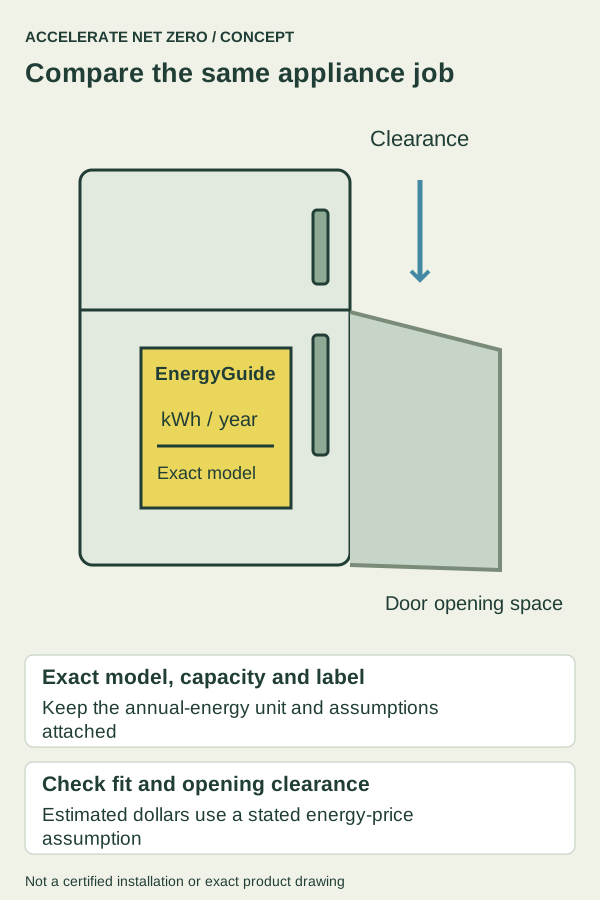
Measure the opening, ventilation clearances, connection locations, delivery route, and the space needed to open doors or lids. FTC's shopping guidance emphasizes physical fit, and a low energy figure cannot compensate for an unsuitable installation.
Read manufacturer requirements for the intended location, including any ambient-temperature limits for a garage or other seasonal space. A product suitable for an ordinary kitchen may not be intended for every unconditioned room.
Think about cleaning access, controls, shelving, and the routines the household will actually follow. An energy comparison remains part of a broader product decision rather than a reason to overlook a design that makes ordinary use difficult.
Ask about service support and read the warranty terms for the exact model. The label describes energy information, while repair arrangements, reliability evidence, and labor coverage require their own sources.
Distinguish EnergyGuide from ENERGY STAR
EnergyGuide is the yellow comparison label, while the ENERGY STAR mark identifies products meeting the program's efficiency requirements. FTC explains the difference, so do not treat the two marks as interchangeable names or assume one replaces the need to read the other.
Check the exact model's current qualification if that status matters for a program or purchase. A brand selling some qualified products does not establish that every model in its range has the same qualification.
Likewise, do not infer independent hands-on testing by this site from a label or certification. The information here helps you interpret documented product data; it does not represent a household trial or a measurement of the specific unit delivered to you.
Finish with a shortlist that serves the same job, fits the space, uses consistent units, and keeps cost assumptions visible. You can then choose with a clearer understanding of energy use without asking the label to predict every aspect of ownership.
Before accepting delivery, compare the model identifier on the invoice and appliance with the label you saved. A substitute that looks nearly identical may belong to a different configuration, so resolve that difference while the seller can still explain exactly what was supplied to your home.
Sources & further reading
- FTC: EnergyGuide Labeling FAQs — Model-specific label data based on DOE test procedures; comparable product range and public label information.
- FTC: How to Use the EnergyGuide Label — Current indexed article read; direct opens time out. Local price/use differ from label estimates; physical fit and ENERGY STAR distinction.
Sources checked October 24, 2026. Product details can change; confirm the exact model and listing before purchase.