Begin a water-heater comparison with the space, hot-water demand, utilities, and installation work your home requires. A heat-pump water heater commonly includes a storage tank, so “tank versus heat pump” is usually a comparison between heating methods and complete installations rather than between storage and no storage.
Measure accessible space and gather the existing equipment information, then have qualified installers evaluate the actual options. Do not assume a new unit can use every old connection simply because the tank looks similar.
Identify the existing arrangement
Record whether the current heater uses electricity, gas, another fuel, or a particular heat-pump arrangement. Use accessible labels or paperwork and leave unfamiliar panels, wiring, gas connections, and vent components to the appropriate professionals.
Write down the current tank size, model, location, and any hot-water complaint. Running short during consecutive showers is a different question from replacing a leaking unit that otherwise met the household's needs.
Note planned changes in demand, such as more occupants, a new bath, or a different laundry routine. The replacement should suit the intended household rather than merely repeat a capacity chosen for a previous owner.
If the existing heater is leaking or unsafe, prioritize the appropriate response and professional help. Planning ahead gives you more comparison time, but an active problem should not remain unaddressed while you research product features.
Measure the route as well as the final space
Check accessible width, depth, overhead space, doorway clearance, and the route to the equipment location. A replacement can fit the room on paper while still being difficult to bring through stairs or a narrow utility doorway.
Keep service access in the measurement, including the space needed to reach controls and maintain the unit. A tank squeezed behind shelves may leave no practical way to inspect connections or perform the manufacturer's maintenance tasks.
For an integrated heat-pump design, look beyond the cylinder because the heat-pump section and air paths add requirements. Ask the installer to show which dimensions are equipment dimensions and which are required installation and service clearances.
Avoid using a generic room-volume number as the final suitability test. ENERGY STAR's design guidance emphasizes the manufacturer's requirements for air access, ventilation, and installation, which can differ by model and configuration.

Consider the air that an integrated heat pump uses
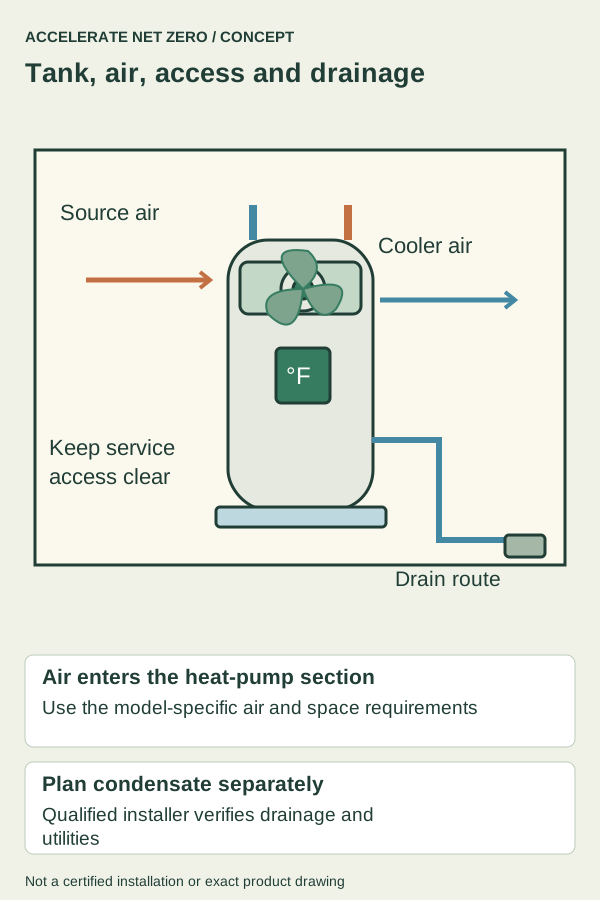
A heat-pump water heater transfers heat from its source environment into the water. For an integrated indoor model, the surrounding air and the way that air enters and leaves the unit therefore belong in the installation design.
Ask whether the proposed room provides the required air volume and operating temperature conditions or whether an approved ducting or transfer-air arrangement is needed. Do not improvise a louvered door or duct route from a general illustration without checking the exact model and local requirements.
Think about the neighboring spaces as well as the equipment room. Cooler discharge air and operating sound may matter more beside a bedroom or frequently used workspace than in a suitable utility area.
Do not count the localized cooling effect as a replacement for designed room air conditioning or assume it will solve a damp basement. The building still needs an appropriate response to leaks, ventilation, and any moisture problem.
Plan condensate and water management
Heat-pump operation can produce condensate that needs an appropriate drain arrangement. Ask the installer where that water will go, whether gravity drainage is suitable, and whether an approved pump or additional work is included in the quote.
Keep condensate drainage separate from the water-heater safety pan and pressure-relief discharge in your questions. Those parts serve different purposes, and a single line drawn toward the floor does not establish a complete compliant installation.
Look at the consequences of water reaching the surrounding floor and finishes. A laundry room with a visible drain, an upper-floor closet, and a finished basement create different practical questions about detection, containment, and service access.
A leak alarm can provide a warning if water reaches its sensing points, but it does not replace required drainage or shut off every water source. Plan the installation correctly first, then consider detection as an additional layer with clear limits.
Verify electrical and fuel work for the exact model
Have the electrical requirements checked for the proposed equipment instead of assuming every heat-pump water heater uses the same circuit. Available designs differ, and an existing receptacle or breaker label does not establish that a new installation is suitable.
If you change from a fuel-fired heater, ask who handles the fuel connection, venting changes, electrical work, permits, and inspections. Other appliances may share parts of a venting arrangement, so changes need qualified review rather than simply capping whatever appears unused.
Do not make new wiring, fuel, relief-valve, or plumbing connections as part of your shopping investigation. Your role is to collect the accessible information and ensure the proposal clearly assigns the technical work to appropriately qualified people.
Ask for those responsibilities and exclusions in writing before comparing prices. A quote that includes a tank but leaves electrical work and drainage unresolved is not equivalent to a complete installed-system proposal.
Match hot-water delivery to the household
Discuss the daily pattern, not just the number of people in the home. Consecutive showers, a large bath, laundry timing, and simultaneous uses can create a peak period that a simple head count misses.
Ask the installer to explain the proposed model's first-hour rating, recovery behavior, and operating modes in relation to that pattern. Tank volume is useful information, but it is not the only measure of how the complete heater will serve the household.
For hybrid designs, ask when resistance elements operate and how the selected mode changes delivery and energy use. A comparison that assumes one mode while the household needs another can create an unrealistic expectation.
Do not increase stored-water temperature or modify mixing controls on your own to compensate for a poor size choice. Scald prevention, temperature settings, and any mixing-valve arrangement need the manufacturer's instructions and qualified installation guidance.
Compare the maintenance routine you can sustain
Read the owner tasks for the exact heater, including any air filter and condensate maintenance on a heat-pump model. Check whether those parts remain accessible once the laundry baskets, shelves, and normal stored items are back in the room.
Ask which tasks belong to the homeowner and which require service, and keep the maintenance instructions with the installation record. A general promise of “low maintenance” does not tell you how to keep a particular air path, drain, or safety component in the intended condition.
Consider the practical service support available in your area, including who handles a fault in the heat-pump section. Warranty length and local service availability are separate questions, so read what the warranty actually covers and who supplies labor.
Keep operating-cost estimates tied to stated electricity or fuel rates, demand assumptions, modes, and location conditions. Do not turn a broad efficiency claim into a guaranteed household saving or assume an incentive will apply without current eligibility verification.
Work through a utility-closet decision
Imagine the existing electric tank sits in a narrow closet beside a bedroom, with no obvious nearby condensate route. A heat-pump replacement may still be possible, but the air arrangement, sound, service access, and drainage need specific design rather than a simple product substitution.
Compare a complete compliant proposal with the conventional replacement option and any other appropriate configurations the installer supports. If essential space or connection requirements cannot be met, leave that model out instead of trying to make the room fit through unsupported modifications.
The right choice is the installation that supplies the household's hot-water needs safely and predictably in the space you actually have. A clear scope, exact model instructions, and an understandable owner routine make that choice reviewable before the old heater fails.
Sources & further reading
- ENERGY STAR: Heat Pump Water Heater Design Considerations — Model-specific air access, cooler discharge, noise, space and condensate design.
- ENERGY STAR: Heat Pump Water Heater Installation Best Practices — Control and service access; installation and owner-maintenance instructions.
Sources checked October 24, 2026. Product details can change; confirm the exact model and listing before purchase.